Superbolts! How New Data Could Improve Storm and Safety Forecasts
Every second, the Earth is struck by about 100 lightning bolts. But only a tiny fraction, so rare they barely register in global datasets, carry currents powerful enough to rewrite what we thought we knew about extreme storms. And a new analysis suggests that these “superbolts” don’t behave the way scientists expected.
For years, textbooks and headlines repeated the same idea: the most intense lightning on the planet comes from storms far out at sea. But what happens when new technology lets researchers look again—this time with billions of data points instead of thousands?
That’s where the story takes a surprising turn.
Storms We Thought We Understood
If you’ve ever watched a storm roll over a field in Nigeria, waited out monsoon rain in India, or seen the sky flash above a fishing harbor in Brazil, you’re already part of this story. Most lightning is familiar: bright, loud, and gone in seconds. But superbolts are in another category—more than 10 to 100 times stronger than typical strikes.
Earlier research from 2019 suggested that over 90% of these extreme events happened over the oceans, especially near the Mediterranean, North Sea, and the Pacific. It made intuitive sense: seawater conducts electricity well, so maybe the sea helps fuel stronger discharges.
But intuition is not evidence. And the technology behind lightning detection has changed fast.
So what happens when scientists trade small antenna networks for a global system of more than 1,800 sensors that can detect lightning down to the millisecond?
A Global Rethink, Powered by Billions of Lightning Events
Researchers analyzed 1.72 billion cloud-to-ground lightning strikes recorded between 2018 and 2021 using the Earth Networks Total Lightning Network (ENTLN). Instead of focusing only on the rarest events, they examined all strikes above 30 kiloamps (kA)—the threshold where lightning becomes unusually energetic.
Only about 3.25% of global lightning crossed that line. But within that small slice, a new pattern emerged:
- Lightning above 50 kA becomes more common over the ocean than land
- At around 120 kA, ocean strikes occur 15 times more often than land strikes
- Above 200 kA, the ratio drops again—suggesting super-extreme bolts are rarer than we thought
That matters because earlier estimates defined superbolts using energy thresholds that may have misclassified what counts as “extreme.” The new data challenges not just the numbers—but the story behind them.
Land Strikes Aren’t Weak—They’re Just Different
The study found dense hotspots over South America’s Andes, Lake Maracaibo in Venezuela, South Africa, Southeast Asia, and Northern Australia. These regions don’t just lead in total lightning—they generate high-current strikes that rival anything offshore.
Meanwhile, some regions previously thought to be superbolt centers—like the North Sea—show almost no high-current strikes in the new dataset. It’s a scientific plot twist. And it raises a simple but powerful question:
Were we looking at the wrong signals all along?
Why the Ocean Still Plays a Powerful Role
Even with the revised results, the ocean remains a major player in extreme lightning—just not in the way earlier research implied. The strongest takeaway is not geography, but consistency:
- Strikes over the sea peak at the same time each day
- Their rhythm matches the Carnegie Curve, a 100-year-old global pattern of atmospheric electricity
- Land strikes are out of sync, rising during hot afternoons and falling overnight
In practical terms: A fishing crew off the coast of Indonesia might experience the most intense lightning after sunset, while a farm in Brazil faces its peak risk late in the day. For storm safety, timing can matter as much as location.
What This Means for the Real World
Extreme lightning is not just a scientific curiosity. It affects:
1. Offshore infrastructure
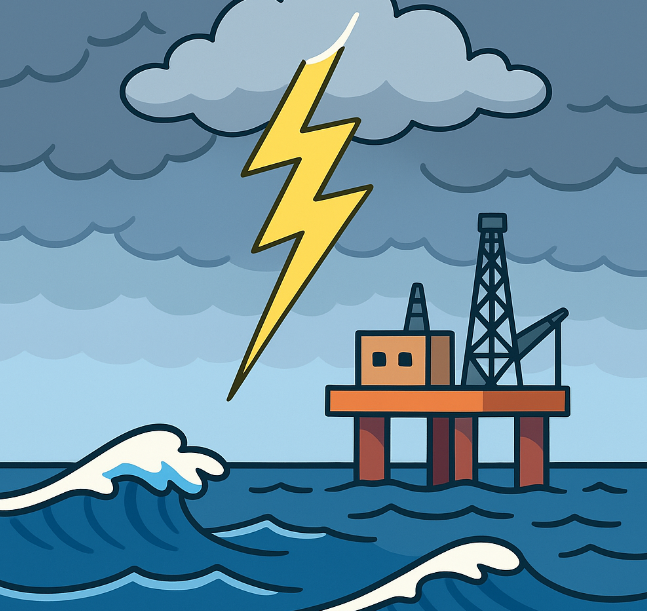
Oil platforms, shipping routes, and undersea cables face higher exposure than previously understood.
2. Renewable energy
Wind turbines—especially coastal and floating systems—may need different grounding standards as currents rise above 100 kA.
3. Aviation and flight paths
Aircraft crossing high-risk ocean regions could benefit from updated lightning forecasting models.
4. Climate and atmospheric science
Because lightning influences ozone chemistry and cloud electrification, changes in intensity can reshape global models. For countries with fast-growing coastal development—from Lagos to Mumbai to Recife—this isn’t abstract. It’s planning.
A Reminder That Even Familiar Things Can Surprise Us
The biggest lesson is not just that superbolts behave differently—it’s that science changes when our tools improve.
Forty years ago, researchers relied on satellites that captured only the brightest flashes. Ten years ago, they depended on a sparse network of radio sensors. Today, billions of measurements reveal a more complex world:
- Extreme lightning isn’t as ocean-dominated as once claimed
- Its global hotspots are shifting
- Its timing follows patterns we still don’t fully understand
And the rarest strikes—those above 500 kA, representing only 0.0003% of events—sit at the edge of what is even physically possible. The more we learn, the more mysterious lightning becomes.
Let’s Explore Together
If you were on this research team, what would you study next?
- Could coastal warming change where extreme lightning occurs?
- Should we redefine what counts as a “superbolt”?
- How could local communities use this information for safety planning?
Share your thoughts, your questions, or your storm stories. Science isn’t just about answers—it’s about staying curious long after the sky goes quiet.