

Did the Internet Make People Report UFO Sightings Faster?
What Can UFO Data Tell Us?
UFOs have fascinated people for generations. Whether they represent extraterrestrial visitors, misunderstood natural phenomena, or simply the quirks of human perception, millions of people have looked to the skies and wondered.
In this series, we’re taking a different approach. Using more than 80,000 documented UFO sightings, we’ll investigate one question at a time through the lens of data science. Rather than asking whether UFOs are real, we’re exploring what these reports reveal about human behavior, culture, and the ways we document the unexplained.
After all, even if the mystery remains unsolved, the data have a story to tell.
Previous Entries
- Did Hollywood Make People See More UFOs? A Data Analysis
- Did the Internet Cause the UFO Reporting Boom?
- Did Smartphones Change UFO Sightings?
The Reporting Hypothesis
One of the most overlooked aspects of any scientific dataset is how quickly observations are recorded.
Imagine someone witnessing an unusual object in the sky in 1955. Reporting that event meant finding an appropriate organization, writing a letter, and waiting for it to be processed. Today, the same observation can be submitted online in minutes.
That raises an intriguing question:
Did the internet fundamentally change how quickly people reported UFO sightings?
Unlike many questions surrounding UFOs, this one is directly testable.
Because this dataset includes both the date of the sighting and the date it was documented, we can calculate the delay between the event and its entry into the historical record.
Rather than asking whether more UFOs appeared, we’re asking whether technology changed how quickly people shared their experiences.
Before the Internet, Reports Often Took Years
The earliest years of the dataset reveal an astonishing pattern.
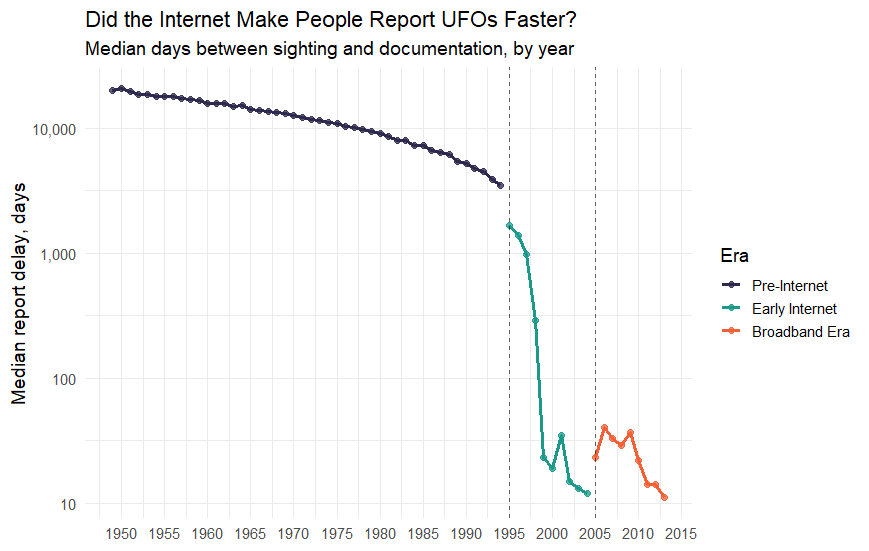
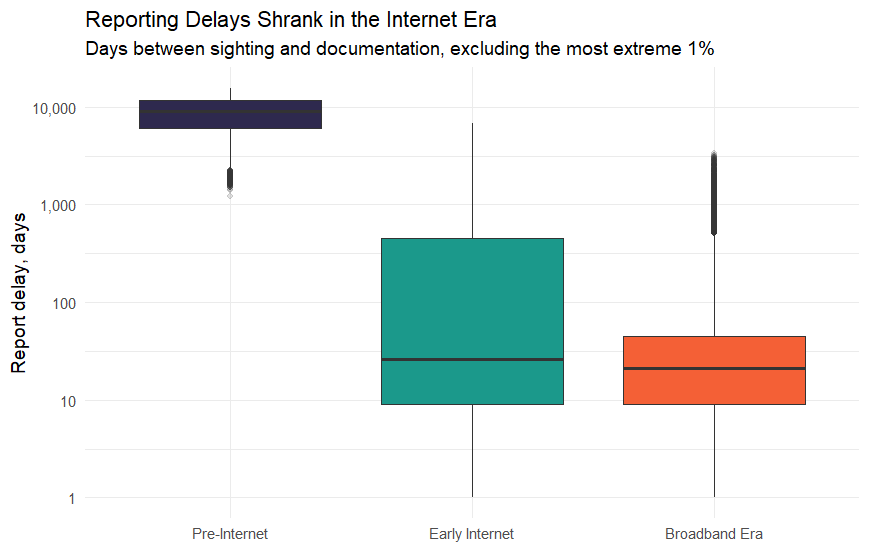
Across the pre-internet era (1949–1994), the median reporting delay was 9,626 days—more than 26 years. Even the middle 50% of reports typically took between 6,438 and 12,778 days to be documented.
This doesn’t necessarily mean witnesses waited decades before telling anyone. More likely, many historical reports were collected years later and entered into centralized databases long after the original event occurred.
The result is a reminder that historical datasets often reflect both the phenomenon itself and the evolution of record-keeping.
Then the Internet Changed Everything
The transition during the mid-1990s is remarkable.
In the early internet era (1995–2004), the median reporting delay collapsed from more than 26 years to just 26 days.
By the broadband era (2005–2013), the median delay fell even further—to only 21 days.
That represents one of the largest changes we’ve seen in any analysis of this dataset.
The difference isn’t subtle.
It is transformational.
A Quarter Century of Progress—in Reverse
Looking at individual years makes the trend even more dramatic.
In 1955, the median UFO report entered the database roughly 18,188 days after the sighting—almost 50 years later.
By 1970, that delay had fallen to about 12,704 days.
By 1990, it was approximately 5,261 days.
Then, after widespread internet adoption, the decline accelerated dramatically:
| Year | Median Reporting Delay |
|---|---|
| 1995 | 1,677 days |
| 2000 | 19 days |
| 2005 | 23 days |
| 2010 | 22 days |
| 2013 | 11 days |
Within less than two decades, the typical reporting delay shrank from years to weeks.
This is exactly the kind of discontinuity we’d expect if online reporting fundamentally changed how people documented unusual experiences.
Reporting Became Almost Immediate
The internet didn’t just reduce average delays.
It also changed how quickly people submitted reports.
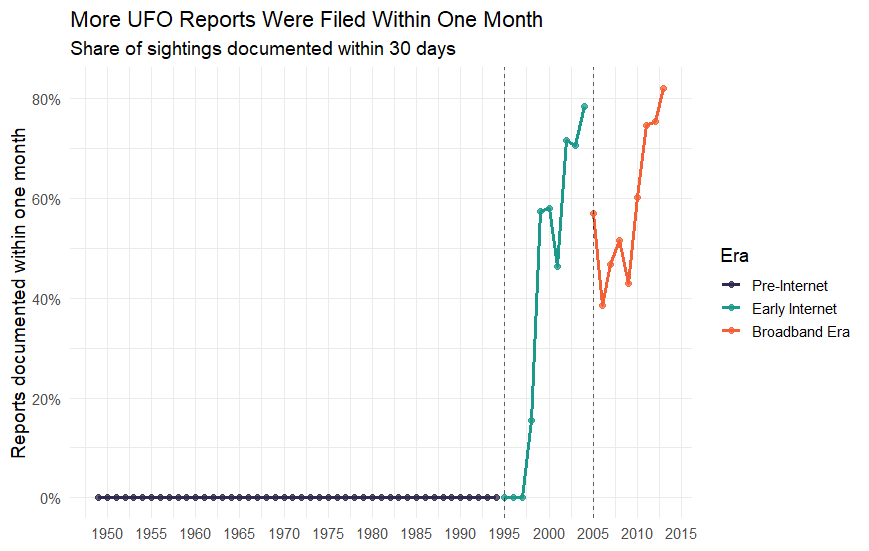
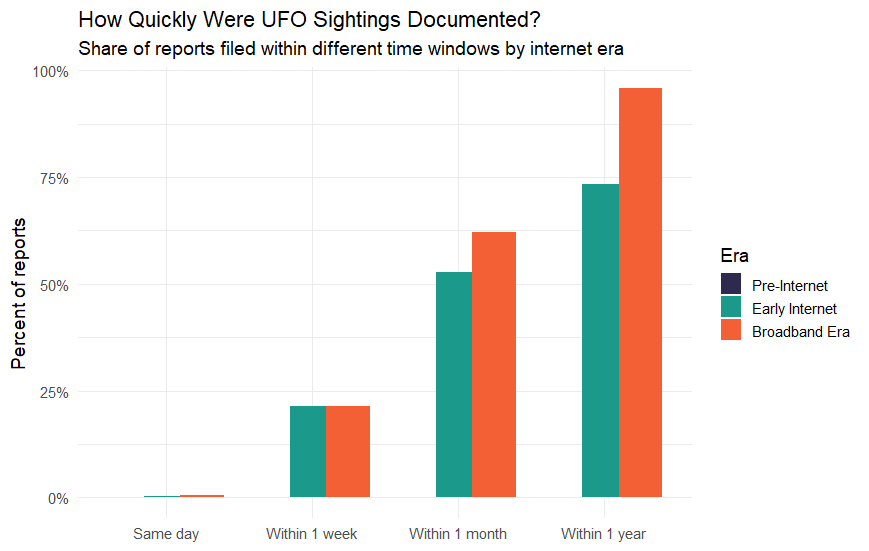
During the early internet era, about 53% of sightings were reported within 30 days.
By the broadband era, that number had increased to more than 62%.
Even more striking, nearly 96% of broadband-era reports were documented within a year of the event.
This represents a complete shift in reporting behavior.
Instead of becoming part of the historical record decades later, most sightings are now entered into the database while they are still recent.
The Statistical Evidence Is Strong
Visual patterns can sometimes be misleading. Fortunately, the statistical models tell the same story.
An interrupted time-series analysis found a highly significant decline in reporting delay beginning in 1995, followed by an additional year-over-year decrease thereafter. Both the immediate change and the continued downward trend were statistically significant.
A separate regression reached the same conclusion, showing that reporting delays consistently declined over time and were substantially shorter during both the early internet and broadband eras than during the pre-internet years.
In other words, the dramatic reduction in reporting delay is not simply an artifact of a few unusual years.
It reflects a sustained, long-term change in how UFO sightings entered the historical record.
Why This Matters
This finding has implications well beyond UFO research.
Many historical datasets are affected by reporting latency—the time between an event and its entry into the scientific record.
Disease surveillance, wildlife observations, citizen science projects, and disaster reporting have all been transformed by digital communication.
The UFO database offers a particularly clear example because the shift is so dramatic. As technology improved, people didn’t necessarily experience more unexplained events. They simply documented them much sooner.
The Bigger Lesson
When we analyze historical trends, it’s easy to assume that changes in the data reflect changes in the world.
Sometimes they do.
But sometimes they reflect improvements in the way information is collected.
Our analysis suggests that one of the most important events in UFO history wasn’t a famous sighting or a blockbuster movie.
It was the arrival of the internet.
By making reporting faster, easier, and more accessible, the internet fundamentally reshaped one of the world’s largest UFO datasets. That doesn’t solve the mystery of what people saw—but it does help explain why modern UFO records look so different from those of the past.