Did UFOs Change Shape Over Time? An Analysis of 80,000 Sightings
What Can UFO Data Tell Us?
UFOs have fascinated people for generations. Whether they represent extraterrestrial visitors, misunderstood natural phenomena, or simply the quirks of human perception, millions of people have looked to the skies and wondered.
In this series, we’re taking a different approach. Using more than 80,000 documented UFO sightings, we’ll investigate one question at a time through the lens of data science. Rather than asking whether UFOs are real, we’re exploring what these reports reveal about human behavior, culture, and the ways we document the unexplained.
After all, even if the mystery remains unsolved, the data have a story to tell.
Previous Entries
- Did Hollywood Make People See More UFOs? A Data Analysis
- Did the Internet Cause the UFO Reporting Boom?
- Did Smartphones Change UFO Sightings?
- Did the Internet Make People Report UFO Sightings Faster?
The Shape Hypothesis
For decades, the classic UFO image was the flying saucer.
But modern UFO stories often sound different. People report glowing lights, fireballs, triangles, spheres, and formations. That raises a fascinating question:
Did UFOs change shape over time?
If reported UFO shapes shifted across decades, that could tell us something important—not necessarily about extraterrestrial craft, but about culture, technology, perception, and the language people use to describe the unknown.
The Most Common UFO Shape Is Not the Saucer
Across the full dataset, the most common category was light or flash, accounting for 22.9% of classified reports. That was followed by circle or sphere at 16.2%, unknown or other at 14.3%, and triangle at 10.3%.
The classic saucer or disk accounted for only 6.6% of reports overall.
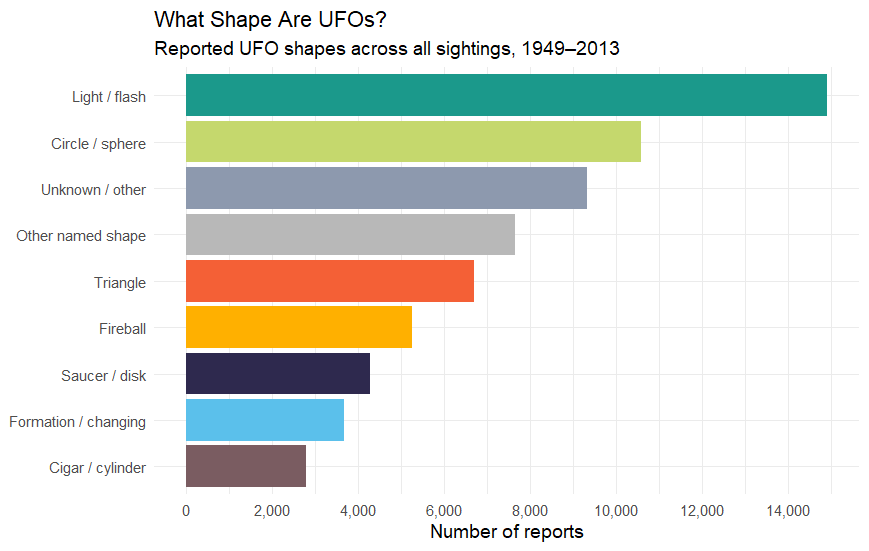
That finding alone suggests that the popular image of UFOs may not match how most witnesses actually describe what they saw.
The Flying Saucer Era Was Real
In the early decades, however, saucers dominated.
The top reported shape in the 1940s, 1950s, 1960s, and 1970s was consistently saucer or disk. In the 1950s, saucers made up 29.7% of reports. In the 1960s, they accounted for 25.6%. In the 1970s, they still represented 24.1%.
Then the pattern changed.
By the 1990s, the most common reported shape was light or flash, and that remained the top category in the 2000s and 2010s.
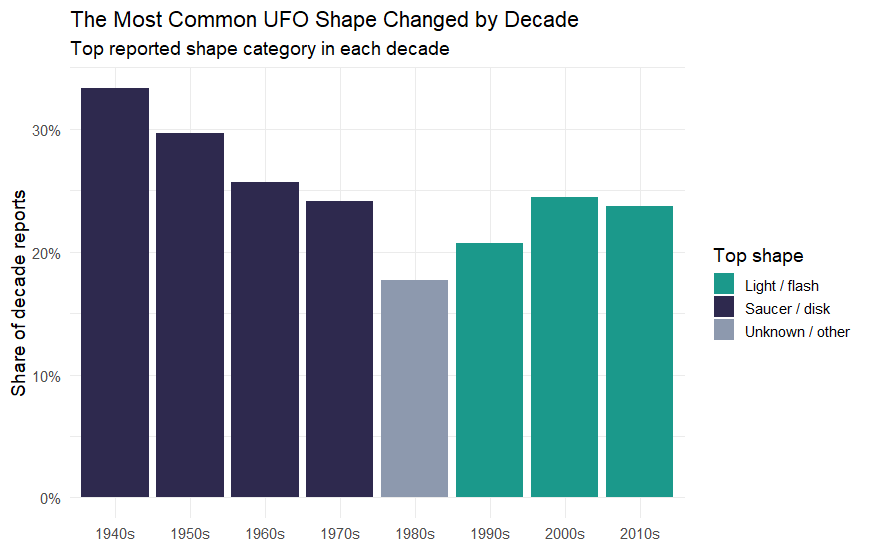
The data suggest that the “flying saucer” was not just a pop-culture stereotype. It genuinely dominated reported UFO shapes for several decades.
But it did not remain dominant.
From Saucers to Lights
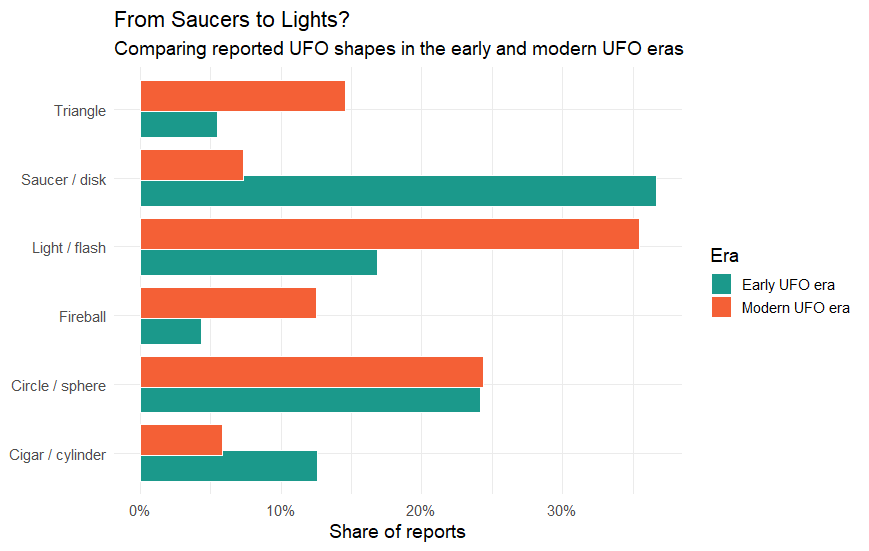
The clearest contrast comes from comparing the early UFO era with the modern era.
In the 1950s and 1960s, saucers accounted for 36.7% of the main shape categories analyzed. Lights and flashes accounted for only 16.8%.
In the 2000s and 2010s, the pattern reversed. Lights and flashes rose to 35.5%, while saucers fell to just 7.3%.
Triangles also became more common, increasing from 5.5% in the early UFO era to 14.6% in the modern era. Fireballs rose from 4.3% to 12.5%.
This is exactly the kind of cultural shift we were looking for.
The UFO did not disappear. It changed vocabulary.
The Change Is Statistically Strong
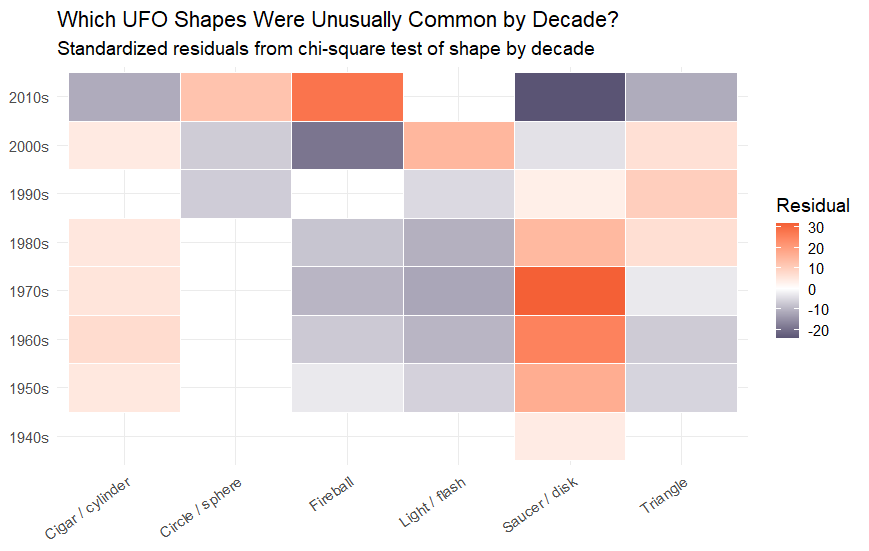
A chi-square test found a strong relationship between decade and reported shape category, indicating that UFO shape distributions changed substantially over time.
The residual analysis shows where the biggest departures occurred. Saucers were strongly overrepresented in the 1950s, 1960s, and especially the 1970s. By contrast, saucers were strongly underrepresented in the 2010s.
Lights became unusually common in the 2000s, while fireballs became especially prominent in the 2010s. Triangles were unusually common in the 1990s and 2000s.
That does not prove the objects themselves changed. It does show that the way people described UFOs changed dramatically.
Why Would UFO Shapes Change?
There are several plausible explanations.
First, culture changes perception. In the mid-twentieth century, the flying saucer was the dominant image of extraterrestrial technology. People had a familiar template for interpreting strange objects in the sky.
Second, technology changes the sky. Modern observers see satellites, drones, aircraft lights, reentering debris, and illuminated objects that earlier witnesses were less likely to encounter.
Third, reporting language changes. A witness in 1955 might describe a luminous disk. A witness in 2012 might describe a light, an orb, or a fireball.
Finally, classification systems matter. When witnesses are asked to select from predefined shape categories, the categories themselves influence how reports are coded.
The Bigger Lesson
The history of UFO shapes is a history of human interpretation.
In the 1950s, people saw saucers. In the 2000s, they saw lights. In the 2010s, fireballs and spheres became more prominent.
That does not make the reports meaningless. It makes them scientifically interesting.
UFO sightings are not just records of unexplained objects. They are records of how people describe uncertainty using the concepts available to them.
And over time, those concepts changed.
The flying saucer did not vanish because the mystery ended. It faded because the culture around the mystery evolved.