

Do UFOs keep Office Hours?
UFOs have fascinated people for generations. Whether they represent extraterrestrial visitors, misunderstood natural phenomena, or simply the quirks of human perception, millions of people have looked to the skies and wondered.
In this series, we’re taking a different approach. Using more than 80,000 documented UFO sightings, we’ll investigate one question at a time through the lens of data science. Rather than asking whether UFOs are real, we’re exploring what these reports reveal about human behavior, culture, and the ways we document the unexplained.
After all, even if the mystery remains unsolved, the data have a story to tell.
Previous Entries
- Did Hollywood Make People See More UFOs? A Data Analysis
- Did the Internet Cause the UFO Reporting Boom?
- Did Smartphones Change UFO Sightings?
- Did the Internet Make People Report UFO Sightings Faster?
- Did UFOs Change Shape Over Time?
- Where Are America’s UFO Hotspots?
The Office Hours Hypothesis
If UFOs are intelligently controlled, do they have a preferred schedule? It’s a playful question, but one with a surprisingly serious scientific angle.
People don’t spend equal amounts of time outside every hour of every day. They work during the week, relax on weekends, stay up later on Friday and Saturday nights, and spend more evenings outdoors during their free time.
If UFO reports simply reflect when people are available to look up, we’d expect clear patterns in the timing of sightings.
Using nearly 69,000 reports with complete date and time information, we examined when sightings occurred by hour of day, day of the week, and weekday versus weekend.
Saturdays Are the Busiest Day for UFO Reports
The first pattern is immediately obvious. Saturday accounts for 17.6% of all reported sightings, making it the single busiest day of the week.
Sunday follows at 14.5%, while Friday contributes 14.4%.
Monday has the fewest reports at 12.5%.
At first glance, that suggests UFOs prefer weekends.
But weekends make up only two of the seven days in a typical week.
To know whether weekends are truly unusual, we have to compare the observed number of reports with what we’d expect if sightings were evenly distributed across the calendar.
UFOs Really Do Overperform on Weekends
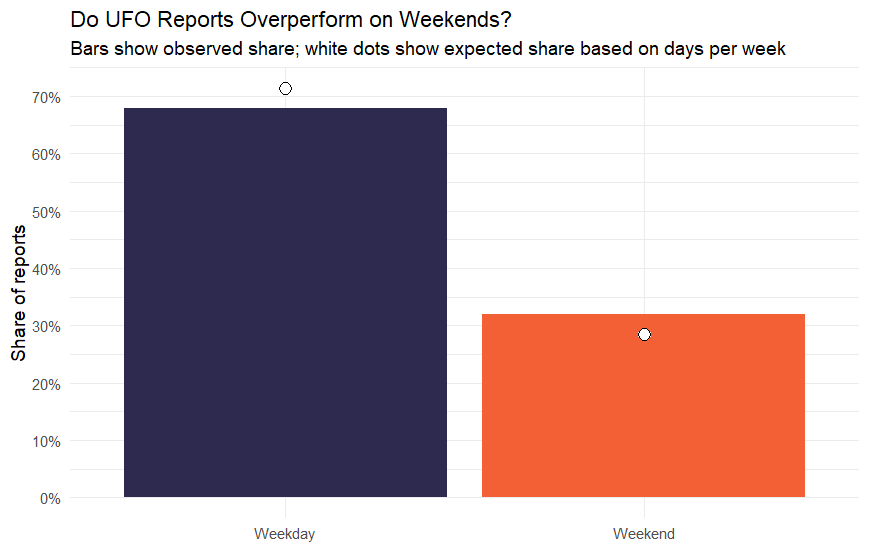
If sightings were evenly distributed throughout the week, weekends should account for about 28.6% of all reports.
Instead, they account for 32.1%.
Weekdays, by contrast, account for 67.9% of reports instead of the expected 71.4%.
That means weekends produce approximately 12% more reports than expected based solely on the number of days available. The statistical test confirms that this difference is extraordinarily unlikely to have occurred by chance (p being way, way, way less than 0.000001)
The simplest explanation is not that aliens prefer weekends.
People do.
They stay out later, spend more time outdoors, travel, camp, attend sporting events, and generally spend more time looking at the sky.
UFO Reports Peak at 9 PM
The daily pattern is even more striking.
Across the entire dataset, the busiest hour for UFO reports is 9:00 PM, accounting for more than 15% of all sightings.
Reports remain elevated through 10 PM and 11 PM, before dropping sharply after midnight.
Morning hours are remarkably quiet.
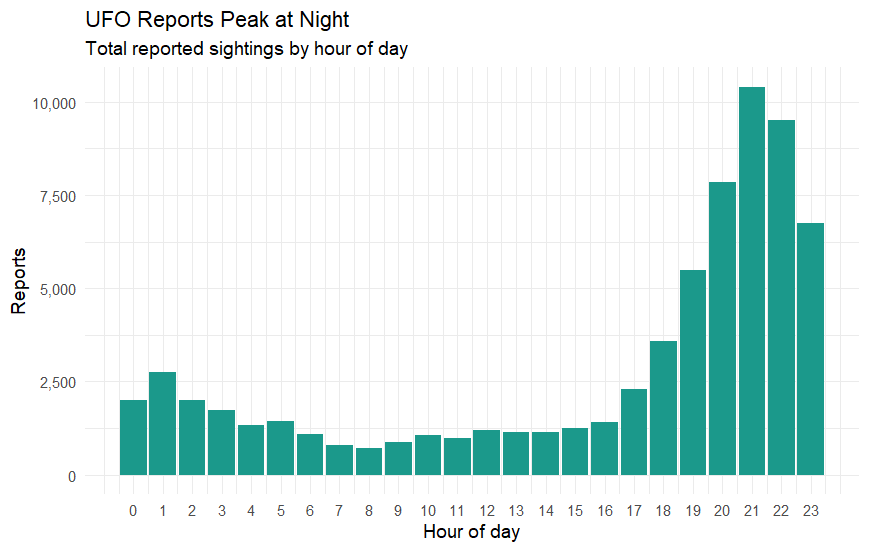
This is exactly what we’d expect if visibility and human activity drive reporting.
The sky is dark enough to notice unusual lights, while large numbers of people are still awake and outdoors.
Saturday Night Is Prime UFO Time
Combining the hour and weekday data reveals an even more interesting picture. The single busiest periods in the entire dataset are:
- Saturday at 9 PM
- Saturday at 10 PM
- Thursday at 9 PM
- Friday at 9 PM
- Wednesday at 9 PM
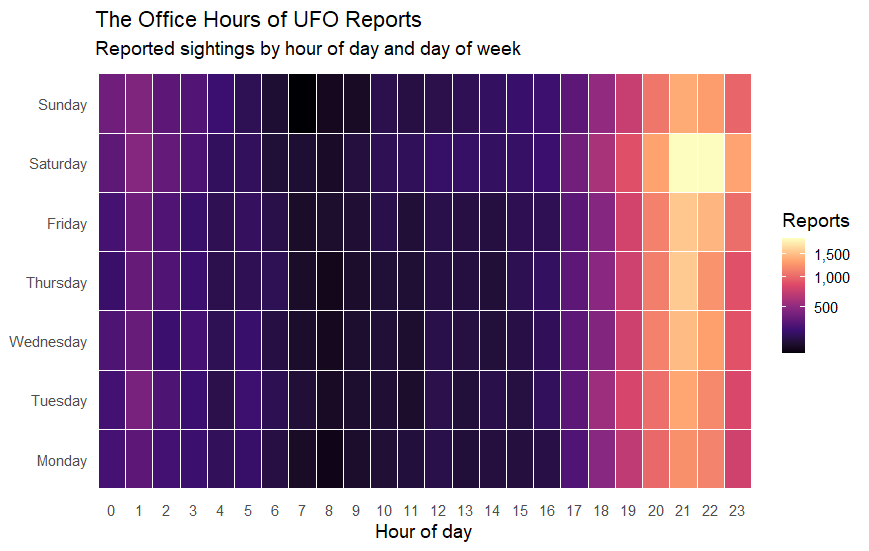
In fact, four of the top ten hour-day combinations occur on Saturday evening alone. The heatmap makes this pattern impossible to miss.
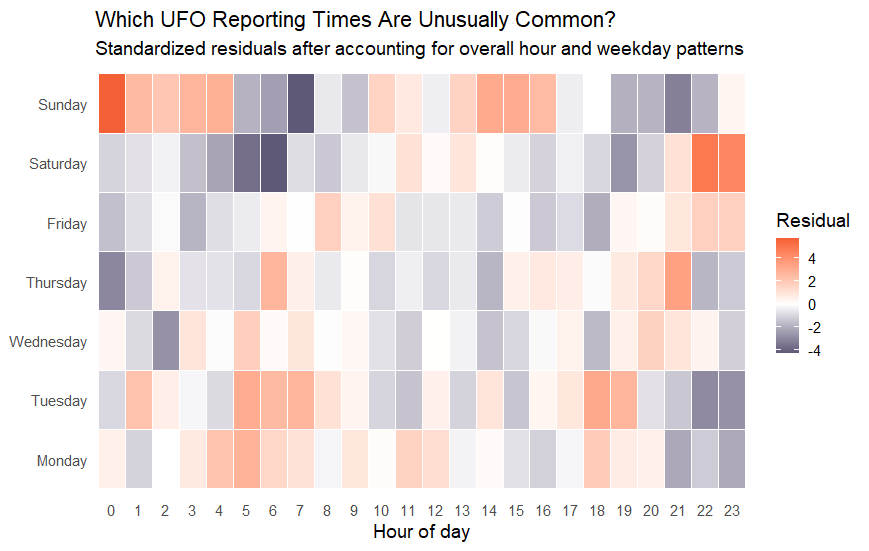
Late Saturday evenings consistently produce more reports than expected, even after accounting for the overall popularity of Saturdays and the general tendency for sightings to occur at night.
Nighttime Dominates Every Day of the Week
Regardless of whether it’s a weekday or weekend, most UFO reports occur after sunset.
During weekdays:
- 38.3% occur at night.
- 28.5% occur during the evening.
Weekends show nearly the same pattern:
- 39.7% occur at night.
- 26.6% occur during the evening.
Morning and afternoon reports remain comparatively rare.
The similarity between weekdays and weekends suggests that the timing of sightings is remarkably consistent. People simply report more of them when they have additional free time.
What Does This Tell Us?
These findings offer an important reminder about observational data. A UFO report is not just a record of something unusual in the sky.
It is also a record of human behavior.
People can only report what they have an opportunity to observe. When millions more people are outside on Saturday evenings, looking toward the sky after dark, the number of reported sightings naturally increases—even if the number of unusual objects overhead remains unchanged.
This phenomenon is well known in many scientific fields. Bird observations increase on weekends because more people go birdwatching. Meteor reports increase during major meteor showers because observers intentionally look upward. Citizen science projects consistently show that participation patterns shape the data researchers collect.
UFO reports appear to follow the same principle.
The Bigger Lesson
One of the most common mistakes in data analysis is confusing human activity with the phenomenon being measured.
Our analysis shows that UFO reports have clear “office hours.”
The busiest time isn’t midnight.
It isn’t 3 AM.
It’s 9 PM on Saturday.
That doesn’t necessarily tell us when mysterious objects appear.
It tells us when people are most likely to notice them.
For scientists, that’s an important distinction.
Understanding when observers are observing is just as important as understanding what they observe.
And sometimes the behavior of the observers explains far more than that of the phenomenon itself.