
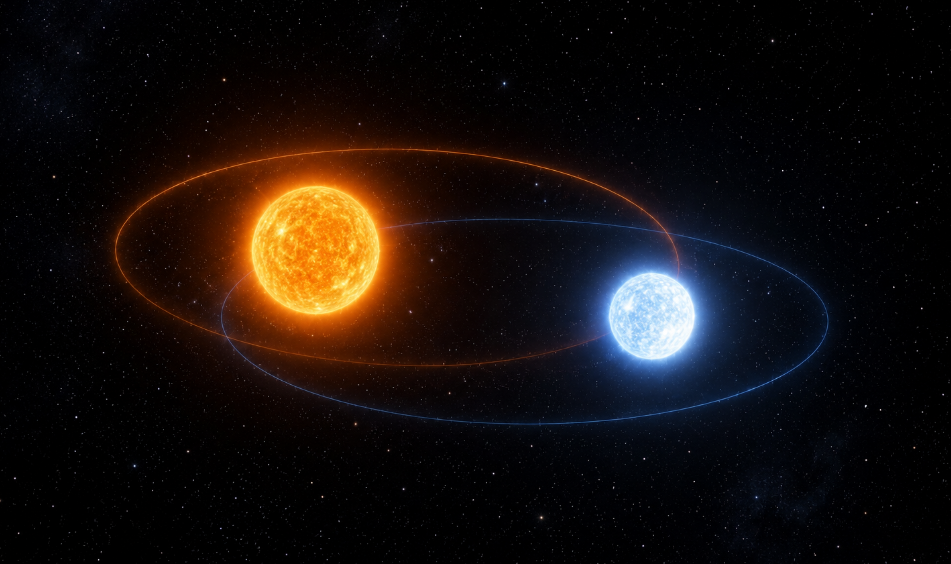
Mystery of a Binary Supernova Solved
In a vast universe where stars are born and die in explosive finales, the remnants of these stellar deaths—known as supernova remnants—leave behind intriguing cosmic puzzles. One such puzzle, the supernova remnant IC 443, has captivated astronomers for decades. Despite extensive study, its surrounding region remained shrouded in mystery. But now, a breakthrough discovery sheds new light on this stellar enigma.
The Cosmic Puzzle of IC 443 and G189.6+3.3
IC 443 is one of the Galaxy’s brightest supernova remnants, often studied for its luminous interactions with surrounding media. But recently, researchers have turned their attention to G189.6+3.3, a nearby and less conspicuous remnant that shares an intriguing spatial relationship with IC 443.
For years, observations revealed gamma-ray emissions in the region, often attributed to IC 443. However, high-energy astrophysicists using the Fermi-LAT Gamma-ray Space Telescope noticed something odd. The emission was larger than expected, suggesting another source was at play.
Unveiling the Shadowed Gamma Rays
To explore this mystery, researchers conducted a meticulous analysis using 16 years of Fermi-LAT data, revealing that the extended gamma-ray emissions originated from G189.6+3.3. The new findings paint a picture of a complex area where two supernova remnants coexist, each with unique energy signatures.
What the Researchers Did
By analyzing gamma-ray and X-ray data, scientists mapped the spatial morphology of G189.6+3.3’s emissions. They found distinct gamma-ray components: one linked to molecular gas and another without. This spatial arrangement suggested that different cosmic ray populations were contributing to the gamma-ray landscape.
The Surprising Discovery
The real surprise came when researchers discovered that G189.6+3.3 and IC 443 might be parts of a stellar binary system, each born from separate supernova events yet closely related in both distance and timing. The interaction between these remnants and the S249 hydrogen cloud suggests a scenario ripe for cosmic ray production through proton re-acceleration.
Why This Matters
The discovery of this potential binary-system supernovae challenges previous assumptions. It provides a new lens to examine how stars evolve and end in dramatic cosmic fireworks. With clearer evidence of spatial separation between hadronic and leptonic gamma-ray emissions, scientists now have a case study for understanding particle acceleration and cosmic ray production within such binary systems.
Moreover, this finding could help refine models about the environments in which supernova remnants evolve, shedding light on matter distribution in our galaxy.
What Remains Unknown
Despite the excitement, questions linger. The exact relationship and historical timeline of the supernova events remain under investigation. More data are needed to understand the full spectral energy profiles and to pinpoint potential pulsar associations with the remnants.
The interaction dynamics in the S249 cloud and their contribution to gamma-ray production also warrant further exploration. Upcoming telescopes and continued observations will be crucial to unraveling these complexities.
Let’s Explore Together
As astronomers continue to investigate the heavens, findings from the IC 443 and G189.6+3.3 region pave the way for future discoveries in cosmic phenomena. This dynamic dance of supernova remnants hints at the undiscovered complexities in our universe.
- How might this binary supernova scenario change the way we think about supernova evolution?
- What technologies could help further unravel the mysteries of regions like IC 443 and G189.6+3.3?
- In what other ways might studying supernova remnants impact our understanding of the universe?