
Hidden Risks in Your Sleep Patterns?
Every night, as we drift into the world of dreams, an intricate dance of physiological processes unfolds, often unnoticed but deeply impactful. For millions, sleep apnoea interrupts this dance, presenting a distinct health risk that goes beyond fatigue. But could there be an unseen layer of risk that traditional measures have been missing?
A Closer Look at Sleep’s Secrets
In a bustling global city or a quiet village, the twilight hours usher in a silent, yet significant battle for quality of life. Many have sought help at sleep clinics, where experts probe the causes of disturbed slumber. The standard diagnostic tool, polysomnography (PSG), often reduces its findings to the apnea–hypopnea index (AHI), a measure that quantifies sleep apnoea severity based only on the frequency of breathing interruptions.
However, recent research suggests that relying solely on AHI might overlook critical details that could change patient prognoses and treatment strategies. This leads us to the question: What if our sleep holds hidden indicators of health risk?
Decoding the Sleep Puzzle
Researchers looked deeper into the physiological data captured during those quiet nights. Using an artificial intelligence (AI) model trained on over 10,000 sleep recordings, scientists are extracting new insights that traditional methods miss.
This model, developed by a team of sleep specialists and AI researchers using data from the Cleveland Clinic, aims to identify ‘latent’ risk structures. It does so by assessing various physiological signals typically recorded during a PSG study, such as brain wave patterns, oxygen saturation, and heart rates.
New Discoveries in Sleep Analysis
The researchers classified patients into five distinct risk groups based on patterns hidden within their sleep data. Those in the highest-risk group faced more than double the risk of death compared to others, despite showing similar AHI scores. This suggests that the nuanced physiological details revealed by the AI-driven model provide a more accurate picture of a person’s health outlook than the AHI alone.
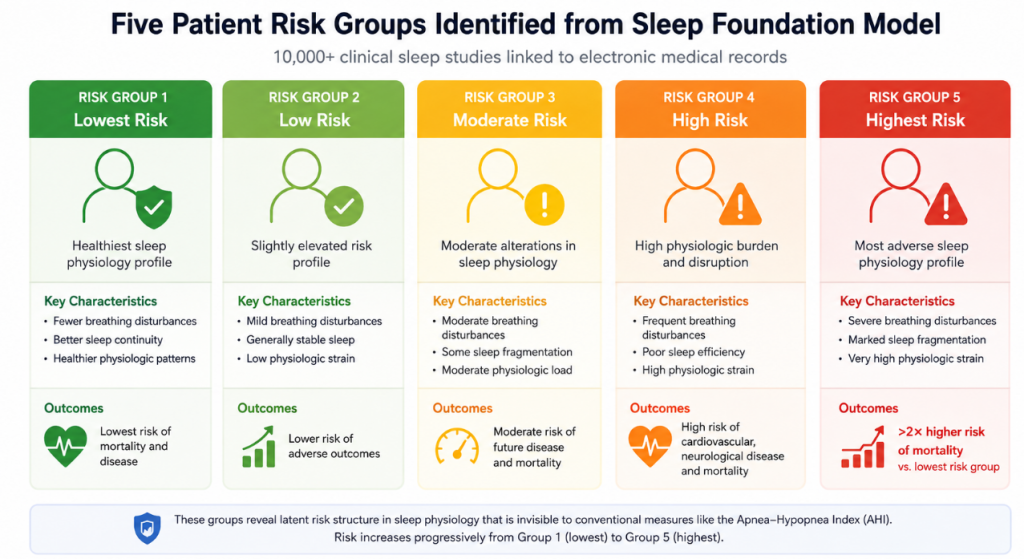
Such findings beg the question: how much more is there to learn from what happens when our bodies are at rest?
Why This Matters: A Global Perspective
Globally, more than a billion individuals experience sleep disturbances, a figure that underscores the urgent need for more comprehensive diagnostic tools. By advancing beyond the limited scope of AHI, this research could revolutionize how we understand and treat sleep-related health risks.
Imagine a world where sleep clinics can preemptively identify and manage health risks by leveraging these new insights. Clinicians in regions with limited access to medical resources might find this data-driven approach invaluable in personalizing patient care, optimizing interventions, and preventing serious health outcomes.
Exploring the Unknown
Despite this progress, questions remain. How will these AI-driven insights be best integrated into daily clinical practice? Can they be adapted to environments with fewer resources without losing their efficacy? And crucially, how soon might sleep analysis evolve from a luxury of high-tech labs to an accessible tool globally?
Let’s Explore Together
The journey into sleep’s uncharted territories continues to unfold, inviting us all to ponder its implications. How might these discoveries alter our understanding of health or reshape interventions in varying cultural contexts? Join the conversation as we delve further into the intriguing world of sleep science.
- How might this discovery change the way we think about everyday health monitoring?
- What steps would be necessary to utilize these findings in resource-limited settings?
- Where else might scientists look for similar latent risk structures in other physiological data?