The History of Aliens: How Humans Imagined Extraterrestrial Life
For thousands of years, something has been coming down from the sky.
Sometimes it has wings.
Sometimes it glows.
Sometimes it looks almost human.
Sometimes it is beautiful. Sometimes terrifying.
And sometimes it has a huge bald head, gray skin, tiny nostrils, and enormous black eyes.
Today, most of us know that last creature immediately. It is the alien. More specifically, it is the “Grey,” perhaps the most recognizable extraterrestrial in modern popular culture. Put a Grey on a T-shirt, bumper sticker, movie poster, or emoji and almost nobody needs an explanation. We know where it comes from.
Space.
But something feels strange about that assumption.
We have no confirmed photograph of an extraterrestrial being. We have no alien body available for scientific study. We have no verified description transmitted from another civilization. NASA says it has found no credible evidence of extraterrestrial life and no evidence that unidentified anomalous phenomena, or UAPs, are extraterrestrial spacecraft.
Yet somehow, we know what an alien looks like.
That contradiction opens a much more interesting question than whether flying saucers are real.
Where did our aliens come from?
The answer leads through religion, folklore, astronomy, psychology, war, science fiction, nuclear weapons, sleep paralysis, and centuries of people trying to understand things they could not explain.
The history of aliens, it turns out, may be partly a history of ourselves.
Before We Had Aliens, We Had Visitors
Imagine living several thousand years ago.
The night sky is not a faint scattering of stars washed out by streetlights. It is enormous, bright, and unavoidable. The Sun determines your working day. The Moon tracks time. The stars help travelers navigate. Comets appear without warning. Meteors streak across the darkness. Eclipses seem to turn off the Sun.
Then there are storms, auroras, strange lights, unusual clouds, planets that wander against the background stars, and atmospheric effects with no scientific explanation yet.
Something is clearly happening above you.
But what?
Every culture developed ways of answering that question. The heavens became populated with gods, spirits, ancestors, monsters, messengers, and other intelligences.
These beings were not “extraterrestrials” in the modern scientific sense. It would be misleading to take an ancient description of an angel or god and simply declare that the writer was describing an astronaut.
Ancient people had their own categories for understanding reality.
But there is a fascinating similarity between the questions they asked and the ones we ask now.
- Who else is out there?
- Can they see us?
- Can they come here?
- Are they more powerful than we are?
- What do they want?
Those questions are extremely old. The answers keep changing.
The Alien Was Once an Angel
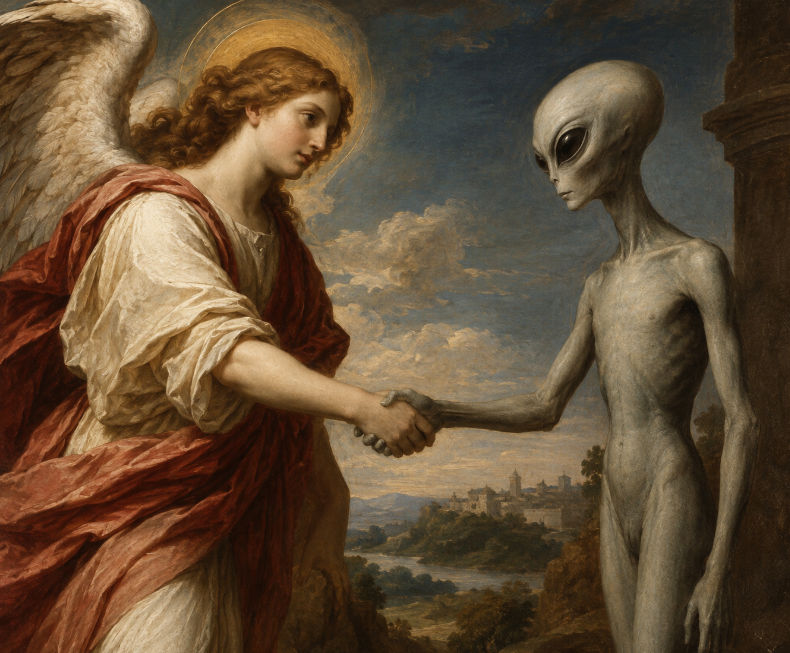
Consider angels. Modern Western culture has created a very specific visual vocabulary for them. Ask a child to draw an angel, and you will probably get something human-shaped, dressed in white, perhaps glowing, and almost certainly equipped with wings. But that image has a history. Early Christian depictions of angels did not necessarily show them with wings. Some of the earliest surviving images portray them as ordinary-looking young men. The familiar winged angel emerged gradually, influenced partly by the visual language already available in the ancient Mediterranean world. By late antiquity, wings had become a convenient artistic symbol for a being that belonged to heaven rather than Earth.
In other words, people faced a problem: How do you draw something that is not quite human and does not quite belong in our world? Artists solved it by borrowing recognizable symbols. Wings represented the sky. Halos signaled holiness. White clothing suggested purity. Human bodies made these mysterious beings understandable. The resulting image became so culturally powerful that centuries later, people often assume this is simply what angels have always looked like.
This is our first clue about aliens. Culture does not merely tell stories about strange beings. Culture can give those beings a body.
The Heavens Become a Place
For much of human history, “heaven” and “the sky” were conceptually tangled together in ways that can be difficult for modern people to appreciate. Then astronomy began rearranging the universe. Earth became a planet. The planets became worlds. The stars became suns. Eventually, the universe became almost unimaginably large. That transformation introduced an extraordinary possibility: the beings above us no longer needed to be supernatural. They could simply live somewhere else.
The idea was not entirely new. Ancient Greek thinkers debated whether other worlds existed, and speculation about a plurality of worlds continued for centuries. But the scientific revolution dramatically changed the question. Once Earth was understood as one world among many, extraterrestrial life could be discussed as a natural possibility rather than a purely supernatural one. The visitor from heaven was slowly becoming a visitor from another planet.
This was a profound cultural shift. An angel crosses a spiritual boundary. An alien crosses a physical distance. As the universe became increasingly understood through physics rather than theology, our mysterious visitors changed with it. They became technological.
But What About the Fairies?
This is where the history becomes stranger. For centuries, European folklore described encounters with beings that occupied an uncertain space between ordinary humans and the supernatural. Fairies were not always the tiny, friendly creatures of modern children’s stories. They could be beautiful or grotesque. They could trick people, paralyze them, or take them away. Time might behave strangely in their realm, and people might return from an encounter confused about how long they had been gone. Folklore also contained stories of changelings, in which a human child was supposedly taken and replaced by another being. To modern readers familiar with UFO stories, some of these themes sound surprisingly familiar.
The resemblance became especially famous after computer scientist and UFO researcher Jacques Vallée argued in his 1969 book Passport to Magonia that modern UFO stories should be compared with older folklore about fairies, demons, angels, and other supernatural beings. Vallée’s conclusion was controversial. He did not simply argue that witnesses were confusing folklore with spaceships. He entertained the much more speculative possibility that different cultures might be encountering some underlying phenomenon and interpreting it differently. No scientific evidence establishes that fairies and UFO occupants are manifestations of the same external phenomenon, but the comparison raises a valuable scientific question even without accepting Vallée’s explanation.
When human beings encounter something strange, how much of what they experience comes from the event itself, and how much comes from the cultural vocabulary available to explain it? Unlike the question of whether fairies and aliens are actually the same phenomenon, researchers can study this. And psychologists have found some remarkable clues.
Meet the Monster Sitting on Your Chest
You wake up in the middle of the night. You are conscious and can see your bedroom, but you cannot move. Something seems to be in the room with you. You can feel its presence. Perhaps you see a shadowy figure near the bed. Perhaps something seems to be pressing on your chest. You might feel watched, touched, or restrained. The experience can be absolutely terrifying.
Today, science has a name for at least one phenomenon that can produce this strange cluster of sensations: sleep paralysis. During rapid eye movement, or REM, sleep, the brain normally prevents the body from acting out dreams by temporarily suppressing most voluntary muscle movement. Sometimes consciousness returns before that paralysis has completely disappeared. The result can be a bizarre overlap between dreaming and waking. A person may be aware of the bedroom while still experiencing dreamlike images, sounds, bodily sensations, or the powerful feeling that another presence is nearby.
The physiology appears across cultures, but the explanation does not. In parts of Brazil, folklore describes a creature called the Pisadeira. In Newfoundland, people historically described the Old Hag. Other traditions have blamed ghosts, witches, demons, spirits, or other supernatural attackers. Researchers comparing sleep paralysis experiences in Egypt and Denmark found striking cultural differences. Among participants from the general Egyptian population who had experienced sleep paralysis, nearly half attributed it to jinn, while Danish participants were much less likely to give the experience a supernatural explanation.
The body can produce a similar mystery. Culture helps supply the monster. And in modern Western societies, another monster is available: the alien.
The Alien Moves Into the Laboratory
By the nineteenth century, science and technology were transforming everyday life at extraordinary speed. Steam engines moved people across countries, telegraph wires sent information faster than any messenger, electricity became something humans could control, and photography captured images of the world with unprecedented realism. Balloons and airships also suggested that humans might soon conquer the sky. At the same time, astronomers were using increasingly powerful telescopes to look at other planets, and one world in particular captured the public imagination: Mars.
In 1877, Italian astronomer Giovanni Schiaparelli described features on Mars using the word canali, meaning channels. In English, the term was famously rendered as “canals,” a word that suggested something very different: artificial construction. American astronomer Percival Lowell became convinced that Mars contained an enormous network of canals built by intelligent inhabitants attempting to move water across a drying planet. Most astronomers were never convinced, but the public imagination certainly was.
Mars was no longer merely a point of light in the night sky. It was a place. And places can have people. The Martian was born.
Then H. G. Wells Changed the Alien Again
In 1898, H. G. Wells published The War of the Worlds, and his Martians were not wise visitors descending from the heavens to enlighten humanity. They were invaders. That mattered because Wells was writing from inside the British Empire, during an era when powerful European nations had invaded, colonized, and exploited enormous parts of the world. Wells reversed the situation. What if the technologically superior civilization arrived in England? What if we became the population confronting weapons we could not match? The alien had become a way to think about imperialism from the other side.
This pattern would repeat again and again. We tend to imagine extraterrestrials wielding whatever kinds of power most frighten or fascinate us. When religion dominates our understanding of the heavens, visitors resemble spiritual beings. When exploration expands our view of the universe, they become inhabitants of other worlds. When empire dominates world politics, they become invaders. When technology accelerates, they arrive in machines. When nuclear war threatens civilization, they come to warn us. When medical technology becomes frightening, they examine our bodies.
Our aliens keep changing because we keep changing.
The Flying Machine Arrives Before the Flying Saucer
This story includes an especially revealing chapter just before 1900. In 1896 and 1897, newspapers across the United States reported mysterious “airships” appearing in the sky. The timing is remarkable. Humans were clearly on the verge of powered flight, but the Wright brothers would not make their famous flight until 1903. People knew that flying machines were becoming possible. They simply did not know exactly what a successful flying machine would look like. Then, seemingly right on cue, mysterious flying machines began appearing in the sky.
This is an almost perfect example of the relationship between technology and imagination. People did not generally report sleek silver discs or futuristic spacecraft. They reported mysterious craft that made sense within the technological world of the 1890s: airships. The unknown was dressed in the future people could already imagine.
World War II Put Strange Lights in a Technological Sky
By the 1940s, airplanes had transformed warfare. Pilots were now regularly moving through a part of the world that previous generations could only observe from the ground. During World War II, Allied aircrews began reporting strange lights that sometimes appeared to follow their aircraft. These mysterious objects became known as “foo fighters.” There was no single accepted explanation for all of the reports. In the confusion of wartime, possibilities included enemy technology, atmospheric effects, misperception, and other phenomena.
But something important had changed in how people interpreted the sky. A strange light overhead was no longer automatically a sign from heaven or the supernatural. It might be a weapon. It might be a secret aircraft. It might be technology. That shift in thinking would become extremely important after the war.
1947: The Flying Saucer Is Born
On June 24, 1947, private pilot Kenneth Arnold reported seeing nine unusual objects while flying near Mount Rainier in Washington. The event became a media sensation. Descriptions of how the objects moved helped inspire the phrase “flying saucer,” and the expression quickly exploded into popular culture. Soon, people across the United States, and eventually around the world, were reporting flying saucers of their own.
Why 1947? The timing is almost too perfect. World War II had ended less than two years earlier, and the atomic bomb had demonstrated that science could suddenly produce civilization-destroying power. Rockets developed during the war suggested that space travel might soon become possible. The United States and Soviet Union were entering the Cold War, military aviation was advancing rapidly, and radar had given humans a new way to detect objects that could not easily be seen. Perhaps most importantly, ordinary people now knew that governments possessed secret technologies they were not allowed to see.
The sky had become a military and technological frontier. The modern UFO was born into a world simultaneously fascinated and terrified by science.
Note: We did a bunch of data analysis on this subject over the summer:
The First Space Aliens Were Surprisingly Nice
If modern movies have trained you to expect alien encounters to involve kidnapping, experimentation, or planetary invasion, the UFO stories of the 1950s can seem surprisingly gentle. A generation of people known as “contactees” claimed to have met visitors from other planets, and many of these aliens looked remarkably human. Some supposedly came from Venus. That sounds absurd today because spacecraft have since revealed Venus as a crushingly hot world with a dense atmosphere dominated by carbon dioxide and clouds of sulfuric acid. But nobody had yet sent a spacecraft to Venus in the early 1950s. Enormous gaps remained in what scientists knew about the planet, and those gaps left plenty of room for the imagination.
Contactees such as George Adamski described beautiful, technologically advanced beings who came to Earth carrying messages for humanity. Their warnings often reflected the anxieties of the early nuclear age. Humans were becoming technologically powerful but remained morally immature. We needed to stop fighting, abandon nuclear weapons, and learn to live peacefully before we destroyed ourselves. These visitors sounded less like invading monsters than prophets. In some ways, they even sounded like angels. Religious scholar Christopher Partridge has described the benevolent extraterrestrial found in some early UFO religions as a kind of “technological angel.” The phrase captures the transformation perfectly. The messenger from heaven had not disappeared. He had acquired a spaceship.
Why Venus?
Another lesson is hidden inside those Venusians. People tend to imagine aliens where scientific knowledge leaves room for them. For centuries, other worlds could support elaborate imaginary civilizations because we knew very little about what those worlds were actually like. Then spacecraft began visiting them. Venus became a hellish world of extreme heat and pressure. Mars became a cold, dry world with no obvious civilization on its surface. The Moon became a dusty, airless landscape. As scientific knowledge filled in the blank spaces of our solar system, those places became increasingly difficult to populate with imagined advanced societies.
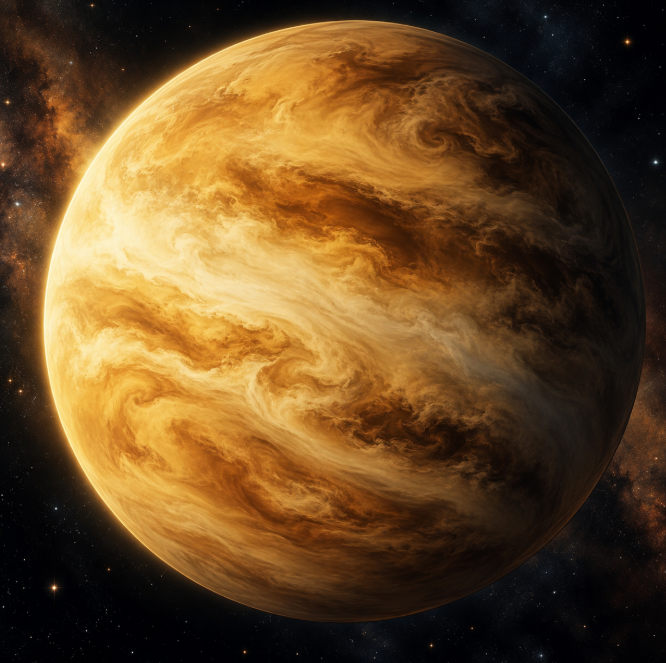
So the aliens retreated. They moved from the Moon, Venus, and Mars to planets orbiting distant stars, places science had shown could exist but had not yet examined closely enough to rule out civilizations. Once again, our picture of extraterrestrial life changed alongside our picture of the universe. Science did not kill the alien. It gave the alien a bigger universe in which to hide.
Then the Visitors Stopped Being Friendly
Then the Visitors Stopped Being Friendly
Something changed during the second half of the twentieth century. The kindly space brothers of the 1950s began losing ground to a much darker kind of visitor. The alien abductors arrived. One of the most influential cases involved Betty and Barney Hill, an interracial American couple who reported seeing a strange object while driving through New Hampshire in September 1961. They later underwent hypnosis and described a frightening encounter involving humanoid beings, missing time, and medical procedures. Their story became enormously influential in the developing culture of UFO encounters.
The Hill case was not the first story of humans being taken by strange beings, nor was it the first alleged encounter with extraterrestrials. But it helped establish a template that would become increasingly familiar. Someone is driving or sleeping when a strange light appears. A period of time seems to be missing. The person remembers being taken somewhere and being unable to control their body while nonhuman beings examine them. In some accounts, the examinations focus on reproduction or sexuality. Eventually, the person is returned, often with incomplete or disturbing memories of what supposedly happened.
By the 1980s and 1990s, the alien encounter had undergone a remarkable transformation. The visitor from the heavens was no longer arriving primarily to deliver wisdom or warn humanity about nuclear war. It was performing a procedure.
That Change May Tell Us Something About Ourselves
Historian Greg Eghigian has argued that alien encounter stories need to be understood within their changing social environments. The contactee stories of the 1950s emerged in the shadow of World War II and the new possibility of nuclear annihilation, and their extraterrestrial visitors frequently warned humanity about war and nuclear weapons. Later abduction stories developed in a society increasingly concerned with medical experimentation, reproductive technology, psychological trauma, abuse, institutional power, and violations of bodily autonomy.
Consider the typical alien abduction room. It often resembles a hospital stripped of its humanity: bright lights, smooth surfaces, cold instruments, immobilized patients, emotionless technicians, and examinations the subject cannot refuse. None of this proves that reports of alien abduction are invented. It does, however, help explain why historians and psychologists find these stories so culturally fascinating. The alien had become a creature capable of violating the modern body using modern technology.
And Then We Gave It a Face
At some point, the alien stopped merely being an idea and became an icon. The Grey is now instantly recognizable: a huge head, weak jaw, tiny mouth, thin body, long arms, and enormous dark eyes. It is close enough to human to be recognizable, but different enough to be disturbing. That balance matters. A completely incomprehensible alien would be difficult for us to understand, much less build stories around. So we do what humans are remarkably good at: we anthropomorphize.
Psychologists have demonstrated just how easily this happens. In a famous 1944 experiment, Fritz Heider and Marianne Simmel showed people a simple animation involving geometric shapes moving around a screen. Viewers spontaneously described the shapes as characters with personalities, emotions, intentions, and relationships. A triangle could become a bully. A circle could become frightened. Nothing about the shapes themselves required these interpretations. Human observers supplied the agency. We are astonishingly good at finding minds, motives, and characters in the world around us.
Perhaps it should not surprise us, then, that even our strangest extraterrestrials are usually built from familiar parts. They have heads, eyes, limbs, faces, intentions, societies, machines, and goals. Even scientists thinking seriously about extraterrestrial intelligence have to guard against this tendency. Researchers in SETI and astrobiology have pointed out how easily we can project human concepts onto beings that, if they exist, may have evolved under conditions completely unlike anything found on Earth.
Real extraterrestrial intelligence might not have a face or eyes. It might not exist as an individual organism. It might not communicate through anything resembling spoken language. It might never build a spaceship, and it might not even be biological in a form we would immediately recognize as life. That leaves us with a strange possibility. The Grey may ultimately tell us much more about human beings than it tells us about extraterrestrials.
Did Pop Culture Create the Grey?
This is where the relationship between culture and experience becomes difficult to untangle. Movies, books, television programs, alleged encounters, newspaper stories, UFO researchers, and eyewitness testimony have been influencing one another for decades. An unusual report becomes a book. The book influences a movie. Millions of people see the movie. Later, someone experiences something strange, but now they have a familiar visual vocabulary for describing what happened. Their story then enters popular culture, where it may influence how the next person understands an unusual experience. The cycle continues.
None of this requires dishonesty. A person can sincerely report an experience while interpreting unclear sensations or memories through familiar cultural categories. This is especially important because memory does not work like a video recording stored inside the brain. Memory is reconstructive. When we remember an event, the brain rebuilds a representation of what happened rather than simply replaying a perfect recording. What we already know, believe, expect, and have encountered in our culture can shape that reconstruction. For researchers studying extraordinary experiences, that makes the relationship between what happened, what was remembered, and how the experience was later interpreted especially complicated.
The Science of Remembering Aliens
Psychologists Susan Clancy, Richard McNally, Daniel Schacter, and their colleagues studied people who reported memories of being abducted by aliens. Using a standard psychological task designed to measure false recall and recognition, they found that participants reporting recovered memories of alien abduction were more susceptible to certain kinds of false memories than control participants. That does not mean these people were lying. In fact, one of the most important lessons from this research is that sincerity and historical accuracy are not the same thing. A memory can feel completely real, and a person can sincerely believe that it happened exactly as they remember it, even if parts of that memory were reconstructed or interpreted incorrectly.
Other research makes this distinction even more striking. In another study, researchers measured physiological responses while people who reported alien abductions listened to recordings describing their experiences. Their bodies responded strongly to the memories. In other words, the fear associated with the experiences was real. Whether extraterrestrials actually caused those experiences is an entirely separate scientific question. A person’s emotional and physical response tells us something important about how intensely an event is remembered, but it does not by itself establish what originally caused it.
That distinction is crucial whenever we investigate extraordinary human experiences. We do not have to choose between two simple explanations: “the aliens did it” or “the person made it up.” An enormous territory lies between those possibilities, involving perception, sleep, memory, expectation, interpretation, and culture. Human perception and memory are much more interesting than either extreme suggests.
Culture Does Not Simply Invent Experience
It would also be a mistake to swing too far in the opposite direction and conclude that culture explains everything. People really do see things they cannot identify. They experience sleep paralysis and hallucinations. They misperceive ordinary objects and witness unusual atmospheric events. Sometimes they encounter aircraft or technologies they do not recognize. And sometimes people report observations for which the available information is simply too limited to determine what actually happened.
NASA has made an important distinction in its work on unidentified anomalous phenomena, or UAPs. An unidentified observation is not evidence of extraterrestrial life. It is unidentified. NASA’s 2023 independent UAP study highlighted a frustrating problem for researchers: many reports simply do not contain enough reliable, consistent data to determine what produced the original observation. Something may genuinely have been observed, but there may not be enough information to identify it afterward.
That answer can feel deeply unsatisfying because humans naturally want mysteries to have solutions. But “we don’t know” is a perfectly legitimate scientific conclusion. It means the available evidence does not justify choosing among the possible explanations. The mistake comes when we treat uncertainty itself as evidence, turning a gap in our knowledge into proof of whatever explanation we already prefer.
The Brain Hates an Empty Space
Humans are pattern-finding animals, and that ability is essential to survival. If something moves in the bushes, quickly deciding whether it might be a predator can keep you alive. If a person’s face looks angry, recognizing the expression helps you decide how to respond. If dark clouds begin gathering overhead, noticing the pattern can warn you that a storm is approaching. Our brains are constantly taking incomplete information and trying to turn it into something meaningful.
But that ability can overshoot. We see faces in electrical outlets, animals in clouds, figures in shadows, intentions in moving shapes, and meaning in coincidences. Psychologists call this pareidolia: the tendency to perceive meaningful forms in ambiguous sensory information. Expectations can influence interpretation as well. Experimental research suggests that when people are primed to expect paranormal phenomena, they can become more likely to interpret ambiguous information in paranormal ways.
That gives us a useful model for thinking about extraordinary encounters. Something happens, but exactly what happened is unclear. The brain tries to understand it by searching through available categories: a ghost, an angel, a demon, a fairy, a secret aircraft, an alien, or perhaps today, a drone. The underlying experience may come first, but culture can help give that experience a name.
Every Age Gets the Alien It Needs
Now step back and look at the larger history, and a pattern emerges. In a religious cosmos, mysterious beings come from heaven. In an enchanted landscape, they come from the fairy realm. In an age of astronomy, they live on nearby planets. In an age of imperialism, they invade. In an age fascinated by airships, mysterious visitors fly airships. In the early Cold War, they pilot flying saucers. In the nuclear age, they warn us about destroying ourselves. And in a society increasingly concerned with technology, medicine, reproduction, surveillance, and bodily control, they abduct us and examine our bodies. The alien evolves alongside the society imagining it.
But there is an important warning here. Similarity does not prove identity. A fairy story involving missing time does not prove that medieval people were experiencing alien abductions. An angel descending from heaven is not evidence of an extraterrestrial astronaut. A modern UAP report is not evidence of a supernatural visitor. Treating these stories as interchangeable can erase the very different cultural worlds in which the original experiences occurred.
The more interesting possibility is subtler. Human beings may repeatedly encounter ambiguity, whether it comes from unusual natural events, altered states of consciousness, unfamiliar technology, misperception, or experiences we simply cannot explain. We then interpret that ambiguity using the most powerful ideas available to us. The mystery may remain remarkably persistent even as explanations change.
This Is Why Ancient Astronaut Theories Miss Something Important
Modern “ancient astronaut” theories often reinterpret religious texts, ancient artwork, myths, or monumental architecture as evidence of extraterrestrial contact. The appeal is easy to understand. A fiery object becomes a rocket. A divine visitor becomes an astronaut. A celestial vehicle becomes a spacecraft. Suddenly, stories written thousands of years ago seem surprisingly modern.
But this approach has a serious problem. It assumes our categories better describe someone else’s experiences than the categories those people used themselves. In doing so, it can flatten history. Ancient people could use metaphor, theology, engineering, mathematics, storytelling, exaggeration, symbolism, and imagination. A strange object in an ancient text does not become a spacecraft simply because a modern reader can imagine one that way. Calling a god an “alien” may tell us more about twenty-first-century culture than about the ancient society supposedly being explained.
In a sense, we have simply replaced their supernatural vocabulary with our technological vocabulary. Where they saw gods descending from the heavens, we imagine astronauts descending from another planet. Both interpretations reflect assumptions about what kinds of powerful beings can exist and where they might come from. Perhaps future humans will look back on our assumptions and find them equally strange.
Imagine the Alien of 2200
Suppose humans survive another two centuries. What will the alien look like then? Biological extraterrestrials might seem old-fashioned. Perhaps our descendants will imagine contact with planet-sized artificial intelligences or a distributed consciousness spread across billions of machines. Perhaps alien life will be microscopic. Humans might discover signs of biology in the atmosphere of a distant exoplanet without ever seeing the organisms themselves. We might detect an artificial signal produced by a civilization that disappeared a million years before humans learned how to listen for it. Or perhaps we will discover something so strange that even the word “life” becomes difficult to apply.
If that happens, the Grey may someday look as culturally specific as the Venusian space brother looks to us today. People in 2200 might watch twentieth-century alien movies and immediately recognize the assumptions of the era that produced them. Of course people imagined aliens as thin humanoids flying metal vehicles, they might say. Humans had only recently invented powered flight, space travel, computers, and artificial intelligence. They imagined the unknown using the technologies and ideas they already understood.
They might be right.
The Scientific Alien Is Becoming Stranger
A wonderful irony underlies all of this. As science becomes better at searching for extraterrestrial life, serious scientific ideas about what aliens might be like are becoming less like Hollywood. Astrobiologists do not begin by searching for humanoids with large eyes and advanced spacecraft. They look for chemistry. They study planetary atmospheres, investigate environments where liquid water might exist, and examine the conditions under which life emerged and survived on Earth. SETI researchers search for possible technological signatures, artificial signals, or other evidence that might indicate the presence of intelligence.
The scientific question is no longer simply, “Where are the little green men?” It is much more fundamental. What is life? What does life do to a planet? And how would we recognize technology created by a mind radically unlike our own? These questions expose an uncomfortable limitation in our search. We have only one confirmed example of life: life on Earth. And we have only one confirmed example of a species capable of building advanced technology: ourselves. Even science, therefore, must constantly guard against turning the search for extraterrestrial intelligence into a search for another version of humanity.
The Alien as a Mirror
Perhaps that is the most useful way to understand the history of aliens. The alien is a mirror placed at the edge of the known world. We look into it and imagine something looking back. Sometimes we see our gods. Sometimes we see our enemies. Sometimes we see our hopes, and sometimes we see our fears.
The peaceful Venusians of the 1950s looked down at a species building hydrogen bombs and told us to grow up. The Martians of H. G. Wells turned the violence of empire against the imperial center itself. The abductors of the late twentieth century transformed anxieties about medicine, technology, reproduction, and bodily control into beings capable of entering our bedrooms and examining us against our will. Even the Grey can be read as a strangely familiar vision of intelligence: an enormous head and eyes paired with a tiny mouth, weak body, and thin limbs. It almost resembles a caricature of what we imagine technological evolution might eventually do to ourselves.
The details keep changing, but the basic figure remains. Gods become angels. Angels give way to inhabitants of other worlds. Martians become Venusians. Venusians become Greys. And through all of these transformations, the visitor keeps arriving.
So, Are We Alone?
This history does not answer the biggest question. It cannot tell us whether intelligent extraterrestrial life actually exists. The universe is enormous, thousands of exoplanets have been confirmed, and modern astronomy gives scientists good reasons to investigate whether life might exist elsewhere. But the possibility of extraterrestrial life is not evidence that extraterrestrials have visited Earth. At present, NASA says it has found no credible evidence of extraterrestrial life and no evidence that UAPs are extraterrestrial in origin.
That leaves us in a fascinating position. Scientifically, extraterrestrial life is a serious research question. Historically, alien visitation is also a serious cultural question. But we should not confuse the two. One asks what exists elsewhere in the universe. The other asks why human beings keep imagining that someone from out there is coming here.
That second question has an increasingly compelling answer. We have never imagined aliens in a cultural vacuum. We build them from the materials around us. Religion gives them meaning. Folklore gives them behavior. Science gives them possible worlds. Technology gives them vehicles. Politics gives them motives. Psychology shapes how we perceive and remember encounters with the unknown. Popular culture gives those visitors faces. Then those faces become part of the cultural vocabulary available to the next person trying to understand something strange. It is a loop stretching across generations.
The Next Alien Is Already Being Invented
Somewhere right now, a child is learning what an alien looks like. Maybe it comes from a cartoon, a movie, an emoji, or a video about UAPs. Without realizing it, that child is inheriting centuries of cultural history. The Grey’s enormous black eyes contain traces of science fiction, Cold War anxiety, UFO reports, psychology, cinema, folklore, and our persistent tendency to turn the unknown into something almost human.
Centuries earlier, another child might have learned to recognize an angel by its wings. Another might have heard that strange beings lived beneath hills. Another might have grown up believing that intelligent creatures had constructed canals across Mars. The beings change. The worlds they inhabit change. But the species telling the stories remains the same.
That may be the most extraordinary thing about alien history. We keep looking toward the sky hoping to discover something completely different from ourselves, yet until the day we actually find it, every alien we encounter is partly human. We give it our fears, our technologies, our ideas about intelligence, our understanding of the universe, and even our expectations about what a body should look like.
And if we ever discover genuine extraterrestrial intelligence, the greatest shock may not be learning that we are not alone. It may be discovering how little the real alien resembles anything we ever imagined.