The Real-Life Zombies: Parasites That Control Their Hosts
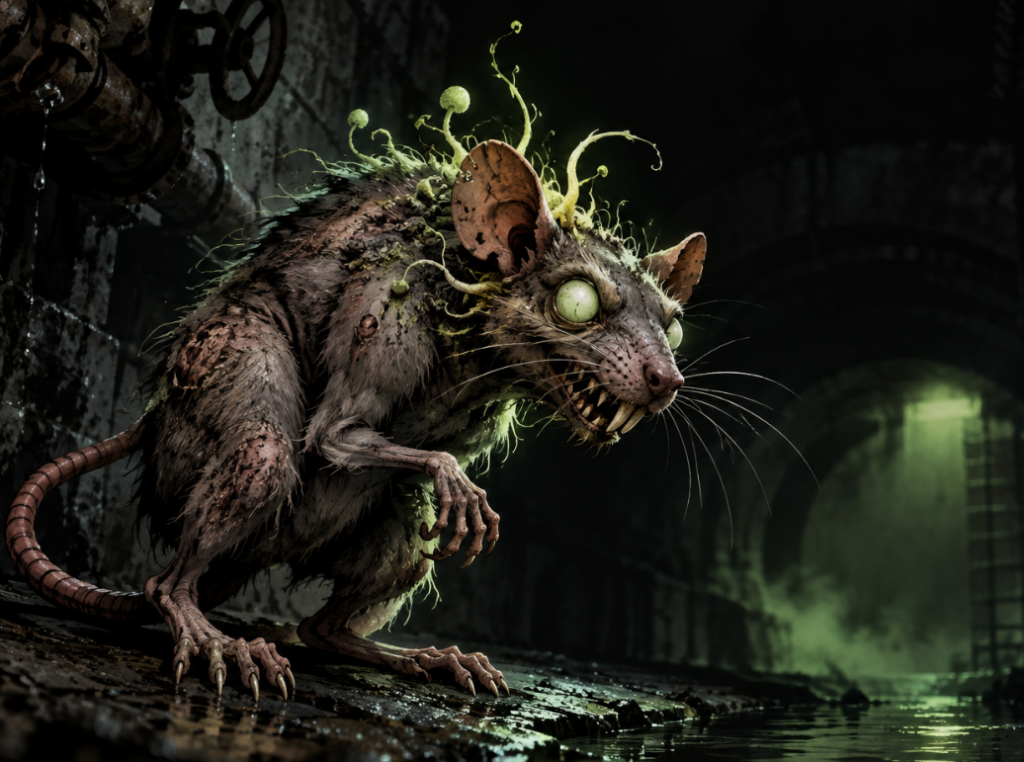
Picture a rat moving through the darkness.
Somewhere nearby, a cat waits.
The rat cannot see it, but it doesn’t need to. A trace of cat odor is enough. Millions of years of evolution have equipped the rat’s nervous system with a simple message: cat smell means danger.
Normally, the rat would turn away.
But this rat doesn’t.
It moves closer.
Something has changed inside its body, changing the meaning of one of the most important signals in its world. The smell of a predator no longer produces quite the same fear.
And the possible culprit is a microscopic passenger living inside the rat.
The parasite is called Toxoplasma gondii, and its strange relationship with rodents is one of the closest things nature has given us to a real-life zombie story.
It is not alone.
Fungi cause ants to abandon their colonies, climb vegetation, clamp their jaws onto plants, and die in positions that help the fungus reproduce. Parasites can change how their hosts respond to predators. And there is rabies, a virus that attacks the mammalian nervous system and can produce agitation, confusion, hallucinations, and aggressive behavior.
None of these creatures creates the shambling undead of horror movies.
What they reveal may be more interesting.
They show us that behavior—the thing we often experience as deeply personal—can sometimes be altered by organisms hiding inside another animal’s body.
And that raises a wonderfully uncomfortable question:
If a parasite can change what an animal wants, fears, or does, where does the parasite end and the host begin?
The Rat That Stopped Fearing Cats
To understand nature’s version of the zombie story, we have to return to our rat.
Toxoplasma gondii is a single-celled parasite found worldwide. It can infect many warm-blooded animals, including humans, but cats are special.
Cats are the parasite’s definitive hosts—the animals in which Toxoplasma can complete the sexual stage of its life cycle.
That creates an interesting evolutionary problem. If Toxoplasma is living inside a rat, somehow getting that rat into a cat would be extremely useful. Researchers began wondering whether the parasite might have evolved a disturbing solution.
What if it changed the rat’s behavior?
In a famous 2000 experiment, researchers Manuel Berdoy, Joanne Webster, and David Macdonald studied how infected rats responded to cat-related odors. Healthy rats normally avoid signs of cats.
The infected rats behaved differently. Their normal avoidance was reduced, and in some situations the animals appeared attracted to areas associated with cat odor.
Later experiments made the story even stranger. Researchers found that chronic Toxoplasma infection could alter a rodent’s reaction to feline odors while leaving several other behaviors relatively intact. The infected animals could still move, smell, learn, and behave normally in many situations.
But one ancient fear had changed.
The smell of a cat.
A severely sick animal can behave strangely for countless reasons. Fever, pain, inflammation, brain damage, or weakness can all change behavior.
But an animal that behaves relatively normally until it encounters one very specific evolutionary threat is much harder to explain as simply “sick.”
This is why Toxoplasma has become one of the most famous examples of possible adaptive host manipulation.
The parasite does not need to know what a cat is. It does not need a plan. It certainly does not need to sit inside the rat’s skull thinking, Go toward the cat.
Natural selection requires none of that.
If parasites that slightly altered rodent behavior were more likely to end up inside cats—and therefore reproduce—those parasite traits could become more common over many generations.
No intelligence required.
Just evolution.
And Toxoplasma is only the beginning.
The Ant That Becomes a Fungal Launchpad
Deep inside tropical forests, another version of the story unfolds.
This one looks much more like a horror movie.
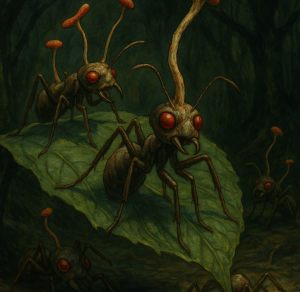
Certain fungi belonging to the Ophiocordyceps unilateralis complex infect carpenter ants.
At first, the ant continues to act like an ant. Then its behavior begins to change. An infected ant may leave its colony’s normal routines. It moves into vegetation and eventually performs an eerie, highly stereotyped action: it bites down onto plant material and locks itself in place.
Then it dies.
Its corpse has effectively become part of the fungus’s reproductive machinery. The fungus continues developing inside the dead ant and eventually produces structures that help disperse spores, potentially infecting new hosts below.
Scientists call these insects “zombie ants,” and it is easy to understand why.
But the most interesting part of the story may be what researchers discovered when they looked inside them.
You might imagine fungal cells invading the ant’s brain and operating it like a biological puppet.
That would certainly make for a satisfying horror story.
Nature did something stranger.
In a 2017 study, researchers used three-dimensional imaging and machine-learning-assisted analysis to map fungal cells throughout manipulated ants.
The fungus was everywhere.
Fungal cells surrounded muscle fibers and formed extensive networks through the ant’s body.
Yet researchers found a striking absence of fungal cells inside the brain itself.
The fungus appeared capable of producing extraordinary behavioral changes without physically invading the brain.
That discovery changes how we think about biological control.
The brain is not an isolated command center floating above the rest of the body. Behavior emerges from an entire system: sensory organs, nerves, hormones, immune signals, muscles, chemical messengers, and the brain itself.
Change enough pieces of that system and you may change what the animal does.
Research on Ophiocordyceps suggests that the fungus may use several of those routes at once. Scientists have found evidence of altered chemical signaling, interactions with muscle tissue, changes in sensory systems, and fungal metabolites that could affect host physiology.
In other words, a parasite may not need to crawl into the driver’s seat.
It may only need access to the controls.
The Hidden Handles of Behavior
This is where zombie biology becomes more than a collection of creepy animal stories.
It becomes neuroscience.
We tend to talk about behavior as though it begins with a decision.
- I am afraid.
- I am hungry.
- I want to go there.
- I choose to move.
But underneath those experiences is an enormous amount of biological machinery.
Sensory organs collect information. Brain circuits assign meaning to it. Neurotransmitters influence motivation and reward. Hormones adjust stress and arousal. Motor neurons send signals to muscles. Immune molecules can influence mood and behavior.
What we experience as one smooth decision is the final result of countless biological events.
Parasites have had millions of years to stumble upon ways of interfering with those events.
Toxoplasma offers one particularly strange example.
Researchers studying infected rats found altered activity in brain regions involved in defensive behavior and sexual attraction when the animals encountered cat odors.
This does not mean an infected rat literally falls in love with a cat.
The real possibility is more subtle.
The smell’s emotional value may have changed.
A signal that once meant danger may no longer produce the same response.
Researchers have also investigated dopamine, a chemical messenger involved in movement, motivation, learning, and reward. Studies have reported changes in dopamine metabolism in Toxoplasma-infected neural cells.
But here we need to resist the temptation to turn an intriguing clue into a solved mystery.
Scientists still lack a complete molecular explanation for Toxoplasma’s behavioral effects.
And this is where real zombie science separates from zombie headlines.
The evidence is fascinating.
It is also complicated.
Rabies: The Zombie Virus That Isn’t Really Mind Control
Then there is rabies.
Rabies often comes up in discussions of real-life zombies because its symptoms seem almost designed for horror.
The virus infects mammals and travels through the nervous system. Once it reaches the brain and spinal cord, it can cause catastrophic neurological disease.
In furious rabies, an infected person or animal may become agitated, hyperactive, confused, or aggressive. Hallucinations can occur. Swallowing becomes difficult. The disease eventually progresses toward death.
There is also a paralytic form of rabies, in which weakness and paralysis become dominant.
That difference is important.
It is tempting to imagine rabies as a virus that has evolved a simple command:
Bite something.
After all, rabies can spread through infected saliva, often following a bite.
But that clean evolutionary story runs ahead of what the evidence can prove.
Rabies causes severe neurological dysfunction. An infected brain is not necessarily executing a precise behavioral program. Some frightening behaviors associated with the disease may help transmission, but agitation and aggression can also arise from catastrophic damage to the nervous system.
That makes rabies different from the cleanest examples of parasite manipulation.
And it introduces one of the hardest problems in this entire field:
How do we know when a parasite is manipulating a host rather than simply making it sick?
When Does Sickness Become Mind Control?
Suppose an infected animal begins behaving strangely.
That alone proves very little.
Maybe the parasite changed its behavior because doing so increases transmission.
Or maybe the animal has a fever.
Maybe its brain is inflamed.
Maybe its muscles are damaged.
Maybe the behavior is part of the host’s own defense against infection.
Maybe the parasite benefits from the change, but the change did not evolve specifically for that purpose.
Scientists therefore set a much higher bar for claims of manipulation.
The most convincing cases tend to involve behaviors that are surprisingly specific and appear closely connected to the parasite’s life cycle.
That is what makes the Toxoplasma rat so intriguing.
Losing fear of many things would simply make a rat reckless.
Changing its response specifically to a predator that happens to be essential to the parasite’s reproductive cycle is much more interesting.
The same logic applies to zombie ants.
An infected ant does not simply stagger around until it dies.
Its final behavior places its body in an environment favorable to the fungus.
That kind of precision is one reason scientists take host manipulation seriously.
But even then, researchers remain cautious.
Evolution produces messy systems. Not every strange symptom is a parasite’s master plan.
Sometimes a sick ant is just a sick ant.
So Is This Really “Mind Control”?
This brings us to the word everyone wants to use.
Mind control.
It is a fantastic phrase.
It is also scientifically dangerous.
Changing behavior is not necessarily the same thing as controlling a mind.
Nor is it the same as controlling consciousness.
Consciousness remains one of neuroscience’s deepest unsolved problems. Researchers can study which brain systems are associated with conscious experiences, perception, attention, decision-making, and awareness.
But there is no known single location in the brain that contains “the self.”
No tiny command room sits there pulling levers.
That makes the zombie-ant findings especially interesting.
The fungus can apparently produce dramatic behavioral changes without fungal cells invading the ant’s brain.
But that tells us almost nothing about what the ant experiences.
Does the ant feel compelled?
Is it confused?
Does it experience anything unusual at all?
We don’t know.
Scientists can observe behavior.
Conscious experience is another question entirely.
The parasites do, however, reveal something unsettling about agency.
Behavior has handles.
Fear has chemistry.
Motivation has circuitry.
Movement depends on electrical signals and muscles.
Change those systems and you can change behavior without needing to replace some mysterious inner “self.”
Perhaps that is what makes these organisms so disturbing.
They remind us that the line between biology and behavior is much thinner than it feels from inside our own heads.
And Then There Are Humans
At this point, one question is probably waiting in the shadows.
Could any of this happen to us?
The answer depends heavily on what we mean. Can infectious organisms affect the human brain and behavior?
Absolutely. Rabies proves that dramatically.
Can Toxoplasma gondii infect humans? Yes.
The Centers for Disease Control and Prevention estimates that tens of millions of people in the United States carry T. gondii. Most people with healthy immune systems develop no noticeable symptoms.
But toxoplasmosis can become serious, particularly during pregnancy and in people with weakened immune systems. It can damage the brain, eyes, and other organs.
What has not been demonstrated is the science-fiction version of the story: Toxoplasma turning humans into behavioral puppets.
Studies have investigated possible links between Toxoplasma infection and human behavior, personality, risk-taking, and psychiatric conditions. But findings in rodents cannot simply be transferred to humans.
A rat approaching cat odor is not evidence that a parasite secretly controls human decisions.
That leap makes a good headline.
It does not make good science.
The same problem appears with zombie-ant fungi.
Could Ophiocordyceps suddenly evolve and turn humans into fungus-controlled zombies?
No evidence supports such a pathway.
The relationship between these fungi and their insect hosts is highly specialized. Research suggests that some Ophiocordyceps fungi respond differently even to different ant species.
That degree of specialization tells us something important.
The fungus is not carrying a universal “control any brain” weapon.
It is part of an intimate evolutionary relationship shaped around particular hosts.
The zombie ant is frightening precisely because it is so specialized—not because it looks like the first chapter of a human apocalypse.
The Zombie Apocalypse We Already Live In
Return one last time to the rat. It catches the smell of a cat. For another rat, that smell might trigger an immediate retreat. For this one, something is different.
Somewhere between odor entering the nose and behavior emerging from the body, biology has changed the message.
Perhaps that is the common thread running through all of nature’s “zombies.”
The fungus does not need to become the ant. Toxoplasma does not need to become the rat. Rabies does not need to invent a second personality inside its host.
These organisms only need to interfere with systems that were already there.
A sensory signal.
A chemical pathway.
A muscle.
A nerve.
A fear response.
Evolution does the rest.
That is both less dramatic and more disturbing than the Hollywood version of mind control.
No parasite sits behind the eyes pulling tiny strings.
Something stranger exists: a biological machine complicated enough to produce behavior, and another organism that has evolved ways to reach inside that machinery and change what happens next.
Nature’s zombies show us that consciousness can be stolen.
They show us something much more concrete.
Behavior has handles.
And evolution has had a very long time to discover where some of them are.
References
Berdoy, M., Webster, J. P., & Macdonald, D. W. (2000). Fatal attraction in rats infected with Toxoplasma gondii. Proceedings of the Royal Society B: Biological Sciences, 267(1452), 1591–1594. https://doi.org/10.1098/rspb.2000.1182
Centers for Disease Control and Prevention. (2025, March 11). About toxoplasmosis. U.S. Department of Health and Human Services.
Centers for Disease Control and Prevention. (2025). About rabies. Centers for Disease Control and Prevention.
de Bekker, C., Ohm, R. A., Loreto, R. G., Sebastian, A., Albert, I., Merrow, M., Brachmann, A., & Hughes, D. P. (2015). Gene expression during zombie ant biting behavior reflects the complexity underlying fungal parasitic behavioral manipulation. BMC Genomics, 16, 620. https://doi.org/10.1186/s12864-015-1812-x
de Bekker, C., Quevillon, L. E., Smith, P. B., Fleming, K. R., Ghosh, D., Patterson, A. D., & Hughes, D. P. (2014). Species-specific ant brain manipulation by a specialized fungal parasite. BMC Evolutionary Biology, 14, 166. https://doi.org/10.1186/s12862-014-0166-3
Doherty, J.-F. (2020). When fiction becomes fact: Exaggerating host manipulation by parasites. Proceedings of the Royal Society B: Biological Sciences, 287, 20201081.
Dubey, J. P., Miller, N. L., & Frenkel, J. K. (1970). The Toxoplasma gondii oocyst from cat feces. Journal of Experimental Medicine.
Fredericksen, M. A., Zhang, Y., Hazen, M. L., Loreto, R. G., Mangold, C. A., Chen, D. Z., & Hughes, D. P. (2017). Three-dimensional visualization and a deep-learning model reveal complex fungal parasite networks in behaviorally manipulated ants. Proceedings of the National Academy of Sciences of the United States of America, 114(47), 12590–12595. https://doi.org/10.1073/pnas.1711673114
House, P. K., Vyas, A., & Sapolsky, R. M. (2011). Predator cat odors activate sexual arousal pathways in brains of Toxoplasma gondii infected rats. PLOS ONE, 6(8), e23277. https://doi.org/10.1371/journal.pone.0023277
Hughes, D. P., Andersen, S. B., Hywel-Jones, N. L., Himaman, W., Billen, J., & Boomsma, J. J. (2011). Behavioral mechanisms and morphological symptoms of zombie ants dying from fungal infection. BMC Ecology, 11, 13. https://doi.org/10.1186/1472-6785-11-13
Koch, C., Massimini, M., Boly, M., & Tononi, G. (2016). Neural correlates of consciousness: Progress and problems. Nature Reviews Neuroscience, 17(5), 307–321. https://doi.org/10.1038/nrn.2016.22
Prandovszky, E., Gaskell, E., Martin, H., Dubey, J. P., Webster, J. P., & McConkey, G. A. (2011). The neurotropic parasite Toxoplasma gondii increases dopamine metabolism. PLOS ONE, 6(9), e23866. https://doi.org/10.1371/journal.pone.0023866
Vyas, A., Kim, S.-K., Giacomini, N., Boothroyd, J. C., & Sapolsky, R. M. (2007). Behavioral changes induced by Toxoplasma infection of rodents are highly specific to aversion of cat odors. Proceedings of the National Academy of Sciences of the United States of America, 104(15), 6442–6447. https://doi.org/10.1073/pnas.0608310104
World Health Organization. (2026, September 17). Rabies. WHO Fact Sheet.
World Health Organization. (2026). Rabies: Overview.