From Teen Steps to Quantum Photons: 8 Science Stories to Watch
What happens to the teenage brain when kids walk more? Could a common antidepressant affect survival during cancer treatment? Why would scientists deliberately lose photons in a quantum experiment?
Those questions all surfaced in recent research.
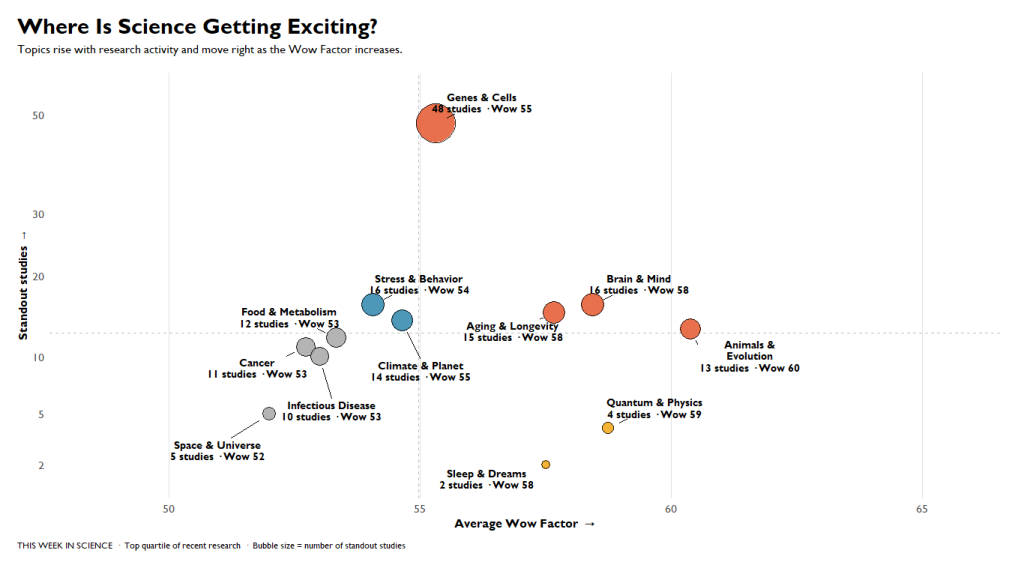
This week’s science stretches from hospital delivery rooms to the developing brain, from individual cells to quantum light. Some findings point toward practical questions we can ask right now. Others offer an early glimpse of technologies and treatments that could take years to develop.
Here are eight studies that caught our attention.
1. A Hospital’s C-Section Rate May Depend on How You Count
Imagine two hospitals. One appears to perform far more cesarean deliveries than the other. Does that mean its doctors are more likely to perform C-sections?
Maybe. But first you need to know who is giving birth there.
A study in JAMA Network Open examined childbirth hospitalizations across 1,231 U.S. hospitals using the 2022 National Inpatient Sample. Across all births, the average cesarean delivery rate was 32.1%.
Then the researchers narrowed their focus.
Among 330,977 deliveries considered “low risk” under criteria from the Society for Maternal-Fetal Medicine, the average rate dropped to 13.5%. After adjusting for factors including age, obstetric conditions, and statistical reliability, it fell to 10.4%.
More importantly, hospital rankings changed depending on the measure researchers used.
When researchers compared two versions of the low-risk measure, however, the picture became much more stable. About 86% of hospitals in the lowest quartile stayed there after adjusting for reliability. Overall, 83.2% of hospitals had rates considered “as expected,” while 10.2% were higher than expected and 6.6% were lower.
Geography also stood out. Hospitals in the Midwest and West had lower adjusted rates than those in the Northeast.
The interesting part: Hospital rankings can look very different when researchers change who counts in the comparison. A simple percentage may tell only part of the story.
2. More Steps, Fewer Mental Health Problems?
Here is a refreshingly simple question: What if adolescents just walked more?
Another JAMA Network Open study followed 5,515 adolescents participating in the Adolescent Brain Cognitive Development Study. The participants were nearly 12 years old on average and wore activity trackers for three weeks.
Kids who accumulated more daily steps tended to report fewer mental health problems.
But the researchers found something else.
Higher step counts were also associated with greater cortical thickness in two areas of the brain: the paracentral region and the rostral anterior cingulate. Differences in paracentral cortical thickness statistically explained part of the relationship between physical activity and fewer mental health problems one year later.
That does not mean the study proved that walking changed children’s brains and improved their mental health. This was an observational relationship, and statistical mediation cannot establish that chain of cause and effect by itself.
Still, one feature of the results is especially intriguing: researchers did not find an obvious point where additional steps stopped being associated with better outcomes.
The interesting part: There was no magic 10,000-step line. Across the range researchers observed, more movement was associated with better outcomes. That raises a practical possibility worth studying further: meaningful physical activity may begin well before someone reaches an ambitious fitness goal.
3. Scientists Watched Brain-Supporting Cells Choose Their Futures
Neurons get most of the attention when people talk about the brain. Glial cells do much of the supporting work that keeps nervous systems developing and functioning.
Using single-cell methods, they followed glial cells from larval development through adulthood. The resulting cellular atlas allowed researchers to trace how different populations changed over time.
One larval cell population, called neuropil glia, appeared to split during the pupal stage and develop into two adult types: ensheathing glia and astrocyte-like glia. The researchers then experimentally tested these developmental paths and identified genetic markers associated with the transition.
They also discovered something happening inside individual cells.
A glial cell’s main body and its thin processes contained different messenger RNAs. That suggests cells can send particular molecular instructions to specific locations instead of distributing everything evenly.
The interesting part: A cell is not simply a bag of biological instructions. Its internal geography may help determine where particular jobs get done.
4. What Happens When Quantum Photons Disappear?
Sometimes losing part of an experiment is the point.
In Science Advances, researchers demonstrated multiport quantum interferometry using what are known as nonunitary transformations. The name sounds intimidating, but the central idea is fascinating.
Quantum experiments often describe systems in which information is preserved. Real optical systems can be messier. Photons can be absorbed or otherwise fail to emerge from the system.
Instead of treating that loss only as a problem, researchers studied what happens to quantum interference under those conditions.
Using a phenomenon called Hong-Ou-Mandel interference, they observed distinctive particle-exchange behavior in both conventional unitary systems and lossy nonunitary ones.
The experiment gives physicists another way to investigate complicated interactions involving quantum light.
This is not a new quantum computer sitting on a laboratory bench. It is a demonstration of a tool that could eventually contribute to areas such as quantum simulation and computation.
The interesting part: Quantum systems do strange things even when pieces of the system disappear. Scientists are learning how to use that messiness rather than simply trying to eliminate it.
5. Two Bone Diseases May Share a Hidden Biological Network
Osteoarthritis damages joints. Osteoporosis weakens bones. They are different conditions, yet they often occur in the same people.
Researchers in PLOS ONE went looking for biological connections between them.
They combined several types of public data, including gene-expression data, protein-interaction networks, and single-cell datasets. Instead of searching for one gene responsible for both conditions, they looked for interconnected biological systems.
Their analysis identified a shared network involving immune signaling, the extracellular matrix, and bone remodeling.
Two proteins, HLA-DRB1 and HSP90AA1, emerged as highly ranked candidates. HLA-DRB1 was particularly stable when the researchers performed virtual “knockout” experiments within their network.
These are computational candidates, not proven treatment targets. Laboratory experiments will be needed to determine whether the predicted relationships hold up in living systems.
The interesting part: Diseases that look separate in the clinic may intersect deep inside biological networks. Mapping those connections could reveal targets that are difficult to see when each disease is studied alone.
6. An Antidepressant Shows an Unexpected Signal in Cancer Treatment
This is the kind of result that deserves attention and caution at the same time.
A PLOS Medicine study examined electronic health records from people receiving immune checkpoint inhibitors, a type of cancer immunotherapy. Researchers compared patients taking selective serotonin reuptake inhibitors, or SSRIs, with those taking benzodiazepines.
SSRI use was associated with lower mortality over two years.
That is an intriguing signal. It is not evidence that cancer patients should begin taking antidepressants to improve their survival.
Electronic health record studies can contain differences between patient groups that researchers cannot fully remove statistically. One particularly important factor, patient performance status, was unavailable. SSRIs and benzodiazepines can also be prescribed to different kinds of patients for different reasons.
Those differences could contribute to the survival pattern.
The interesting part: A medication developed for one purpose may interact with health in unexpected ways. This finding creates a question worth testing prospectively, rather than an answer ready for the clinic.
7. Could Tumor Stress Make CAR T-Cell Therapy Work Better?
CAR T-cell therapy has transformed treatment for some blood cancers. Solid tumors, including pancreatic cancer, have been much harder to crack.
A Science Advances study approached the problem from inside the tumor.
Researchers used CRISPR screens, single-cell genomics, and mouse models to identify tumor pathways associated with sensitivity to CAR T-cell treatment. Disrupting two genes, Keap1 and Slc33a1, made tumors more vulnerable to the therapy in living models.
The Nrf2 stress-response pathway also emerged as an important part of the story. Activation of this pathway was associated with greater susceptibility to CAR T cells.
That suggests treatment response may depend partly on the internal state of the tumor itself.
The work remains preclinical. Results in cells and mice can point researchers toward promising mechanisms without guaranteeing the same effect in people.
The interesting part: Making CAR T cells better may be only half of the equation. Scientists may also be able to change the tumor so that it becomes easier for those engineered immune cells to attack.
8. Can Epidemic Models Learn as an Outbreak Changes?
One of the great frustrations of the COVID-19 pandemic was that the virus, human behavior, public policy, immunity, and testing patterns were all changing at the same time.
A model built for yesterday’s outbreak could quickly become a poor description of tomorrow’s.
Their best short-term approach reached an R² of 0.87 when predicting one week ahead.
That is promising, but there are limits. The analysis was retrospective and came from a single German region. A model that describes one outbreak well does not automatically transfer to another disease, population, or public health system.
Still, the approach points toward a different philosophy of epidemic modeling.
The interesting part: Instead of assuming that the mathematical rules of an outbreak stay fixed, future models may be able to adapt as the outbreak itself changes.
This Week’s Bigger Picture
These eight studies operate on wildly different scales.
One asks how we should compare hospitals. Another tracks the relationship between walking, mental health, and the developing brain. Others follow individual cells, map disease networks, manipulate tumors, model epidemics, or send photons through strange quantum systems.
That variety is part of what makes a week in science so interesting.
Some of these findings are close to practical questions people face today. Others are early-stage discoveries whose applications remain uncertain. The exciting part is watching scientists develop sharper tools for seeing things that were previously difficult to detect: differences hidden inside hospital statistics, molecular instructions inside cells, vulnerabilities inside tumors, and even unusual behavior emerging from quantum light.
Next week, the picture will change again.