
Timewave Zero: Did Terence McKenna Find a Fractal Clock Counting Down History?
Not just a rhythm in the poetic sense, but a hidden mathematical beat—one that controls when civilizations rise, technologies explode, empires crack, and reality itself becomes increasingly strange.
That was the dazzling possibility behind Timewave Zero, one of the most peculiar attempts ever made to turn mystical revelation, ancient Chinese divination, computer mathematics, fractals, psychedelics and the philosophy of history into a single theory.
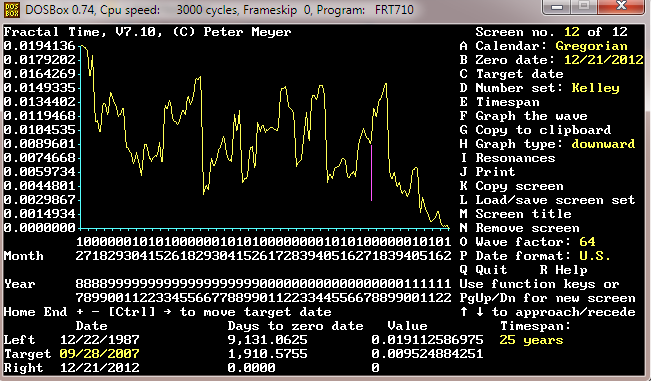
Its creator, psychedelic thinker Terence McKenna, proposed that time does not flow with a constant qualitative texture. Instead, it swings between “habit” — stability, repetition and conservation — and “novelty” — change, complexity and the arrival of genuinely new forms. According to McKenna, the balance was shifting. Novelty was accelerating. History was being squeezed into shorter and shorter bursts of transformation until the whole process would reach zero on a particular date.
Eventually, that date became December 21, 2012.
The world did not end.
But does that automatically make the entire idea worthless? Or is there something scientifically interesting hiding inside one of the strangest graphs ever aimed at human history?
A psychedelic clock built from the I Ching
Timewave Zero did not begin in a physics laboratory.
Its roots stretch back to a 1971 psychedelic experiment involving Terence McKenna, his brother Dennis, and their companions at La Chorrera in the Colombian Amazon. The brothers later tried to explain their extraordinary experiences in The Invisible Landscape, first published in 1975. Historian of religion Wouter Hanegraaff identifies that book’s “Eschaton Timewave” as an important early source of the later 2012 millenarian movement.

The crucial object was the I Ching, the ancient Chinese Book of Changes. Its divination system uses 64 symbols called hexagrams. Each consists of six broken or unbroken lines, traditionally associated with yin and yang.
McKenna became fascinated with the standard King Wen ordering of those 64 hexagrams. He attempted to assign numbers to the amount of change between successive symbols. Since 64 hexagrams contain 384 individual lines, those transformations produced a numerical sequence from which he believed he could extract a deeper pattern.
Here came the enormous leap: What if the sequence was not merely an artifact of an ancient divination system? What if it encoded the structure of time itself?
In McKenna’s model, the resulting wave could be projected across cosmic and human history at multiple scales. Similar shapes would reappear over shorter and shorter periods. Events separated by vast spans of time might therefore be “resonant” with one another.
The final destination was an eschaton -> a point at which the wave reached zero, and novelty became effectively infinite.
That sounds like mystical poetry. McKenna nevertheless spent years trying to give it mathematical machinery. The model was later implemented in computer software, and mathematicians including Matthew Watkins became involved in examining its construction. Watkins had a Ph.D. in mathematics and eventually produced the critique that would become known as the “Watkins Objection.”
So the weird question became a serious one: Did the numbers actually justify the cosmic story?
How Timewave Zero was supposed to work
Strip away the psychedelic language and Timewave Zero has a recognizable structure.
First, convert the King Wen sequence into numerical values based on changes among its lines. Next, transform those values into a waveform. Then reproduce related versions of that pattern at different time scales. Finally, place that wave over actual history so that dips and rises can be compared with periods of novelty and habit.
The fractal-like scaling was central. A section of the wave could resemble a larger section, creating what McKenna called temporal resonance. In this picture, history was almost like a melody repeating itself at faster tempos.
And there is the first seductive piece of genuine mathematics: self-similarity really exists.
Benoit Mandelbrot’s landmark work on fractal geometry showed how complex objects can exhibit similar statistical structure at different scales. His famous 1967 paper on the coastline of Britain described curves whose measured complexity changes with scale and introduced fractional dimension to characterize such forms. Fractals became powerful tools in mathematics and the sciences.
But a self-similar mathematical object does not mean history is.
A fern can display fractal structure. Coastlines can have scale-dependent geometry. Certain physical systems can generate strange attractors. None of that establishes that the Protestant Reformation, Hiroshima, the invention of the microchip and tomorrow’s headlines occupy predetermined positions in a cosmic novelty waveform.
Another problem hid in plain sight: Where should the graph be placed?
McKenna acknowledged that the endpoint’s position determines where every other point on the wave falls. In an August 1997 seminar at California’s Esalen Institute, he explicitly told his audience that an endpoint had to be chosen and that he was using December 21, 2012. He even offered 11:18 a.m. GMT as the moment of the eschaton.
That is not a small technical detail. It is the hinge on which the predictive claim turns. If you can move the ruler until its markings line up with interesting events, are you discovering a pattern — or manufacturing one?
The real science hiding inside the weirdness
Timewave Zero borrowed the atmosphere of several legitimate scientific revolutions, especially chaos theory, complexity, and fractal mathematics.
Chaos theory had already shattered a simple assumption about predictability. In 1963, meteorologist Edward Lorenz showed that deterministic nonlinear systems can be extremely sensitive to small differences in starting conditions. Two nearly identical initial states can eventually produce very different trajectories. That insight became foundational to modern chaos theory and to understanding limits on long-range prediction.
But chaos theory does not say that seemingly chaotic events secretly follow a prewritten historical timetable.
In fact, Lorenz’s work points almost in the opposite direction. Deterministic rules can generate behavior that becomes extraordinarily difficult to predict because tiny uncertainties grow. A chaotic system may contain structure without granting us a crystal ball.
Fractals present a similar temptation. Mathematical self-similarity is real, beautiful, and sometimes found in natural systems. Yet seeing a repeating pattern in a graph does not establish what the graph represents. You could create an exquisitely self-similar curve and label its low points “historical novelty,” but the label would remain an assumption until independently measured data showed that the curve tracked something real.
And that word — novelty — is Timewave Zero’s greatest scientific difficulty.
How much novelty was the invention of movable type worth? More or less than the Black Death? Does the French Revolution score above the discovery of DNA? Is the first iPhone a local dip in the wave, while the fall of Constantinople is a deeper one?
Science can study fuzzy ideas (and we often do!), but first it must make them measurable. Researchers would need an operational definition of novelty established before looking at the Timewave. Independent observers would need to code historical events by those rules. The model’s endpoint and mathematical parameters would need to be fixed in advance. Its predictions would then have to be tested against data it had not been fitted to.
That is where Timewave Zero never became a scientific theory in the strong sense. It remained a fascinating hypothesis wrapped around a quantity that was never objectively measured.
Does the wave actually predict history?
This is where the Timewave enters the laboratory — and the laboratory door slams shut.
McKenna pointed to historical events that appeared to coincide with movements in the curve. The twentieth century was particularly attractive territory: world wars, nuclear weapons, computing, biotechnology, mass communications and the internet certainly make modern history feel as though change has accelerated.
That intuition is not absurd. Technological systems can build on earlier technologies, populations can generate more inventors and communication networks can spread innovations faster. Plenty of real processes produce accelerating-looking curves.
But “history seems to be speeding up” is not the same claim as “this particular I Ching-derived waveform predicts history.”
To demonstrate the second claim, investigators would need a predefined event database and a statistical procedure to decide whether major events cluster near predicted novelty points more often than chance allows. They would also need comparison models: randomized event dates, alternative wave placements, different definitions of importance and corrections for the many possible historical matches one could search.
No peer-reviewed validation establishing such predictive performance emerged from the material reviewed for this article.
Worse, the mathematical foundation itself faltered.
Watkins examined the construction of the wave and argued that important steps could not be rigorously justified from the King Wen sequence. His essay carried the wonderfully lethal title Autopsy for a Mathematical Hallucination? Hanegraaff’s scholarly account describes Watkins as finding the mathematics in The Invisible Landscape worryingly arbitrary and mathematically clumsy. According to Watkins’ account, McKenna eventually understood how serious the objection was.
The endpoint created another statistical red flag. Hanegraaff’s reconstruction shows that the theory’s historical placement depended strongly on the belief that modern civilization was approaching a climax. In other words, the feeling that history was reaching an extraordinary endpoint helped determine how the waveform was positioned — after which the positioned waveform was presented as evidence that history was approaching an extraordinary endpoint.
That is circularity wearing a very impressive mathematical hat.
There is also an intriguing wrinkle in the 2012 date itself. McKenna’s eschatological ideas preceded the popular Mayan-2012 craze. The exact December 21 date became entangled later with interpretations of the Maya Long Count. Scholarship on the 2012 phenomenon found little factual basis for the New Age claim that ancient Maya expected an apocalyptic global transformation on that date.
NASA likewise emphasized before 2012 that the Maya calendar was not physically forecasting Earth’s destruction and that the astronomical disaster scenarios associated with the date lacked credible evidence.
Then December 21, 2012 arrived. No detectable singularity of infinite novelty, no collapse of ordinary time, and no transformation of physical law. For a model tied to a sharply specified endpoint, that is a formidable failed prediction.
Why does Timewave Zero feel so convincing?
Here the story becomes less about cosmic mathematics and more about the wonderfully strange machine between our ears.
Human beings are pattern-finders. Usually that is an advantage. Finding regularities lets us recognize faces, learn language, track seasons and detect danger.
But the machinery can overshoot.
Psychologists use terms such as illusory pattern perception for cases in which people perceive meaningful relationships among unrelated or random information. In six experiments published in Science, Jennifer Whitson and Adam Galinsky found that participants experiencing reduced control became more likely to see images in noise, detect illusory correlations, endorse conspiratorial connections, and develop superstitious interpretations.
Then there is confirmation bias: our tendency to seek, interpret, or remember evidence in ways that favor an existing belief. Raymond Nickerson’s major review described it as a pervasive feature of human reasoning appearing in many forms and settings.
Timewave Zero creates unusually fertile ground for both effects.
Imagine a curve with hundreds of peaks and valleys. Now spread it across thousands of years containing wars, discoveries, migrations, plagues, dynastic changes, religious movements, inventions, and revolutions. Human history gives you an enormous collection of candidate events.
Find a dip near the printing press? Fascinating.
A peak doesn’t seem to fit? Perhaps that period expressed “habit.”
A predicted turn misses the French Revolution? Maybe another event fits better.
Move to a different time scale, reinterpret “novelty,” or choose another historically important milestone, and the search begins again.
This is a classic multiple-comparisons problem in spirit: the more possible matches you can inspect, the easier it becomes to find an impressive-looking one by chance.
A rigorous test prevents that trick by locking the rules before examining the results.
Timewave Zero largely did the reverse: historical interpretation and model fitting grew together.
That does not mean McKenna was simply fooling people. His own later discussions show unusual openness about the criticism. In 1997, he discussed the mathematical objections publicly, admitted the construction needed correction, and repeatedly encouraged listeners to think critically about his ideas. He also acknowledged that the endpoint’s placement controlled the other historical positions.
There is something refreshingly scientific about being willing to let your favorite cosmic machine be taken apart.
Unfortunately, willingness to be wrong does not make the machine right.
The clock hit zero, but the idea did not die
So what is Timewave Zero today?
As science, the evidence is poor. Its central variable was never independently quantified. Its historical correlations were vulnerable to flexible interpretation and post-hoc fitting. Its mathematical derivation faced a serious technical critique. And its most memorable prediction — a unique endpoint in 2012 — failed.
Yet dismissing the whole episode as mere nonsense misses why it still fascinates people.
McKenna put his finger on a feeling that has only become harder to ignore: modern life really can feel like an acceleration chamber. Artificial intelligence, genetic engineering, planetary communication networks and rapidly shifting technologies make yesterday’s impossible ideas arrive with unsettling speed. McKenna was talking in 1997 about the internet, artificial intelligence, nanotechnology and technological acceleration as signs that civilization was entering qualitatively unfamiliar territory.
That did not make his waveform prophetic. It made him an imaginative futurist who watched genuine trends and fit them into an extraordinary metaphysical story.
Timewave Zero also helped feed the broader cultural mythology surrounding 2012. Scholars tracing that phenomenon distinguish the actual Maya calendrical tradition from the Western New Age interpretations that accumulated around it, while Hanegraaff places McKenna’s earlier timewave ideas near the roots of that millenarian ecosystem.
And perhaps that is Timewave Zero’s most interesting legacy.
It is not a successful scientific theory of time. It is almost a case study in how a theory can look scientific.
It has numbers. It has graphs. It has computer software. It invokes fractals, complexity, attractors, and scaling. It can be compared with real events. It arose during an era when chaos theory was revealing genuinely bizarre forms of order in nature.
But science is not defined by how strange an idea sounds, how sophisticated its graph appears or how many real scientific words surround it.
The decisive question is nastier: What result would prove the idea wrong?
When definitions stay flexible, dates can be fitted, historical events can be selected after the fact, and mismatches can be reinterpreted, a theory becomes hard to defeat—and therefore hard to test.
Timewave Zero reached zero. Reality kept going.
Yet the eerie question that powered McKenna’s experiment survives: Is the pace of change genuinely accelerating, and if so, can science measure that acceleration without turning history into a cosmic horoscope?
Now that would be a weird experiment worth running.
References
Hanegraaff, W. J. (2010). “And end history. And go to the stars”: Terence McKenna and 2012. In C. M. Cusack & C. Hartney (Eds.), Religion and retributive logic: Essays in honour of professor Garry W. Trompf (pp. 291–312). Brill.
Horgan, J. (2012, June 6). Was psychedelic guru Terence McKenna goofing about 2012 prophecy? Scientific American.
Lorenz, E. N. (1963). Deterministic nonperiodic flow. Journal of the Atmospheric Sciences, 20(2), 130–141.
Mandelbrot, B. B. (1967). How long is the coast of Britain? Statistical self-similarity and fractional dimension. Science, 156(3775), 636–638.
McKenna, T. (1991). The archaic revival: Speculations on psychedelic mushrooms, the Amazon, virtual reality, UFOs, evolution, shamanism, the rebirth of the goddess, and the end of history. HarperSanFrancisco.
McKenna, T. (1993). True hallucinations: Being an account of the author’s extraordinary adventures in the Devil’s Paradise. HarperSanFrancisco.
McKenna, T. (1997, August). Our cyberspiritual future [Lecture]. Esalen Institute.
McKenna, T., & McKenna, D. (1975). The invisible landscape: Mind, hallucinogens & the I Ching. Seabury Press.
Nickerson, R. S. (1998). Confirmation bias: A ubiquitous phenomenon in many guises. Review of General Psychology, 2(2), 175–220.
Sitler, R. K. (2006). The 2012 phenomenon: New Age appropriation of an ancient Mayan calendar. Nova Religio: The Journal of Alternative and Emergent Religions, 9(3), 24–38.
Watkins, M. (n.d.). Autopsy for a mathematical hallucination? Fourmilab.
Whitson, J. A., & Galinsky, A. D. (2008). Lacking control increases illusory pattern perception. Science, 322(5898), 115–117.
Yeomans, D. (2009, November 10). 2012—A scientific reality check. NASA Jet Propulsion Laboratory.