
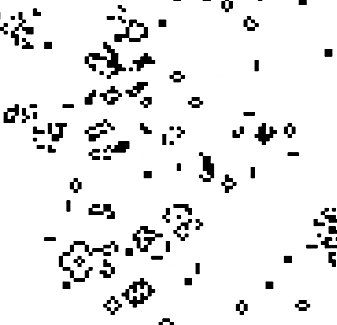
What Are Cellular Automata? How Simple Rules Create Complex Worlds
Imagine a world made of tiny squares. Each square follows a few basic rules. There is no leader, no central plan, and no one telling the squares what to build.
Yet something remarkable happens.
Patterns begin to form. Some grow and spread. Others move across the screen. A few repeat forever, while others disappear almost as quickly as they appear.
This is the world of cellular automata, a branch of mathematics and computer science that helps us explore one of science’s biggest questions:
How can simple interactions create complex behavior?
This has implications far beyond mathematics. Scientists have used cellular automata to study traffic jams, wildfires, infectious diseases, cancer growth, and artificial intelligence.
These simple computer models offer a powerful way to understand how small changes can shape entire systems.
[newsletter_signgup]
What Are Cellular Automata?
A cellular automaton is a mathematical model made of individual units called cells. These cells are usually arranged in a grid, much like squares on a chessboard.
Each cell follows a set of rules that determine what happens next. Most cellular automata share four basic features:
- A grid: The world is divided into individual cells.
- States: Each cell has a condition, such as alive or dead, occupied or empty, or healthy or infected.
- Neighbors: A cell’s behavior depends on its own state and the states of nearby cells.
- Rules: The same instructions determine how cells change from one step to the next.
As time moves forward, the cells update their states.
In a traditional cellular automaton, all cells follow the same rules and update at the same time. Scientists call each update a time step or generation.
What makes these models interesting is that no cell needs to understand the entire system.
Each cell responds to its immediate surroundings. Yet those local interactions can produce large and surprising patterns.
This idea is known as emergence.
Conway’s Game of Life: A Universe Built From Four Rules
One of the most famous cellular automata is Conway’s Game of Life.
British mathematician John Conway developed the game, which became widely known after Martin Gardner introduced it in Scientific American in October 1970.
Despite its name, the Game of Life is not a traditional game. There are no points, levels, or winners.
Instead, it simulates a tiny universe.
Every square on the grid is either alive or dead. Each square has up to eight neighbors, including the squares beside it and diagonally around it.
Four rules control everything:
Rule 1: Underpopulation: A living cell with fewer than two living neighbors dies.
Rule 2: Survival: A living cell with two or three living neighbors survives.
Rule 3: Overpopulation: A living cell with more than three living neighbors dies.
Rule 4: Reproduction: A dead cell with exactly three living neighbors becomes alive.
That’s it.
There are no extra instructions for movement, growth, or organization.
Yet when these rules are applied again and again, the results can be astonishing.
Patterns That Seem Almost Alive
Some arrangements of cells remain unchanged. These are called still lifes.
Others switch between two or more shapes. Scientists call them oscillators.
Then there are gliders.
A glider is a small arrangement of five cells that changes shape as the simulation runs. After four generations, the pattern returns to its original shape but has moved diagonally across the grid.
It looks as though something is traveling through the digital world.
Even more impressive is the Gosper glider gun, a pattern that repeatedly produces new gliders.
None of the individual cells knows how to move or build anything. Movement and production emerge from the rules and the arrangement of cells.
In fact, researchers have shown that the Game of Life can perform universal computation. In principle, carefully arranged patterns can carry out the same kinds of calculations as a general-purpose computer.
All of this comes from four simple rules.
Try it yourself: Explore our interactive Conway’s Game of Life simulator here on This Week in Science. Create your own patterns, start the simulation, and see what happens.
Lesson 1: Complexity Doesn’t Always Require Complex Rules
We often assume that complicated systems must have complicated instructions.
A human body contains trillions of cells. Cities depend on millions of decisions. Ecosystems include countless relationships among plants, animals, microorganisms, and their environments.
It seems reasonable to expect equally complicated rules behind these systems.
But cellular automata challenge that assumption.
Simple rules can sometimes produce remarkably complex outcomes.
Consider a traffic jam.
Each driver may follow a few basic behaviors: maintain a safe distance, speed up when the road is clear, and slow down when another vehicle gets too close.
Yet researchers have shown that simple models of these behaviors can create traffic waves and stop-and-go congestion.
In a landmark 1992 study, Kai Nagel and Michael Schreckenberg developed a cellular automaton model of freeway traffic.
Their work demonstrated how the actions of individual vehicles could produce larger traffic patterns.
No driver needs to decide to create a traffic jam. Congestion can emerge from the interaction of many drivers.
The larger lesson is important: To understand a system, we often need to study how its parts interact, not just the parts themselves.
Lesson 2: Small Local Changes Can Have Large Effects
Imagine placing two nearly identical patterns into Conway’s Game of Life.
In one version, you add just one extra living cell.
At first, the difference seems minor. But after several generations, the two patterns may behave very differently.
One might disappear. Another might settle into a repeating pattern. A third might continue changing for hundreds of generations.
The rules never changed.
Only the starting conditions were different.
This illustrates an important feature of many complex systems: small differences can sometimes lead to large changes over time.
We see related ideas throughout science.
A small change in the location of an infection can influence which people become exposed. A patch of dry vegetation can affect how a wildfire spreads. A minor interruption in traffic can create delays for many vehicles.
Not every small change produces a large effect, of course. Some systems are remarkably stable.
The challenge is understanding when small changes matter and when they do not.
Cellular automata provide a controlled environment for investigating these questions.
Lesson 3: Our Neighbors Shape What Happens Next
One of the most useful ideas in cellular automata is that behavior depends on local surroundings.
In the Game of Life, a cell does not know what is happening across the entire grid.
It responds only to nearby cells.
This simple feature makes cellular automata useful for studying systems where location and proximity matter.
Understanding Infectious Disease
Imagine a grid representing a community.
Each square represents a person who may be susceptible to an infection, infected, or recovered.
Researchers can create rules describing how infection passes between nearby people.
As the simulation runs, clusters of infection may emerge and spread across the grid.
Scientists can then experiment with different assumptions.
What happens if contact between people decreases? What if some people are immune? What if certain neighborhoods have more connections than others?
Researchers have used cellular automata to investigate infectious disease transmission, including how outbreaks change across space and time.
A review of epidemic models in transportation networks describes how these approaches can help researchers visualize disease spread and explore different conditions.
However, real people do not interact only with their immediate neighbors. They commute, travel, attend events, and maintain social connections across long distances.
That is why cellular automata are one tool among many. More detailed models may be needed to capture how real communities interact.
Still, the central lesson remains useful: where people live, move, and connect can influence the spread of disease.
Lesson 4: Patterns Can Form Without a Central Leader
Many natural systems organize themselves without anyone directing the process.
Think about the branching structure of trees, the organization of an ant colony, or the patterns that form as certain crystals grow.
These systems can develop complex structures through many small interactions.
Scientists call this self-organization.
Cellular automata offer a simple way to explore how self-organization might work.
Rather than telling every part of a system exactly where to go, researchers define local rules and watch the patterns that emerge.
This is particularly interesting in biology.
How Do Cells Build a Body?
A developing organism begins with a small number of cells.
As those cells divide and communicate, they form tissues, organs, and complex body structures.
Real biological development involves genes, chemical signals, physical forces, and many other processes. It is much more complicated than Conway’s Game of Life.
But cellular automata can help researchers explore how local communication contributes to larger structures.
In 2020, researchers published an experiment called Growing Neural Cellular Automata.
They combined cellular automata with machine learning to create digital systems that could grow recognizable images from simple starting conditions.
Even more interesting, some of their models could repair themselves after parts of the images were removed.
The researchers trained the systems to respond to damage and rebuild their original patterns.
These were computer experiments, not living tissues or biological organs. Still, they demonstrated how simple local interactions, combined with learned rules, could produce coordinated growth and repair.
That raises an exciting question: Could similar ideas one day help researchers design more adaptable technologies or better understand how living tissues organize and heal?
The research is still developing, but cellular automata provide an interesting starting point.
Lesson 5: Cellular Automata Can Help Us Understand Wildfires
Wildfires are another example of a system shaped by local interactions.
A fire spreads when burning material transfers enough heat to ignite nearby fuel.
Whether the fire continues depends on factors such as vegetation, moisture, wind, and terrain.
Researchers can represent a landscape as a grid.
Each cell might be classified as unburned vegetation, burning vegetation, or burned ground.
Rules then determine whether a burning cell can ignite nearby cells.
By changing the conditions, researchers can explore how fire might spread through different landscapes.
For example, a model may show how gaps in vegetation interrupt fire movement. It might also reveal how wind direction changes the shape of a spreading fire.
A 2026 review of cellular automata wildfire models examines these methods, their strengths, and their limitations.
The models can help scientists investigate fire behavior and compare possible scenarios.
But a simplified grid cannot capture every detail of a real wildfire. Fire behavior depends on changing weather, landscape features, fuel conditions, and other physical processes.
A model can help us understand what might happen under certain conditions. It does not automatically tell us exactly what will happen in the real world.
Lesson 6: Cellular Automata Can Help Researchers Study Cancer
Cancer begins when cells develop changes that affect how they grow, divide, and interact with their surroundings.
But a tumor is more than a collection of individual cancer cells.
Its behavior depends on relationships among cells, available nutrients, oxygen levels, immune responses, and nearby tissues.
These interactions can produce complicated patterns of growth.
Scientists have developed cellular automata to study how tumors grow and change over time.
In some models, each simulated cell responds to conditions in its local environment.
Researchers can explore how limited oxygen, competition for space, or different cell behaviors affect the tumor as a whole.
A study of cellular automata for tumor growth describes how these models can connect individual cell behavior with larger patterns of tumor development.
Other models combine cellular automata with additional mathematical approaches to study more detailed biological processes.
The goal is not to pretend that cancer follows a few simple rules.
Instead, researchers use simplified models to test particular ideas about how cells interact.
When compared with real biological data, these simulations can help scientists develop and evaluate new explanations of disease.
Lesson 7: Simple Rules Don’t Always Make the Future Easy to Predict
Another surprising feature of cellular automata. Even when we know every rule and every starting condition, it may still be difficult to predict what a complicated pattern will do far into the future.
We can run the simulation and observe the result. But finding a shortcut that tells us the answer without carrying out the steps can be much harder.
Knowing the rules of a system is not always the same as being able to predict its future.
Some cellular automata are easy to understand. Their patterns quickly disappear or settle into repeating cycles.
Others produce complicated behavior that can continue for very long periods.
Mathematician and computer scientist Stephen Wolfram helped expand the study of cellular automata by investigating how different rules produce different types of behavior.
One famous example is Rule 30.
Rule 30 is a one-dimensional cellular automaton. Its cells are arranged in a line, and each new generation depends on the cells directly above it.
Despite its simplicity, the rule produces strikingly irregular patterns.
These patterns can look random, even though the system follows fixed instructions.
This does not mean cellular automata prove that every part of nature is unpredictable.
Instead, they show that simple rules are not always enough to make a system’s behavior obvious.
Lesson 8: The Rules We Choose
Cellular automata also teach us an important lesson about scientific modeling.
Every model is a simplified version of reality.
Scientists decide which features to include, which relationships to represent, and which details to leave out.
Those choices shape the results.
Consider a model of infectious disease.
If we assume that people interact only with their nearest neighbors, we may observe one pattern of transmission.
If we allow people to travel across a city or between countries, we might observe something very different.
Neither model is automatically correct.
Each represents a different set of assumptions.
The same challenge appears in wildfire modeling, cancer research, and traffic simulation.
Scientists must ask whether the model’s rules reflect the real system closely enough to answer the research question.
They also need to compare simulation results with observations.
This process is called validation.
A model that creates beautiful patterns may be interesting. But a model intended to guide public health or safety decisions must also be supported by evidence.
The value of a simulation depends not only on what it produces, but on how well its assumptions match the world.
Are Cellular Automata Actually Alive?
Conway’s Game of Life raises a fascinating question.
If digital cells can reproduce, move, interact, and form increasingly complicated structures, are they alive?
The answer is no, at least not according to standard biological definitions of life.
Cells in the Game of Life lack DNA, metabolism, and the biological systems that support living organisms.
The words alive and dead simply describe two mathematical states.
However, the simulation helps us ask deeper questions about what makes living systems special.
How much complexity can emerge from local interactions? What kinds of rules allow a system to maintain its structure? How can organized behavior arise without a central controller?
Researchers also debate whether the universe itself might operate through some form of digital or computational rules.
That remains a speculative idea, not an established scientific fact.
Cellular automata demonstrate what certain mathematical systems can do. They do not prove that reality is a giant computer simulation.
Still, they encourage us to think about how order, information, and complexity might arise.
Try Three Experiments With Conway’s Game of Life
One of the best ways to understand cellular automata is to experiment with them yourself. Our interactive Game of Life simulator lets you create living cells, explore starting patterns, and watch generations unfold. Here are three experiments worth trying.
Experiment 1: Start With Randomness
Fill part of the grid with randomly placed living cells.
Before pressing Play, make a prediction.
Will the population grow, shrink, or remain stable?
Start the simulation and watch what happens.
You may see large groups disappear, small stable shapes survive, and unexpected moving patterns emerge.
Try the experiment several times.
Notice how different starting arrangements can produce different outcomes, even when the rules never change.
Experiment 2: Change Just One Cell
Choose a small pattern and run the simulation.
Then reset the board and add or remove one cell.
Run it again.
Compare the results.
Does the pattern still behave the same way? Does it disappear? Does it form something new?
This experiment shows why starting conditions matter in many complex systems.
Experiment 3: Watch a Glider Move
Select the glider pattern.
Watch how its five cells change through each generation.
After four generations, the pattern has moved diagonally by one square.
The individual cells have not traveled across the grid. Instead, cells in one location die while new cells appear nearby.
The moving shape is a pattern of change.
This is one of the most interesting lessons of the Game of Life: sometimes what appears to be a moving object is actually information passing through a system.
What Cellular Automata Teach Us About the World
Cellular automata are simple mathematical systems, but the questions they raise are anything but simple.
They remind us that large patterns can emerge from small interactions.
They show that the location and connections of individual parts can shape what happens across an entire system.
They reveal how small changes sometimes create large effects, while other systems remain stable despite disruption.
They also remind scientists to be careful with predictions.
Models can help us understand possible outcomes, but their results depend on the assumptions we build into them.
Perhaps the most powerful lesson is that understanding a complex world requires understanding relationships.
A cell’s behavior matters. But so does the environment around it.
The same principle can help us think about ecosystems, human communities, health, and technology.
The Game of Life may begin with a few squares on a screen.
But it invites us to consider much bigger questions about how the world works.
Frequently Asked Questions About Cellular Automata
What is a cellular automaton in simple terms?
A cellular automaton is a computer-based mathematical model where cells follow simple rules. Each cell changes based on its current state and the states of nearby cells. When many cells interact, they can produce complex patterns.
What is Conway’s Game of Life?
Conway’s Game of Life is a cellular automaton created by mathematician John Conway. It uses four rules to determine whether cells survive, die, or become alive. These rules can produce stable shapes, repeating patterns, and moving structures.
What are cellular automata used for?
Researchers use cellular automata to explore complex systems, including traffic flow, infectious disease spread, wildfire behavior, cancer growth, and self-organizing computer systems. They are especially useful for studying how local interactions can produce larger patterns.
Are cellular automata related to artificial intelligence?
Yes. Some researchers combine cellular automata with machine learning to create neural cellular automata. These systems can learn local rules that produce larger patterns, including digital structures that grow and repair themselves.
Can cellular automata predict the future?
They can simulate possible outcomes under specific assumptions. However, a simulation is not automatically an accurate forecast. Reliable predictions require realistic rules, good data, and testing against real-world observations.
Explore the Science Yourself
One of the joys of science is discovering that simple questions can lead to extraordinary ideas.
Cellular automata offer a way to experience that process firsthand.
Start with a few squares. Choose a pattern. Change one cell. Watch what happens.
Then ask yourself why.
Build Your Own Science Issue
Tell us what fascinates you. We’ll search today’s science and build a personalized issue just for you.
Your science issue is being built.
We’re searching today’s research for stories that match your interests. Your personalized issue will arrive in your inbox shortly.
Something went wrong.
We couldn’t build your issue right now. Please try again in a moment.