
Improving Quantum Networks: When Single Photons Collide
Every year, billions of internet messages travel through fiber-optic cables. But in the future, these streams may not just carry data—they could carry entangled photons, linking distant cities with unbreakable quantum security. The catch? Until now, making single photons truly talk to each other was almost impossible.
A new study from Japan’s National Institute of Information and Communications Technology (NICT) reports a breakthrough: they’ve successfully swapped entanglement between two sets of photons using a nonlinear interaction once thought too weak to matter. It’s a step toward global-scale quantum communication and a big win for the dream of all-photonic quantum computers.
Why This Matters Beyond the Lab
To picture the challenge, think of two people shouting across a crowded street in Lagos or São Paulo. Unless they have a translator or megaphone, their words fade into noise. That’s how single photons behave—weak signals that don’t normally “hear” each other.
Until now, scientists worked around this by adding lots of extra equipment—ancillary photons, detectors, and careful post-processing. It worked, but it was like needing a whole orchestra just to play a single note. The NICT team showed that a carefully engineered nonlinear material—a crystal waveguide—can let two independent photons interact directly. It’s the photonic equivalent of finally giving those two people a shared language.
The Science Story: From Theory to “Aha!”
Physicists have long dreamed of using a property called χ(2) (chi-squared) nonlinearity to let photons combine and create a new one at a higher frequency. This “sum-frequency generation” is well-known with lasers, but doing it at the single-photon level? That’s been elusive.
The problem wasn’t theory—it was noise. Early experiments found that background signals from detectors overwhelmed the faint photon-photon interaction. Imagine trying to hear a whisper during a football match in Rio.
The NICT team solved this by combining three clever moves:
- Better detectors: They used superconducting nanowire single-photon detectors with almost no false clicks.
- Stable design: A special crystal waveguide built into a Sagnac interferometer allowed week-long stable data collection without constant adjustments.
- Fast sources: They generated entangled photon pairs at telecom wavelengths in the gigahertz range, speeding up the experiment.
Together, these tweaks created a system where real photon-photon interactions stood out clearly from the noise.
What They Actually Did: Swapping Entanglement
Here’s the heart of the experiment.
- The team started with two separate pairs of entangled photons.
- From each pair, one photon was sent into their special χ(2) waveguide device.
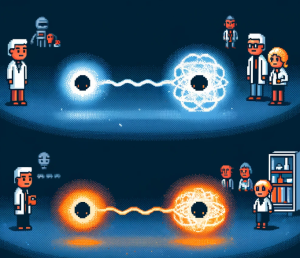
- When those two photons interacted, a new photon of higher frequency appeared—a signal that “entanglement swapping” had occurred.
- The two leftover photons (one from each pair) became entangled, even though they had never touched.
The result was a fidelity of 0.77—well above the classical limit of 0.5, meaning genuine quantum entanglement was achieved..
Why It’s a Big Deal
For decades, scientists relied on linear optics to manage entanglement swapping. It worked but came with trade-offs: lots of wasted photons, noisy results, and a dependence on postselection (throwing away bad data). The χ(2) approach changes the game:
- Faithful entanglement: The swapped states stay closer to ideal, usable immediately for tasks like quantum key distribution.
- Loss tolerance: The system naturally resists some photon losses, a huge advantage in long-distance communication.
- Multi-user networks: Because different-color photons can be entangled this way, it opens paths to linking diverse quantum devices.
In other words, this is not just an experimental curiosity—it’s a potential building block for the quantum internet.
Global Relevance: From Tokyo to Abuja to São Paulo
Why should early-career scientists and professionals outside high-tech hubs care? Because the applications of this research will ripple far beyond Japan.
- In India, where rural telemedicine often struggles with data security, quantum communication could one day protect patient records sent across patchy networks.
- In Nigeria, where universities are building capacity in quantum science, this kind of result shows that practical experiments are possible, not just theory.
- In Brazil, where smart grids and banking already push the limits of cybersecurity, entanglement swapping could form the backbone of next-generation financial security.
This is not just physics for physics’ sake. It’s laying the groundwork for infrastructure that could be as globally transformative as GPS or the internet.
The Twist: Still Some Way to Go
Of course, there’s a catch. The efficiency of the photon-photon interaction is still tiny—on the order of 10⁻⁸. To make this practical, scientists need to boost it by 10 to 100 times. The good news? Advances in new nonlinear materials suggest that kind of leap is realistic within a decade.
In other words, we’re in the “Wright brothers” phase of quantum communication: the plane has left the ground, but it won’t carry passengers just yet.
Let’s Explore Together
This experiment is a milestone, but the story is far from over. It leaves us with big, practical questions:
- Could this method scale up fast enough to secure communications in developing nations before cyberthreats outpace them?
- If you were on the research team, what material or design would you test next to improve efficiency?
- What everyday problem in your community could be transformed if unhackable quantum links became cheap and available?
Quantum science is no longer locked in physics journals. It’s reaching into the way we connect, share, and secure knowledge worldwide. The photons have started to talk—now it’s our turn to listen.