Why Nothing Can Go Faster Than the Speed of Light
Ever heard that nothing can travel faster than light? It’s true, and it’s one of the most fascinating rules in all of physics.
But why does the universe even have a speed limit?
The Fastest Thing in the Universe
Light moves at about 186,000 miles per second (or nearly 300,000 kilometers per second) in a vacuum. That’s fast enough to circle the Earth more than seven times in a single second. This is the fastest speed anything can reach in our universe. It’s not just technology holding us back; it’s the laws of physics themselves.
Why Everyone Measures Light the Same Way
Here’s the weird part: no matter how fast you’re moving, you’ll always measure the speed of light as the same: 186,000 miles per second.
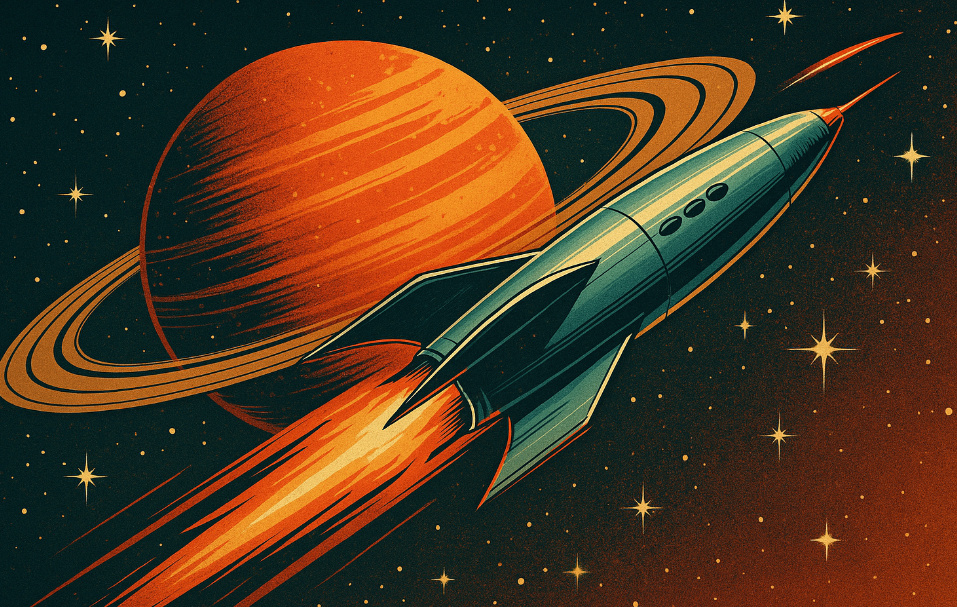
Imagine you’re in a rocket ship blasting through space at nearly light speed, say, 185,000 miles per second. You’d think light coming from your flashlight would move more slowly compared to you. But it doesn’t! Even from your rocket, light still moves away at the same speed.
That’s what Einstein discovered with his theory of special relativity. Space and time aren’t fixed; they stretch and shrink depending on how you move. This bending of time and distance ensures that light’s speed never changes, no matter where you are or how fast you’re going.
Time and Distance Get Weird
When you approach the speed of light, strange phenomena occur.
- Time slows down for you compared to people watching from Earth.
- Distances shrink in the direction you’re traveling.
So if you could somehow zip across one billion light-years in what feels like a second on your ship, people on Earth would see billions of years pass. From your perspective, though, the journey might feel short because space itself would appear compressed. This is called time dilation and length contraction, core effects of relativity that keep light’s speed constant for everyone.
Why There’s a Speed Limit in the Universe
The short answer: because of how space and time themselves are built.
Light’s speed limit isn’t about how powerful your warp drive is it’s about how the fabric of reality works.
1. Space and time are connected
Einstein’s theory demonstrated that space and time form a unified fabric known as spacetime. When you move faster through space, you move slower through time and vice versa. The “speed of light” is the built-in exchange rate between the two.
Everything in the universe moves through spacetime at a constant combined rate. Light, which has no mass, spends all that motion traveling through space. You, with mass, spend most of it moving through time. That balance creates the cosmic speed limit.
2. The laws of nature depend on it
Every law of physics, from gravity to electricity, includes c, the speed of light, as a constant. It’s not just about photons. It’s the maximum rate at which cause and effect can happen.
If anything could move faster, it would break causality. This means you could see an effect before its cause (like receiving a message before it’s sent). The universe doesn’t allow that.
3. Mass resists acceleration
As you speed up, your mass effectively increases, making it harder to accelerate. At light speed, your mass would be infinite, and you’d need infinite energy, which is impossible.
Light can move that fast only because it’s massless.
4. It’s really about spacetime, not just light
The “speed of light” isn’t a property of light itself. It’s a property of spacetime. Light simply travels at that speed because it’s not weighed down by mass. Even if photons didn’t exist, this same speed would define how time and space are connected.
5. The universe needs this rule
Without a speed limit:
- Physics would break down.
- Events could happen out of order.
- Cause and effect would lose meaning.
The speed limit maintains the universe’s consistency and logic — the ultimate cosmic safety rule.
Why You Can’t Go Faster Than Light
Here’s the big catch: when something gets faster, it also gets heavier in a sense as its mass increases. The closer you get to the speed of light, the more energy it takes to keep accelerating. By the time you’d reach the speed of light, you’d need infinite energy, which is impossible.
In short, the universe has a built-in “speed governor.” No matter how advanced your rocket is, you can’t beat light.
What If You Tried?
If you somehow could travel that fast, you’d run into another problem. At such extreme speeds, radiation and light particles would slam into you with unimaginable energy (essentially frying your spacecraft, a phenomenon called relativistic beaming). So even if you could approach light speed, surviving it would be another story.
The Takeaway
The speed of light is the foundation upon which the universe operates. It maintains a delicate balance between space, time, and energy, ensuring consistency for everyone, everywhere.