Mars’ hills keep streaking in the dark—no water needed.
We thought water—turns out, it’s mostly wind.
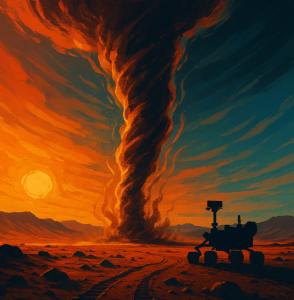
For years, many of us pictured thin films of briny water painting those long, dark lines down Martian hills. This new work flips that story. Think of a kitchen pan sprinkled with cocoa powder: nudge it, and a patch slides, revealing the shiny surface beneath. On Mars, it’s fine dust that avalanches off dusty slopes, leaving darker streaks where fresh, less dusty ground shows through. The twist? The “nudge” is usually not a quake or a meteor. It’s the planet’s seasonal winds kicking sand into motion.
How scientists cracked the case (with 2.1 million clues).
A researcher trained a deep-learning detector (the same family of tools used to spot objects in photos) to scan the entire archive of NASA’s Context Camera (CTX) images taken from 2006 to 2024. The algorithm flagged more than 2.1 million slope streaks across Mars, then mapped them into a fine grid to track where and when new streaks appeared. By pairing images taken months or years apart, the team estimated how fast streaks form, when they peak, and what might be pushing them to start.
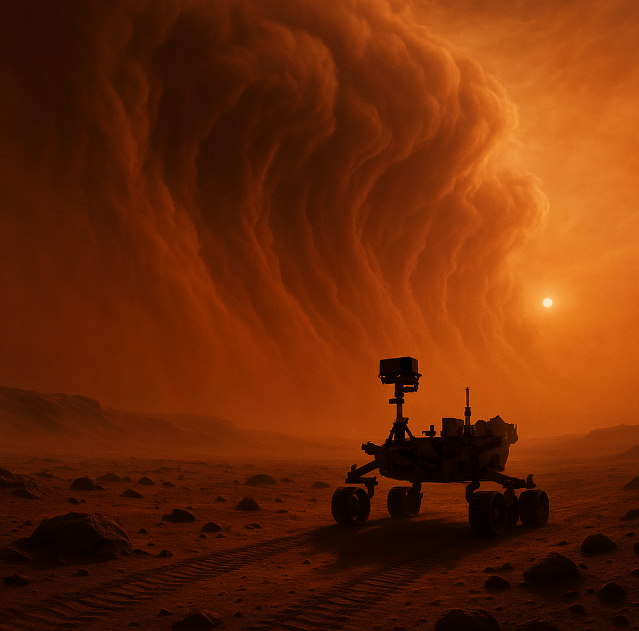
The aha: on average, the streak population grows by about 4–6% per Martian year, but only ~0.1% of new streaks line up with clear one-off events like fresh impact craters or marsquakes. Most of the action lines up with southern summer and autumn, when modeled wind stress crosses a key threshold (~0.02 pascals) that can make sand grains hop like the first domino in a chain, kicking finer dust into motion and triggering mini-avalanches down slopes. Sunrise and sunset seem to be prime time, which might be why cameras rarely catch streaks forming in real time.
From Lagos to Lucknow to Ladakh: why this matters off-planet.
If you’ve walked through a Harmattan dust storm in Nigeria, you know how gritty the air can be, reshaping daily life by coating shops, slowing traffic, and irritating the lungs. On Mars, dust is life: it heats the atmosphere, dims sunlight, and fuels planet-spanning storms. This study suggests that slope streaks could be a significant component of Mars’s dust budget, possibly accounting for a quarter of the yearly dust exchanged between the ground and the sky.
For Earth scientists, that’s a lesson in feedback loops: when surfaces are primed with loose particles and the wind hits a threshold, small triggers can scale up. In India, a researcher in Lucknow might observe the parallel in post-harvest fields that shed soil during pre-monsoon gusts; in Brazil, a lab in Fortaleza tracking dune migration could use similar thresholds to predict when sand starts to move. The shared insight: look for thresholds, not just averages.
Hotspots, seasons, and the power of “just enough.”
The maps point to five busy neighborhoods: Amazonis, Olympus Mons Aureole (OMA), Tharsis, Arabia, and Elysium: all dust-rich and slightly lower in elevation (about 2 km below Mars’s average). The winds there aren’t the strongest on the planet, but they’re strong enough at the right times. It’s like football: you don’t need a gale to score, just the right kickoff speed to send the ball sailing. Once sand starts to hop (scientists call it saltation), it plucks finer dust from the surface, and gravity takes over.
Occasionally, there are “streak storms”: bursts of dozens to hundreds of new streaks between image passes. Some bursts match fresh impact clusters; others may hint at hidden faults shifting underground. That suggests these streaks could become remote sensors for marsquakes, a clever workaround on a planet with few seismometers.
Method in a minute (so you can reuse it).
The study presents a template that any data-savvy lab can adapt: combining AI-based mapping of surface change, time-pairing of images to estimate rates, and simple physics thresholds (here, a wind-stress level that triggers sand movement).
The model isn’t perfect. Regional wind data likely underestimates local gusts, and surface roughness varies a lot. Still, the pattern is robust: when dusty slopes meet just-enough wind at the right season, streaks bloom. If you’re in a resource-limited setting, this approach, smart detection combined with clever proxies, can transform vast public image archives into actionable insights. Start with what’s free, validate a subset by hand, and watch for thresholds that flip systems from “quiet” to “go.” But here’s where it gets interesting…
Why it changes the mission playbook.
If slope streaks are mostly dry dust avalanches, we can prioritize wind and dust monitoring, especially at sunrise and sunset, to forecast when they’ll form. That could guide where orbiters point their cameras and how future landers plan operations during dusty seasons. It also reframes the search for water. Streaks once hinted at modern liquid activity; now they point to a living dust cycle that shapes climate and may even help flag active tectonics from orbit.
For Mars explorers, more accurate streak forecasts could mean safer solar power planning and smarter timing for instruments that are sensitive to dust. For Earth, it’s a reminder: many environmental hazards, from crop loss to air-quality spikes, follow seasonal windows and trigger thresholds that we can learn to anticipate.
Let’s Explore Together
- Could this “threshold mindset” help you model dust, floods, or heat stress in your city or field site?
- If you were on the Mars team, what dawn-or-dusk experiment would you run to catch a streak forming?
- What everyday problem, such as traffic jams, classroom airflow, or power outages, might have a hidden threshold that we could measure next?