When Spiders Meet Twice
A jumping spider with a brain smaller than a grain of sand can remember who it has seen before. That’s the startling message from a new eLife study showing that Phidippus regius—a mostly solitary jumping spider—can distinguish familiar spiders from unfamiliar ones even after long delays. And it does this using vision alone.
Most of us learn early on that “bigger animals are smarter.” Bigger brains, more neurons, more cognitive power. However, this research turns that simple story on its head. If you’re working in a lab in Nairobi or São Paulo, or studying animal behavior with limited equipment, this discovery matters: it shows how much cognition can hide in small packages—and how much we still underestimate the world’s smallest minds.
Why This Discovery Matters Everywhere
If you’ve ever walked through a fruit market in Lagos or waited for a crowded bus in Delhi, you’ve seen the everyday power of recognition: who you greet, who you avoid, who you trust. It’s the social glue of human life.
In nature, this glue often depends on brainpower and frequent social interaction. That’s why individual recognition—remembering specific individuals rather than just categories like “male,” “female,” or “rival”—has been assumed to belong to social animals with big brains: primates, dolphins, elephants, and maybe some social insects like wasps.
A solitary spider? With a miniature nervous system? That’s supposed to be impossible.
A Global Story Wrapped Inside a Tiny Arachnid
Let’s ground this in an everyday image. Think of trying to recognise a person across different lighting conditions—bright sunlight, a dim hallway, the glow of a street vendor’s stall at dusk. Your brain stitches all those impressions into a single identity. Now shrink your brain dramatically and imagine doing the same.
Jumping spiders already have extraordinary visual abilities. They rely on vision to hunt and navigate, and some species can even discern colors humans can’t. But could they recognise a specific individual? Not just “another spider,” but that spider?
That’s the twist Dahl and Cheng set out to test.
The Experiment: A Social Drama Behind Acrylic Walls
The researchers placed spiders in small clear boxes arranged face-to-face. No touching—only seeing. Then they recorded what mattered: how close each spider moved toward the other.
Closer distance = more interest.
More distance = less interest (or familiarity).
This simple measurement—distance—turned out to be a surprisingly powerful window into memory.
Here’s the pattern they found:
1. First encounters triggered strong curiosity.
Spiders approached each other, often moving toward the clear walls that separated them.
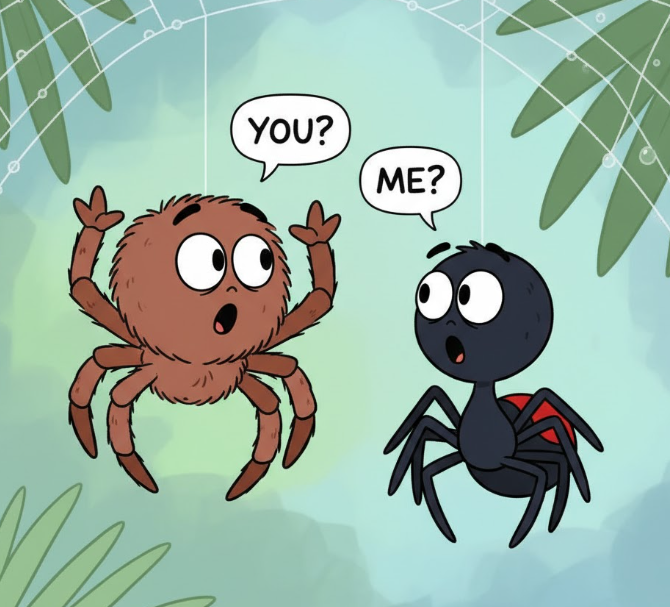
(“Who are you?”)
2. But when the same two spiders met again shortly after…
They kept more distance.
(“Oh, it’s you again.”)
3. When a new spider appeared, interest jumped again.
(“Wait, you’re different.”)
This rise–fall–rise pattern repeated again and again across dozens of controlled pairings.
The Long Memory Surprise
In many species, “habituation” (getting used to something) fades quickly. If jumping spiders were simply bored or fatigued, interest should decline across the board. But something else happened.
When the scientists brought in a completely new spider after hours of testing, the focal spider’s interest skyrocketed—higher than earlier trials.
If this were fatigue, interest should drop.
If this were random, the pattern should be messy.
Instead, it was clean, repeatable, and specific.
The spider remembered every individual it had seen that day—and knew exactly who was new.
This implies long-term recognition memory, something previously assumed to require much larger brains and more social lifestyles.
Why Would a Solitary Spider Need This Skill?
Here the story opens up again. Jumping spiders are not social the way bees, ants, or even some wasps are. They don’t live in groups. They rarely meet the same spider twice. They mate and fight, but those interactions mostly rely on simple cues: size, color, movement.
So why keep track of individual identities?
The authors offer a possibility: this ability may not be “for” social interaction at all. Instead, it may be a byproduct of the spider’s already powerful visual and learning systems.
In other words:
They evolved strong general intelligence for hunting and navigation—and individual recognition came along for free.
It’s like owning a smartphone with a great camera. Even if you never become a photographer, the camera is capable of amazing things simply because the hardware allows it.
The Big Picture: Rethinking What Small Brains Can Do
This study nudges us to rethink an old assumption in biology: Brain size ≠ cognitive limit.
Across the world, researchers are looking for low-cost ways to study cognition. This experiment is a reminder that groundbreaking discoveries don’t always require MRI machines or massive budgets. Sometimes, two small acrylic boxes, a camera, and careful design can reveal abilities we thought belonged only to the largest animals.
If a tiny spider can store and retrieve identity-specific memories over hours, what else have we overlooked in other “simple” organisms?
What might this mean for understanding distributed intelligence, minimal neural computations, or the evolution of learning?
And perhaps most importantly:
What other assumptions about intelligence are we overdue to revise?
Let’s Explore Together
Here are a few questions to spark conversation, classroom debate, or lab discussions:
- Could this kind of memory help spiders in ways we haven’t discovered yet?
- If you were designing the next experiment, what would you test—longer delays, more individuals, or different sensory cues?
- What everyday animal behavior do you think hides complex cognition beneath a simple surface?
Curious minds make science move. Share this with someone who still thinks you need a big brain to have a big mind.