
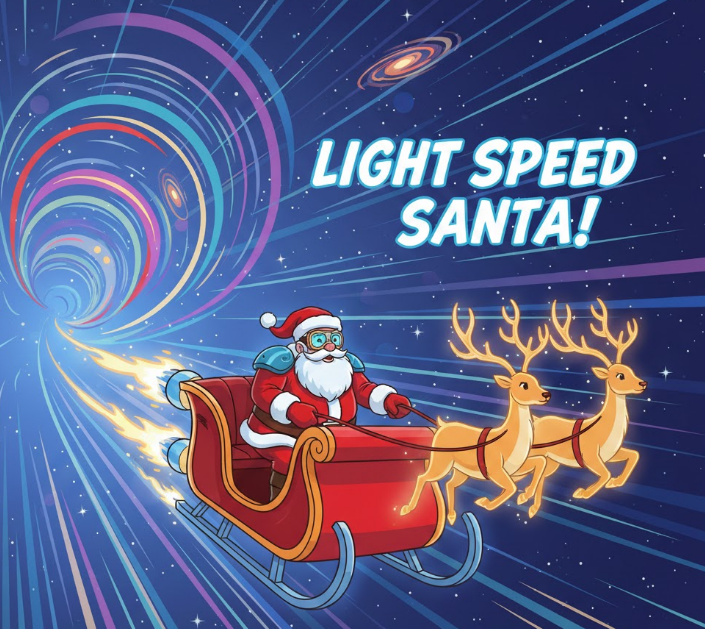
The Physics of Santa’s Trip Around the World
How Does One Jolly Elf Deliver Billions of Gifts in Just One Night?
Every December, physicists, science lovers, and bored relatives with calculators ask the same delightful question: How on Earth does Santa Claus visit millions of homes in one night without violating the laws of physics? Let’s unwrap the science behind the sleigh with a mix of real calculations, holiday magic, and just enough cheekiness to keep your eggnog warm.
Santa’s Speed: Faster Than You Think!
To start, Santa doesn’t have 24 hours — he has more, thanks to clever time zone use. By traveling east to west, he chases midnight around the globe and gets an extended delivery window of about 31–34 hours from when the first Christmas Eve begins to when the last one ends. Now imagine this:
- There are hundreds of millions of homes Santa needs to visit — let’s say roughly 238 million, based on estimates of Christian households around the world.
- To hit all those rooftops, he must make millions of stops per hour, or even hundreds per second! (Discovery UK)
Depending on the math you use, Santa’s sleigh would have to travel at mind-boggling speeds — on the order of 0.5% the speed of light, or more than 4.7 million kilometers per hour. That’s faster than most spacecraft we’ve launched! (University of Leicester)
Relativity to the Rescue
At speeds that high, Einstein’s theory of relativity enters the party. Time doesn’t tick the same for everyone:
- At relativistic speeds, time for Santa could slow down compared to Earth observers.
- This time dilation means that while Earth clocks race through Christmas Eve, Santa’s clock might stretch those minutes into hours — giving him more “felt” time to deliver gifts.
So maybe that extra hour of sleep we all ask for isn’t so out of reach after all. 😉
Magic (and Reindeer) vs. Physics
Classic physics calculations also highlight an absurdly heavy payload — think millions of tons of presents. (Chalkdust) Even if each child only gets one toy, the total weight would dwarf the largest ships and planes we’ve ever built!
Combine that with near-light speeds, and the air resistance would create unimaginable heat and forces on any ordinary vehicle. (Science Focus) For conventional physics, this spells disaster. But Santa’s sleigh doesn’t use conventional physics… it uses holiday magic.
Some scientists (okay, fun bloggers) speculate that Santa might use quantum effects, time dilation fields, or even wormhole shortcuts through space-time to make his rounds (Medium) Who says string theory can’t come with a side of gingerbread?
Physics + Cookies: A Sweet Conclusion
So what’s the verdict on the physics of Santa’s trip around the world?
- Speed? Insanely fast — possibly near relativistic. (University of Leicester)
- Time? Flexible, thanks to relativity and time-zone gymnastics. (Discovery UK)
- Magic? Absolutely essential (and delicious).
- Cookies? A non-negotiable energy source.
At the end of the day, even the most rigorous physics can’t fully explain Santa’s Christmas Eve journey — but that’s part of the fun. Whether it’s relativity, quantum mechanics, or simply a sprinkle of holiday spirit, Santa’s sleigh remains the most efficient delivery system in the known universe.
So here’s to another year of wonder, cheer, and the triumphant melding of science and holiday magic. ✨
Happy Holidays from This Week in Science!