
HAARP: Can Scientists Really Control the Weather?
If you spend enough time online, you’ll eventually encounter a startling claim: somewhere in the Alaskan wilderness sits a government facility capable of controlling the weather.
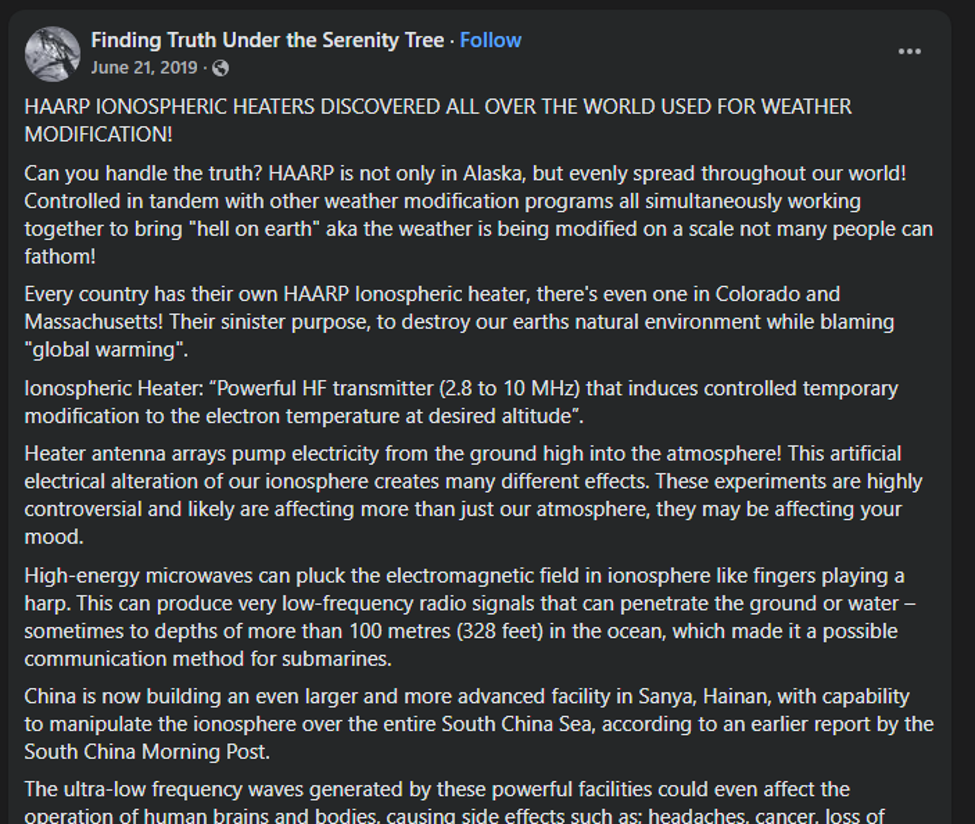
The facility’s name is HAARP, short for the High-frequency Active Auroral Research Program. For decades, it has occupied a unique place in the modern conspiracy landscape. Depending on who is telling the story, HAARP has been blamed for hurricanes, droughts, wildfires, earthquakes, power outages, and even mind control. It has appeared in documentaries, viral social media posts, and countless internet discussions as supposed evidence that governments possess technologies far beyond what the public realizes.
At first glance, the story has all the ingredients of a compelling mystery.
HAARP is real. It was originally funded by the U.S. military. It uses powerful radio transmitters. And most people have only a vague understanding of what it actually does. But there is another reason the theory has proven so durable: humans really have spent decades trying to influence the weather.
Scientists have seeded clouds to increase rainfall. Governments have experimented with weakening hurricanes. Researchers today are actively debating geoengineering schemes that could alter Earth’s climate on a planetary scale. The idea of deliberately modifying the atmosphere is not science fiction; it is an ongoing scientific and political reality.
Which raises an obvious question.
If scientists can already influence certain atmospheric processes, where exactly is the line between weather modification and weather control? Could a facility like HAARP actually steer storms, trigger droughts, or manipulate the climate? Or has a legitimate scientific research program fallen victim to one of the internet’s most persistent myths?
The answers reveal something far more interesting than a conspiracy theory. They reveal how the atmosphere actually works, why weather remains extraordinarily difficult to control, and how real scientific efforts to engineer the environment differ from the extraordinary claims often made about HAARP.
The claim is that scientists can use HAARP to control the weather.
What does the evidence actually say?
Humanity’s Long History of Trying to Control the Weather
In reality, humans have been trying to control the weather for at least a century.
The most familiar example is cloud seeding. Since the 1940s, scientists have dispersed particles such as silver iodide into clouds to encourage the formation of rain or snow. The logic is simple enough: if a cloud already contains enough moisture, adding the right particles may help water droplets or ice crystals form more efficiently. In practice, the results are more complicated. Cloud seeding can sometimes increase precipitation under favorable conditions, but the effects are usually modest, localized, and difficult to measure with certainty.
Other weather-control efforts have been far more ambitious.
During the Cold War, U.S. researchers explored whether hurricanes could be weakened before they reached land. The best-known attempt was Project Stormfury, which tried to reduce hurricane intensity by seeding storms with silver iodide. The theory was that seeding could disrupt the storm’s eyewall and reduce peak winds. But hurricanes proved too large, too powerful, and too complex for the method to work reliably. After years of experiments, the project was abandoned (Willoughby et al., 1985).
Then there were the truly audacious ideas.
For decades, people have proposed using nuclear weapons to destroy approaching hurricanes. The proposal resurfaces so often that meteorologists have a standing answer: no. A mature hurricane releases vastly more energy than a nuclear weapon, and detonating one would be unlikely to meaningfully disrupt the storm. It could, however, spread radioactive fallout across large areas of ocean and land.
Today, the conversation has shifted from controlling individual storms to altering the planet’s climate. As global temperatures rise, researchers have begun studying geoengineering proposals such as injecting reflective particles into the stratosphere or brightening marine clouds to reflect more sunlight back into space (National Research Council, 2015). If you’ve seen it, this was the inciting incident in the movie Snowpiercer
These ideas remain highly controversial. They also raise questions that are not only scientific, but political and ethical: Who gets to decide whether the atmosphere should be engineered? Who benefits? Who bears the risk?
This history matters because it shows why HAARP conspiracies can sound plausible at first. Humans really have tried to modify the weather. Scientists really do study ways to influence clouds, storms, and climate. But there is a crucial difference between nudging a specific atmospheric process under narrow conditions and controlling weather systems at will.
No one has demonstrated the ability to steer hurricanes, create droughts, trigger floods, or manipulate global weather patterns on command.
That distinction lies at the heart of the HAARP controversy.
So what does HAARP do?
While the claim is familiar- HAARP was secretly built to manipulate storms, trigger droughts, or “control the weather.” the evidence is less cinematic but more scientifically interesting.
HAARP is an ionospheric research facility. In plain English, that means it studies the ionosphere: the electrically active region of the upper atmosphere, beginning roughly 60 miles above Earth. Instead of working in the layer where clouds, rain, and hurricanes form, HAARP uses high-frequency radio waves to briefly perturb charged particles far above ordinary weather. Scientists can then observe how that region responds, including changes in plasma waves, radio propagation, auroral processes, and other features of near-Earth space.
That does not mean the atmosphere is neatly divided into sealed compartments. The lower atmosphere and upper atmosphere do interact. Waves, tides, electrical currents, solar activity, geomagnetic storms, and space-weather processes all connect different layers of the atmosphere in complicated ways. In fact, atmosphere-ionosphere coupling is an active area of research (Yigit et al., 2016).
This is where the strongest version of the HAARP conspiracy theory gets a tiny foothold. It starts with a real scientific idea: the atmosphere is connected from top to bottom. But then it makes a leap that the evidence does not support. A subtle, global, multiscale coupling process is not the same thing as a steering wheel for the weather. The scientific literature describes a system shaped by solar radiation, geomagnetic activity, atmospheric waves, tides, and large-scale dynamics, not a singular mechanism that can be directed at will by a localized radio facility in Alaska.
That distinction matters. It is the difference between saying, “Scientists can perturb a small patch of ionospheric plasma and learn from the response,” and saying, “Scientists can turn hurricanes left.”
The first claim is well documented.
The second is not.
What HAARP was built to do
HAARP did not emerge from nowhere. The program began in 1990; construction near Gakona, Alaska, started in 1993; and the facility was developed to study how powerful radio waves interact with the ionosphere. Those interactions mattered for practical reasons: radio communication, radar, surveillance, navigation, and understanding the space environment around Earth (National Research Council, 2014).
That origin story helps explain why HAARP became such fertile ground for suspicion. The project was initially funded by the U.S. Air Force, the U.S. Navy, DARPA, and the University of Alaska system. Some of its early motivations were clearly defense-related, especially in areas such as communication and ionospheric monitoring. But “defense-related research” is not the same thing as “weather weapon.” The documented focus was the upper atmosphere, radio propagation, and geospace physics, not precipitation engineering, hurricane steering, or storm generation (National Research Council, 2014).
HAARP’s institutional home has also changed. In 2015, the Air Force transferred operation of the research facility to the University of Alaska Fairbanks. In 2021, National Science Foundation funding helped establish the Subauroral Geophysical Observatory at HAARP, expanding its role as a community science facility for space physics and radio science.
Today’s HAARP is much more public-facing than the conspiracy version suggests. The University of Alaska Fairbanks posts transmission notices before research campaigns, maintains pages describing publications and experiments, hosts open houses, and advertises training programs such as the Polar Aeronomy and Radio Science summer school. That does not mean the science is simple. It does, however, run counter to the image of a black-box installation quietly conducting secret hurricane experiments.
The simplest way to understand HAARP is this: it was built to study the upper atmosphere, not to control the lower one.
What HAARP can actually do
The easiest way to separate HAARP fact from HAARP mythology is to look at the machine itself.
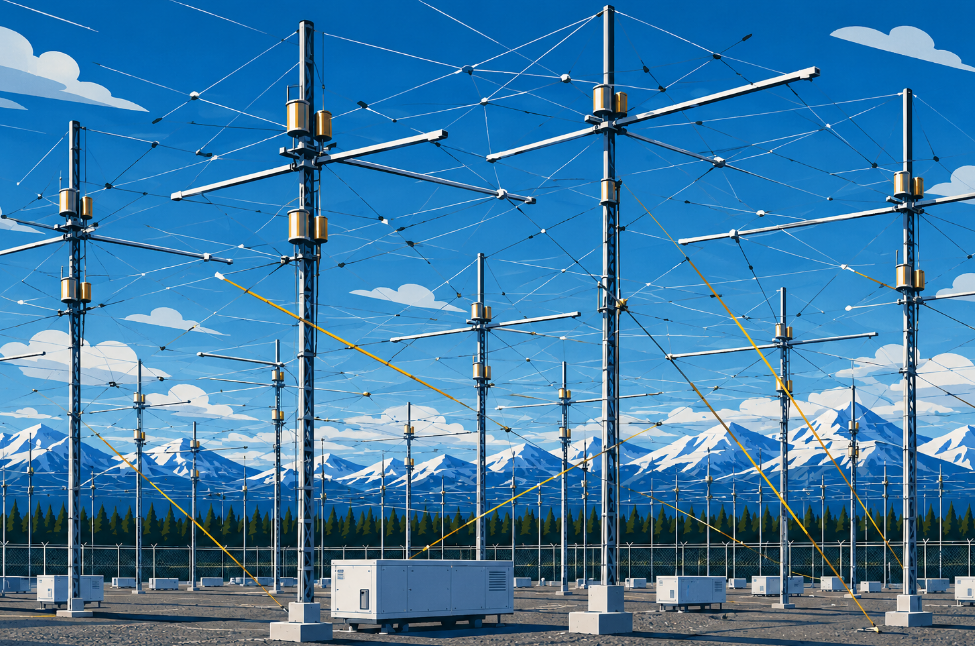
HAARP’s main instrument is the Ionospheric Research Instrument, an array of 180 crossed-dipole antennas spread across roughly 33 acres in Alaska. Together, those antennas can transmit up to 3.6 megawatts of high-frequency radio power, with operating frequencies ranging from about 2.8 to 10 MHz. The beam can also be directed within a limited range, allowing scientists to focus radio energy on a targeted region of the upper atmosphere.
That sounds dramatic, and in one sense it is. HAARP is an exceptional upper-atmosphere laboratory. But several details are easy to misunderstand.
First, HAARP’s target is the ionosphere, not the weather layer. Ordinary weather happens mainly in the troposphere, the lowest layer of the atmosphere, where clouds form and storms develop. HAARP operates far above that. Official descriptions place its research region beginning around 100 kilometers above Earth, well above the jet stream and the part of the atmosphere that produces terrestrial weather. Depending on the operating frequency, the affected region is generally described as being in the upper atmosphere, roughly 70 to 350 kilometers above the surface.
Second, the affected region is small by meteorological standards. HAARP can disturb a localized patch of ionospheric plasma, often measured in tens of kilometers. That is impressive for space physics, but tiny compared with a hurricane, a winter storm, or a frontal system stretching across several states. Even when HAARP is precisely aimed, it is not pushing around air masses, clouds, or moisture in the lower atmosphere.
Third, the power numbers are often misleading. Some descriptions of HAARP mention gigawatt-scale effective radiated power, or ERP. That does not mean the facility is creating gigawatts of raw energy. ERP is a radio-engineering measure that accounts for how antenna arrays concentrate transmitted power in a particular direction. The actual transmitted power is still about 3.6 megawatts. Comparing HAARP’s directional radio signal to the energy budget of a hurricane is like comparing the brightness of a flashlight beam to the heat output of a wildfire. They are not the same kind of quantity.
Fourth, most HAARP effects are temporary. When the transmitter turns off, many induced ionospheric effects fade quickly. Some specialized experiments have produced artificial plasma structures that persist longer, sometimes for minutes or hours, but these remain upper-atmosphere plasma phenomena. They are not changes to clouds, pressure systems, rainfall, or winds in the troposphere.
So yes, HAARP can do something real. It can briefly perturb a small region of the ionosphere, allowing scientists to observe how that region responds. That is valuable science.
It is not weather control.
What the peer-reviewed literature shows
The peer-reviewed HAARP literature is extensive, but it does not read like a weather-control program. It reads like space physics.
One group of studies focuses on artificial airglow. When HAARP transmits radio energy into the ionosphere, it can sometimes excite particles high above Earth, producing faint optical emissions—essentially a human-made glow in the upper atmosphere. Early studies reported the first HAARP-produced airglow observations, later showed that this glow could be enhanced when the beam was aimed in particular directions, and modeled the conditions under which high-frequency heating could accelerate electrons enough to produce visible emissions (Mishin et al., 2004; Pedersen et al., 2003). Later work examined fine structure within these heater-induced airglow patches (Kendall et al., 2010).
Another major line of research involves ELF and VLF waves, very low-frequency electromagnetic waves that can travel long distances through the Earth-ionosphere system. By modulating ionospheric heating, HAARP can generate these waves in a controlled way. Cohen and colleagues developed theoretical models of this process and later summarized nearly 100 days of HAARP ELF/VLF generation experiments (Cohen et al., 2013). Satellite observations have also detected intense upward-propagating ELF/VLF columns above HAARP, confirming that the facility can act as a controllable source for wave-injection studies (Piddyachiy et al., 2008).
Other studies have documented artificial ducts in the topside ionosphere, ionospheric turbulence, cross-modulation effects, and large artificial plasma disturbances under specific experimental conditions. Bernhardt and colleagues reported some of the most dramatic findings, including large ionospheric disturbances and artificial ionization structures produced during specialized HAARP experiments (Bernhardt et al., 2016; Vartanyan et al., 2012).
This is where online exaggerations often begin. A phrase like “large ionospheric disturbance” sounds ominous if stripped of context. But in the papers themselves, the subject is not rain, clouds, drought, or hurricanes. It is ionized plasma in the upper atmosphere, radio propagation, and magnetospheric coupling.
In other words, the literature supports a narrower and more defensible claim: HAARP can temporarily alter the local state of a small region of the ionosphere. That makes it useful for studying upper-atmosphere dynamics and wave-particle interactions.
It does not show that HAARP can alter cloud microphysics, redirect moisture, move frontal boundaries, or control storm formation in the lower atmosphere.
Why weather control is the wrong comparison
If the question is, “Can HAARP heat part of the ionosphere?” the answer is yes.
If the question is, “Can it therefore control the weather?” the comparison falls apart remarkably quickly.
One reason is that known weather-modification techniques operate in the same atmospheric layer as the process they are trying to influence. Cloud seeding, for example, works by introducing particles into existing clouds to encourage the formation of rain or snow under favorable conditions (Bruintjes, 1999; Flossmann et al., 2019). Proposed geoengineering techniques, such as stratospheric aerosol injection, would operate differently but would still place reflective particles directly into the atmosphere to alter how sunlight is absorbed and reflected.
HAARP does neither of these things.
Instead, it transmits radio waves into the ionosphere, a region of the atmosphere far above the clouds, weather fronts, and jet stream. The difference is not merely technical—it is fundamental. Weather occurs primarily in the troposphere, the lowest layer of the atmosphere. HAARP’s effects occur at altitudes of roughly 70 to 350 kilometers above Earth’s surface. It is operating in a different part of the atmosphere altogether.
The mismatch in scale is equally striking.
A typical HAARP experiment affects a region measured in tens of kilometers. By contrast, the weather systems people imagine HAARP controlling are enormous. Hurricanes can span hundreds of kilometers. Major storm systems routinely stretch across multiple states. The atmospheric processes that drive them involve vast quantities of air, water, and energy moving across continental and ocean-basin scales.
Then there is the question of power.
Conspiracy discussions often point to HAARP’s impressive technical specifications, including references to gigawatt-scale effective radiated power. But these figures can be misleading. HAARP’s actual transmitted power is about 3.6 megawatts. A mature hurricane, by comparison, releases energy on the order of 10^14 watts through the condensation of water vapor and roughly 10^12 watts in kinetic energy alone. Even before considering the details of atmospheric physics, the difference in scale is staggering.
Finally, the mechanisms are entirely different.
HAARP works by altering the behavior of charged particles in the ionosphere. Weather modification, to the extent that it is possible at all, involves clouds, water droplets, aerosols, latent heat, atmospheric circulation, and precipitation processes. One system is primarily about plasma physics. The other is about fluid dynamics and the water cycle.
At this point, a thoughtful skeptic might raise an important question. If the atmosphere is connected from top to bottom, could a disturbance in the ionosphere eventually cascade downward and influence weather?
In principle, the atmosphere is indeed coupled. Energy and momentum move between atmospheric layers through waves, tides, and other large-scale processes (Yigit et al., 2016). But that observation is very different from demonstrating control. The scientific literature contains no evidence that HAARP can create a predictable chain of effects that produces meaningful changes in clouds, storms, rainfall, or other forms of weather in the lower atmosphere.
And that missing link is the entire case. Without it, the leap from “HAARP can perturb the ionosphere” to “HAARP can control the weather” remains a leap rather than a scientific conclusion
Conspiracies, policy, and realistic futures
At this point, the scientific verdict is fairly clear. HAARP can perturb a small region of the ionosphere. It cannot control the weather.
So why does the theory refuse to die?
Part of the answer is that good conspiracy theories often begin with a grain of truth. HAARP really does heat part of the upper atmosphere. It really was funded by military agencies. It really is a powerful and unusual scientific instrument. Those facts provide just enough reality for speculation to take hold.
Most HAARP theories follow a similar pattern. They start with legitimate scientific concepts—ionospheric heating, resonance, electromagnetic waves, atmosphere-ionosphere coupling—and then leap to conclusions that the underlying science does not support. A radio experiment becomes a weather weapon. A plasma disturbance becomes a hurricane generator. A research facility becomes a machine for planetary control.
The leap is understandable. Modern science routinely produces technologies that would have seemed impossible a century ago. We can edit genes, communicate through satellites, and land spacecraft on distant worlds. Against that backdrop, the idea of weather control does not seem entirely absurd.
But plausibility is not evidence.
The irony is that there are real scientific and policy debates about environmental modification. Cloud-seeding programs operate in multiple countries. Researchers are actively studying geoengineering proposals that could, in theory, influence global temperatures. International agreements such as the 1977 Environmental Modification Convention even address the possibility of hostile environmental modification.
In other words, humanity’s ability to influence the atmosphere is not a fantasy. It is simply far more limited—and far more complicated—than most conspiracy theories suggest.
The future of HAARP is likely to be much less dramatic than its online reputation suggests. The facility is increasingly used as a research platform for studying the ionosphere, radio-wave propagation, auroral processes, and the interaction between Earth and near-Earth space. Scientists continue to use it to investigate fundamental questions about our planet’s upper atmosphere, much as astronomers use telescopes to study distant galaxies.
That future may not make for compelling conspiracy videos.
But it is arguably more interesting.
The real story of HAARP is not about secret weather weapons. It is about how science works: asking questions, testing ideas, and trying to understand an extraordinarily complex planet. And if there is one lesson that emerges from decades of HAARP research, it is that controlling the weather is far harder than understanding it.
Build Your Own Science Issue
Tell us what fascinates you. We’ll search today’s science and build a personalized issue just for you.
Your science issue is being built.
We’re searching today’s research for stories that match your interests. Your personalized issue will arrive in your inbox shortly.
Something went wrong.
We couldn’t build your issue right now. Please try again in a moment.