
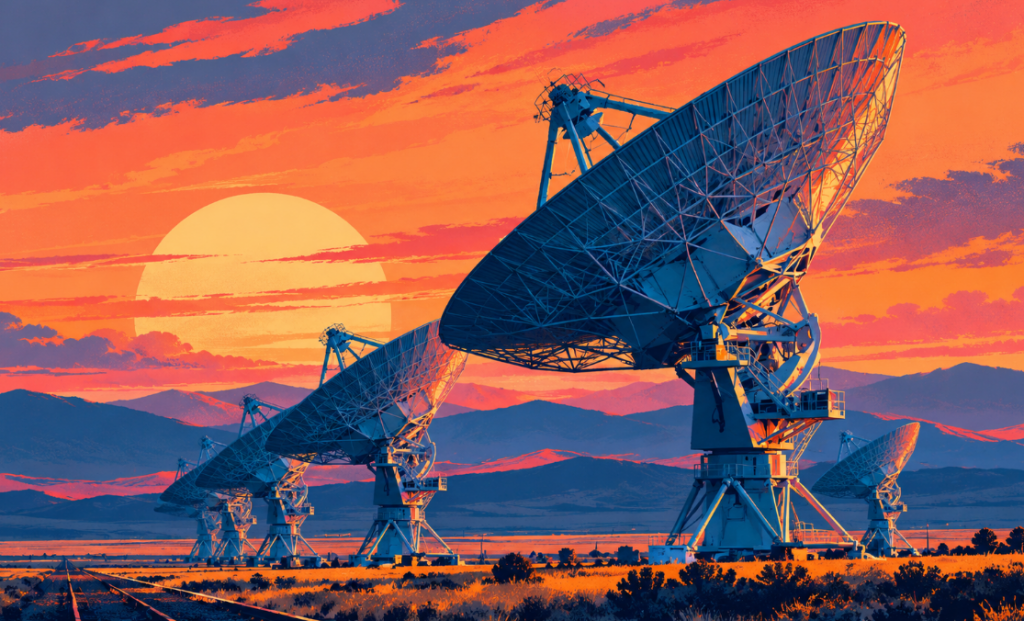
The Wow! Signal: Did We Hear Something From Space?
In 1977, a radio telescope detected a mysterious signal from deep space. Nearly 50 years later, scientists still don’t know exactly what caused it. That signal’s story reveals how humanity’s search for extraterrestrial intelligence has evolved—and why we’re still listening.
The 72 Seconds That Changed the Search for Aliens
On August 15, 1977, a radio telescope in Ohio picked up something extraordinary.
For 72 seconds, an unusually powerful radio signal appeared in the data collected by Ohio State University’s Big Ear telescope. It came from the direction of the constellation Sagittarius, near a frequency that scientists had long considered promising for interstellar communication.
Then it disappeared.
A few days later, astronomer Jerry Ehman was reviewing the telescope’s computer printouts when he noticed a strange sequence of characters:
6EQUJ5
He circled the sequence in red ink and wrote a single word in the margin.
“Wow!”
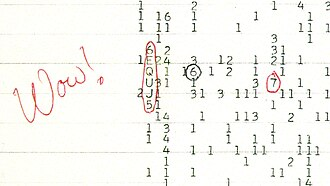
That handwritten reaction gave the mysterious transmission its name: the Wow! Signal.
Almost half a century later, nobody has definitively explained what caused it. Despite repeated attempts, the signal has never been detected again.
Was it an unusual natural phenomenon? A brief burst of interference? Or something far more extraordinary?
The Wow! Signal remains one of astronomy’s most intriguing mysteries. But understanding why scientists took it seriously means going back to when humanity first wondered whether radio technology might let us communicate with another world.
Before SETI, Scientists Were Listening for Martians
Long before radio telescopes began searching distant stars, some of the world’s most famous inventors believed they might already be hearing extraterrestrial messages.
Around the turn of the 20th century, Nikola Tesla reported detecting unusual radio signals during experiments in Colorado Springs. He speculated that they might originate from another planet, possibly Mars.
Guglielmo Marconi, another pioneer of radio communication, made similar suggestions in the early 1920s.
Neither claim produced convincing evidence of extraterrestrial intelligence. But they reflected something remarkable about the era.
For the first time in human history, people had invented a technology that could transmit information invisibly across enormous distances.
If humans could communicate through radio waves, perhaps intelligent beings elsewhere could do the same.
In 1924, when Mars made a relatively close approach to Earth, American authorities even coordinated periods of radio silence to help scientists listen for possible Martian transmissions.
Nothing convincing emerged.
Still, the idea had taken hold: perhaps the universe wasn’t silent. Perhaps we simply hadn’t learned how to listen.
Project Ozma: The First Scientific Search for Alien Signals
Modern SETI—the Search for Extraterrestrial Intelligence—began in earnest in 1959.
That year, physicists Giuseppe Cocconi and Philip Morrison published a paper in the journal Nature proposing that radio waves offered a practical way for civilizations separated by interstellar distances to communicate.
Their reasoning was straightforward.
Radio waves can travel through space, and certain frequencies can pass through the galaxy with relatively little interference. One particularly interesting frequency was approximately 1420 megahertz, associated with radiation emitted by neutral hydrogen.
Hydrogen is the most abundant element in the universe.
Perhaps, the scientists reasoned, an advanced civilization would recognize its radio frequency as a natural meeting place for interstellar communication.
In 1960, astronomer Frank Drake decided to test the idea.
At the National Radio Astronomy Observatory in Green Bank, West Virginia, Drake pointed an 85-foot radio telescope at two nearby stars: Tau Ceti and Epsilon Eridani.
The experiment was called Project Ozma, named after a character from L. Frank Baum’s Oz books.
For several weeks, Drake listened for unusual radio signals that might suggest intelligent activity.
He found no confirmed extraterrestrial transmissions.
But Project Ozma established something important: searching for alien intelligence could be a legitimate scientific investigation rather than speculation.
Researchers could identify promising stars, select frequencies, collect observations, and test whether unusual signals had natural or artificial explanations.
The search had officially begun.
Why the Wow! Signal Was So Unusual
By the 1970s, radio astronomy had become much more sophisticated.
Scientists could survey larger regions of the sky, monitor more frequencies, and search enormous amounts of data for unusual patterns.
One instrument was Ohio State University’s Big Ear radio telescope.
Unlike a traditional dish that follows objects across the sky, Big Ear relied on Earth’s rotation to sweep its observing beams across the heavens.
That design helps explain why the Wow! Signal attracted so much attention.
The signal lasted about 72 seconds, matching how long a stationary celestial radio source would be expected to remain within one of the telescope’s beams.
Its strength rose and fell in a pattern consistent with a source passing through the telescope’s field of view.
And it appeared near the hydrogen frequency that SETI researchers considered especially interesting.
The mysterious characters on the printout weren’t an alien message. They were shorthand for recording signal intensity.
The sequence 6EQUJ5 described how the signal grew stronger, peaked, and then weakened.
At its strongest, it rose roughly 30 standard deviations above the background noise—a remarkably prominent event.
There was another puzzling detail.
Big Ear used two receiving beams, which meant a persistent source in the sky would ordinarily be detected twice as Earth rotated.
The Wow! Signal appeared in only one.
That left astronomers with an extraordinary observation but no clear explanation.
And then came the most frustrating part.
It never happened again.
The Signal That Refused to Repeat
Science depends heavily on repeatability.
If a telescope detects something unusual, astronomers want to observe it again. A second detection can help establish where the signal originated, whether it follows a pattern, and whether other instruments can confirm it.
With the Wow! Signal, researchers never got that opportunity.
Over the following decades, scientists returned to the same region of the sky using increasingly powerful instruments.
Observations with the Very Large Array and Australia’s Hobart radio telescope failed to find a matching transmission.
Later searches using modern SETI facilities also produced no confirmed repeat.
That absence creates a fundamental problem.
A single unexplained radio signal is not sufficient evidence of extraterrestrial intelligence.
Many explanations can account for unusual astronomical observations, including equipment artifacts, human-made interference, and rare natural events.
The Wow! Signal’s characteristics made some ordinary explanations difficult to reconcile with the data. But its failure to repeat made it impossible to establish more extraordinary explanations.
Researchers have proposed several possibilities over the years.
One suggested that the signal might have been a terrestrial transmission reflected toward the telescope by an object in space.
Another proposed that hydrogen surrounding passing comets could have produced the unusual emission.
Neither explanation has gained broad acceptance.
More recently, researchers associated with the Arecibo Wow! project proposed another possibility: a cold cloud of hydrogen in space might have briefly become much brighter after a powerful astronomical event, potentially involving a magnetar, stimulated it.
A magnetar is a neutron star with an extraordinarily powerful magnetic field. These objects can produce intense bursts of radiation.
Under the proposed scenario, a transient event could cause hydrogen gas to emit a brief, unusually strong radio signal.
The researchers reported observations of much weaker narrowband hydrogen emissions that helped motivate their hypothesis.
It’s an intriguing natural explanation, but it remains a hypothesis, not a confirmed solution.
The Wow! Signal is still unexplained.
And that uncertainty is precisely what makes it scientifically interesting.
SETI’s Biggest Challenge Wasn’t Just Finding Aliens
While the Wow! Signal captured public imagination, SETI researchers faced a more immediate challenge: money.
Searching for extraterrestrial intelligence requires expensive instruments, substantial computing power, and enormous amounts of observing time.
It also comes with an uncomfortable reality for funding agencies.
Researchers cannot promise when—or whether—they will find anything.
During the 1970s and 1980s, NASA investigated increasingly ambitious SETI programs.
One early proposal, Project Cyclops, envisioned a massive network of radio antennas to detect signals from distant civilizations.
It was never built, largely because of the extraordinary cost.
Eventually, NASA developed a more practical program called the High Resolution Microwave Survey.
Launched in October 1992, it combined targeted observations of promising nearby stars with a broader sky survey.
Less than a year later, Congress canceled the program.
For researchers who had spent years developing the technology, the decision was devastating.
But the search didn’t end.
Private donors and nonprofit organizations stepped in, helping scientists continue their work outside NASA’s main funding structure.
The SETI Institute, founded in 1984, became one of the field’s central organizations.
Its researchers, including astronomer Jill Tarter, helped maintain the scientific infrastructure and public credibility of the search.
Project Phoenix, launched in 1995, examined hundreds of nearby star systems using advanced radio receivers.
It found no confirmed extraterrestrial signals.
Yet it demonstrated that SETI could survive even without a large federal program.
The search was becoming a persistent scientific enterprise.
When Millions of Ordinary People Joined the Search
In 1999, SETI took an unexpected turn.
Instead of relying entirely on professional observatories and dedicated supercomputers, researchers at the University of California, Berkeley, invited ordinary people to participate.
The project was called SETI@home.
Its premise was brilliantly simple. Radio telescopes generate enormous amounts of data. Searching that data for unusual signals requires tremendous computing power. Meanwhile, millions of personal computers spend much of their time sitting idle.
What if those computers could help? Participants downloaded software that analyzed small portions of radio telescope data whenever their machines had spare processing capacity.
The software searched for unusual patterns, including narrowband signals and repeated pulses that might warrant closer investigation.
Completed results were sent back to Berkeley for further analysis.
Suddenly, people worldwide could participate in the search for extraterrestrial intelligence without leaving home.
For many users, SETI@home became an iconic computer screensaver.
But behind the familiar graphics was a serious scientific effort.
At its peak, the project attracted approximately one million active participants. Over its lifetime, millions of volunteers contributed computing resources.
Together, they helped process extraordinary quantities of astronomical data.
SETI@home also helped popularize distributed computing—the practice of dividing large computational tasks among many separate computers.
Its underlying technology eventually contributed to the development of BOINC, the Berkeley Open Infrastructure for Network Computing.
BOINC expanded the approach beyond astronomy, allowing volunteers to contribute computing power to other scientific problems.
In this way, SETI@home helped change how people could participate in science.
You didn’t need a telescope, a laboratory, or a doctorate.
You just needed a computer and curiosity.
Did SETI@home Ever Find Anything?
In March 2020, SETI@home stopped distributing new work to volunteer computers.
The announcement disappointed people who had participated for years.
But the project wasn’t ending because researchers had decided the search was pointless.
They had accumulated an enormous amount of data and needed to concentrate on analyzing what they already had.
The scientific challenge was no longer simply processing radio observations.
It was separating potentially interesting signals from the overwhelming number of false alarms.
Most unusual radio detections have mundane explanations.
Satellites, radar, communication systems, and other human technologies can create signals that superficially resemble artificial sources in space.
Researchers therefore had to develop methods to reject interference and identify candidates worth closer examination.
By 2025–2026, analyses of the SETI@home data had narrowed roughly 14 billion candidate signals to around 100 particularly interesting cases for additional scrutiny.
Some of those candidates were selected for follow-up observations using China’s Five-hundred-meter Aperture Spherical Radio Telescope, better known as FAST.
None had been confirmed as extraterrestrial.
But the project left behind something more substantial than a collection of disappointing results.
It demonstrated that enormous scientific investigations could involve millions of people, and that decades of observations could be revisited with better analytical tools.
A signal overlooked years ago might become more interesting when examined with improved methods.
The data don’t necessarily lose their scientific value just because the original project stops collecting them.
The Search Has Changed: Scientists Now Look for Technosignatures
For much of SETI’s history, the central idea was to listen for radio transmissions.
But modern researchers increasingly use a broader concept: technosignatures.
A technosignature is an observable sign that might indicate technology beyond Earth.
Radio transmissions are one possibility, but not the only one.
Scientists are also investigating whether advanced civilizations might produce powerful laser pulses, unusual light patterns, or other detectable effects associated with technological activity.
The logic is important.
If extraterrestrial intelligence exists, we have no reason to assume it uses the same communication systems humans developed during the 20th century.
A civilization thousands or millions of years older than ours might communicate in ways we haven’t imagined.
Or its technology might produce detectable effects without any intention of contacting us.
Modern SETI projects are expanding the search accordingly.
Breakthrough Listen, announced in 2015, brought major private funding to the effort and dramatically increased the scale of observations. The initiative uses powerful radio telescopes and other instruments to examine nearby stars, regions of the Milky Way, and distant galaxies.
The Allen Telescope Array in California was designed specifically for SETI research. Its network of antennas lets researchers conduct radio observations while developing new methods to identify unusual signals.
The COSMIC system at the Very Large Array in New Mexico takes another approach. It analyzes copies of telescope data while the observatory conducts other astronomical research.
This lets SETI search the sky without dedicating every observation exclusively to extraterrestrial intelligence.
Other projects, including LaserSETI, NIROSETI, and PANOSETI, investigate brief flashes of optical or near-infrared light that might otherwise escape notice.
Together, these projects reflect a major shift.
SETI is no longer just a search for someone transmitting a radio message.
It’s a search for evidence that technology might exist somewhere else in the universe.
Artificial Intelligence Is Changing How We Listen
One of the greatest difficulties in modern SETI is the sheer volume of information.
Radio telescopes can monitor enormous numbers of frequencies and generate datasets far too large for humans to inspect individually.
And most unusual detections aren’t aliens.
They’re interference, natural phenomena, or statistical noise.
This makes machine learning particularly valuable.
Algorithms can help identify suspicious patterns, classify signals, and prioritize observations that deserve further investigation.
They can also search for features that traditional detection methods might overlook.
But artificial intelligence doesn’t eliminate the need for scientific skepticism.
An algorithm that identifies an unusual pattern doesn’t prove the pattern came from extraterrestrial technology.
It has simply identified something worth investigating.
The next steps remain familiar: check for interference, examine the instrument, search for natural explanations, and attempt independent confirmation.
In that sense, SETI’s technological advances haven’t changed its fundamental scientific problem.
The challenge is still distinguishing something extraordinary from something merely unusual.
What If the Universe Really Is Silent?
A difficult question hangs over the entire history of SETI.
After more than six decades of scientific searching, why haven’t we found convincing evidence of extraterrestrial intelligence?
The Milky Way contains billions of stars, and astronomers now know that planets are common.
Some of those planets may have conditions that could support life.
Yet no extraterrestrial civilization has been confirmed.
This tension is closely related to the famous Fermi paradox, often summarized by a simple question:
If intelligent life should be common, where is everybody?
There are many possible answers.
Perhaps intelligent life is extremely rare.
Perhaps civilizations tend to disappear before developing technologies that can communicate across interstellar distances.
Maybe advanced societies communicate in ways we don’t recognize.
Or perhaps the distances and timescales involved make communication much more difficult than we appreciate.
There’s also a simpler possibility.
We may barely have started looking.
The galaxy is enormous. SETI observations have sampled only a limited range of stars, frequencies, times, and possible technologies.
Even a powerful telescope cannot listen everywhere, at every frequency, all the time.
And if a distant civilization transmits only occasionally, our instruments would need to be looking in the right direction at precisely the right moment.
The absence of a confirmed signal is meaningful, but it isn’t proof that nobody is out there.
It tells us what we haven’t detected under the conditions we’ve examined.
Nearly 50 Years Later, the Wow! Signal Still Inspires
Return to that computer printout from 1977.
Six characters. A red circle. One handwritten word.
The Wow! Signal remains famous because it represents a possibility that science has neither confirmed nor completely explained.
It appeared at an interesting frequency, displayed a compelling signal pattern, and vanished before astronomers could learn more.
No credible evidence supports declaring it a message from an alien civilization.
But no definitive explanation for the observation exists.
Science isn’t simply about finding answers. It’s about developing better ways to distinguish between competing explanations.
SETI’s history is filled with experiments that produced no confirmed extraterrestrial detections. Yet those efforts helped improve radio astronomy, signal processing, distributed computing, and our understanding of how difficult it is to search the universe systematically.
Project Ozma demonstrated that the search could be scientific.
The Wow! Signal showed how mysterious a single observation could be.
SETI@home allowed millions of people to participate.
Today’s technosignature programs are expanding the range of phenomena scientists can investigate.
Nearly 50 years after Jerry Ehman wrote “Wow!” on a sheet of paper, the universe hasn’t given us a confirmed answer.
But our ability to ask the question has changed dramatically.
And somewhere among the billions of stars in our galaxy, there may still be something worth hearing.
The question is whether we’ll recognize it when we do.
Build Your Own Science Issue
Tell us what fascinates you. We’ll search today’s science and build a personalized issue just for you.
Your science issue is being built.
We’re searching today’s research for stories that match your interests. Your personalized issue will arrive in your inbox shortly.
Something went wrong.
We couldn’t build your issue right now. Please try again in a moment.