Transform Desert Energy Systems in Qatar
PubTrawlr is heading to Qatar University for the Driving Change: Regional Conference on Health and Emerging Fields in Implementation Science on 5–6 December 2025. We’ll be sharing key insights, takeaways, and regional perspectives on evidence-based public health. Learn more or register here: https://www.qu.edu.qa/en-us/conference/gis-qatar-2025/
Summer power demand in Qatar can soar to nearly 8,000 megawatts—more than twice the country’s winter lows. But here’s the twist: some renewable technologies produce the least energy at the very moment Qatar needs them most.
That mismatch is the puzzle that a team of researchers set out to solve. Their study is not just about Qatar. It’s a window into how countries with extreme climates—India’s megacities, Nigeria’s northern states, Brazil’s semi-arid northeast—can build cleaner, more reliable energy systems without breaking their grids.
What they found is surprising, practical, and hopeful. And it offers lessons far beyond the Gulf.
The Everyday Stakes: Power, Water, and Heat
If you live in a hot climate, you already know: electricity is more than plugs and lights. It is comfort, safety, and even survival.
In Qatar, electricity doesn’t just power homes; it also runs desalination plants that produce 99% of the nation’s drinking water. The hotter the country gets, the more electricity is needed for cooling—and the more water is needed for people, agriculture, and industry. That means any failure in the energy system doesn’t just turn off lights. It can shut down water taps.
Now imagine this challenge in a city like Lagos during a heatwave—or in Rajasthan when temperatures spike above 45°C. Stability matters.
So the research team used a powerful simulation tool, EnergyPLAN, to test different combinations of renewable energy: solar PV, concentrated solar power (CSP), wind, biomass, and storage. They modelled eight scenarios, from Qatar’s current natural-gas-dominated system to an ambitious 2025 future where renewables supply almost all electricity.
And this is where the story gets its plot twist.
The Researcher’s “Aha” Moment: Not All Sunshine Is Equal
At first glance, Qatar seems like a solar paradise. Long days. Clear skies. High heat. But here’s what the data shows: solar shines brightest when the grid needs it most—in summer midday peaks. That’s good for reliability.
But wind? Wind behaves differently.
On page 8 of the study, the graphs show a striking pattern:
- Winter: strong, steady winds
- Summer: weak winds—just when electricity demand skyrockets
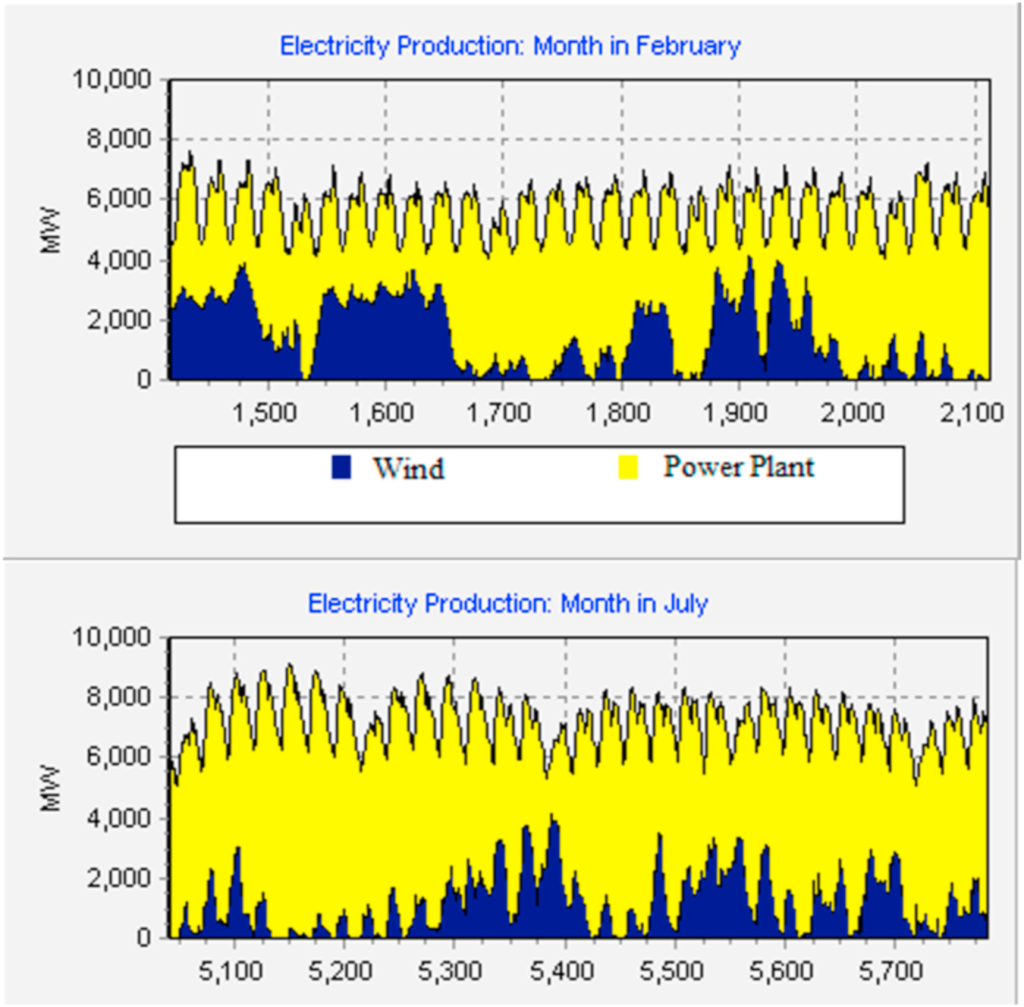
This means wind alone can never be the backbone of Qatar’s grid. But mix wind with solar? Now you have a 24-hour partnership: sun when it’s hot, wind when it’s cool.
And the modeling confirmed it: A hybrid wind–solar system cut emissions by nearly one-third and produced energy more evenly across the year
The Storage Problem: The Missing Ingredient
No renewable plan works without storage. Qatar tested two major solutions:
1. Thermal Storage for CSP
Adding 70 GWh of heat storage to concentrated solar plants doubled the share of usable solar electricity—from 18.8% to 38.2%.
That’s huge. Why? Because CSP uses mirrors to heat fluid, and stored heat can keep generating electricity after sunset. Like keeping chapati dough warm so it stays soft hours later.
2. Pumped Hydro Storage
In their most advanced scenario, the researchers modelled pumps that move water uphill when electricity is cheap and release it downhill to generate power when needed. Even with Qatar’s flat terrain, simulated pumped storage made the grid far more stable.
With these technologies combined, the researchers achieved something bold: A system where 89% of electricity came from renewables.
The Real World Limits: Geography, Economics, and Behavior
The study is refreshingly honest: even with abundant sunlight, storage limits everything.
- Thermal storage helps for a few hours, not seasons.
- Pumped hydro needs mountains—a challenge in flat regions.
- Electro-fuels (like hydrogen) require huge upfront investments.
- And natural gas remains so cheap in Qatar that switching to renewables can be hard to justify economically.
If you work in energy in India, Kenya, Pakistan, or Brazil, this may sound familiar. Clean technology is improving, but infrastructure and costs matter as much as sunshine and windspeed.
That’s why the authors also emphasize something often overlooked:
Efficiency is the fastest win.
Qatar’s national plan includes smart cooling, efficient buildings, and seasonal energy-saving measures that could cut electricity use by 7%—without installing a single new panel.
(Small actions. Big impact.)
The Global Lesson: Hybrid Systems Win
Looking across all eight scenarios, the study points to three takeaways any nation can use:
1. Mix and match technologies.
No single renewable source can run a grid alone—not even in the sunniest desert.
2. Storage turns “good” renewables into “great” renewables.
Thermal storage boosted CSP performance from 18% to 38%. Storage is the difference between “clean energy” and “clean reliable energy.”
3. Policy matters as much as physics.
The authors recommend:
- carbon taxes
- net metering
- low-interest loans
- government-backed renewable investment
For countries outside the Gulf, this means energy transitions depend as much on political courage as on technology.
The Ending: A Future That’s Possible—Not Theoretical
The final figure in the study shows something remarkable: Even with the challenges, Qatar can technically reach 100% renewable electricity if storage technologies mature and policies support investment.
This isn’t a fantasy scenario. It’s a model built on real data, real costs, and real weather patterns.
And if Qatar—with its extreme heat, high water needs, and rapidly growing population—can get close to a clean-energy future, then so can dozens of other countries facing the same pressures.
Let’s Explore Together
What part of this research surprised you the most?
Could a hybrid solar–wind–storage system work in your city or region?
If you were on this research team, what would you test next?