
The Pluriverse Paradigm
The concept of multiple dimensions beyond our familiar four has long intrigued both scientists and philosophers. Recent discussions in scientific circles, particularly around the “pluriverse” idea, offer a fascinating look into how our understanding of reality may be more interconnected than ever imagined. This paradigm could resolve many quantum paradoxes and push the boundaries of our current scientific theories.
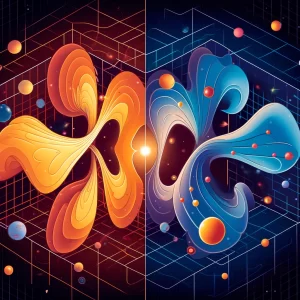
In essence, the pluriverse suggests that there isn’t a single objective view of reality; rather, reality is woven from the interlocking perspectives of multiple dimensions. This represents a radical shift from the conventional multiverse theory, which often depicts a collection of separate universes that exist independently of one another.
Quantum Realities: A Revolutionary View
The intricacies of quantum mechanics have been a fertile ground for theories about multiple dimensions. According to New Scientist, the pluriverse offers a novel way to integrate quantum variations into a cohesive model. This contrasts sharply with the string theory that suggests additional spatial dimensions are tightly compactified.
‘A radical idea that resolves many quantum paradoxes suggests there is no objective view of reality,’ – New Scientist.
A recent highlight involves observing entangled light revealing complex topological structures in up to 48 dimensions, providing a powerful “alphabet” for encoding quantum information. This finding signals a promising shift towards practical applications of such theories in quantum computing and communication.
Scientific Implications and Challenges
Embracing a pluriverse model has profound implications for scientific research. Not only does it demand a reconsideration of long-standing theories in cosmology and physics, but it also encourages innovative methods for exploring these dimensions. The challenge lies in developing technologies capable of mapping and experimenting within this multidimensional framework.
For instance, the discovery of a particle related to the proton at CERN’s Large Hadron Collider has set a precedent for future explorations into the subatomic realm. This finding reinforces the notion that what we perceive as reality might be only part of a much larger and richer tapestry.
Philosophical and Cultural Repercussions
The implications of a pluriverse extend beyond physics, touching on philosophical and cultural domains. It challenges the traditional separation between subject and object, inviting a reconsideration of how we define existence. Furthermore, this may influence everything from literary narratives to virtual reality experiences, shaping new forms of storytelling and digital interaction.
Looking Forward: Bridging Dimensions
In the coming years, the integration of pluriverse concepts into mainstream science could lead to technological innovations that might seem like science fiction today. The potential to create new architectures for computers and communication systems, as seen in current research on time crystals and quantum batteries, could revolutionize industries.
ScienceDaily highlights Australia’s advancements in quantum batteries that leverage quantum effects for ultra-fast charging, representing just one frontier potentially accessible through understanding high-dimensional systems.
The Road Ahead
While the pluriverse theory requires further exploration and validation, its tantalizing prospects offer endless possibilities for innovation and understanding. By bridging these high dimensions, humanity might find not only answers to longstanding scientific puzzles but also deeper insight into the nature of existence itself.
The exploration of this new paradigm might, in the end, redefine how we perceive ourselves within the universe—a universe that is perhaps far grander and more intricate than we have ever imagined.