Why Humans Can Outrun Heat-Stressed Prey
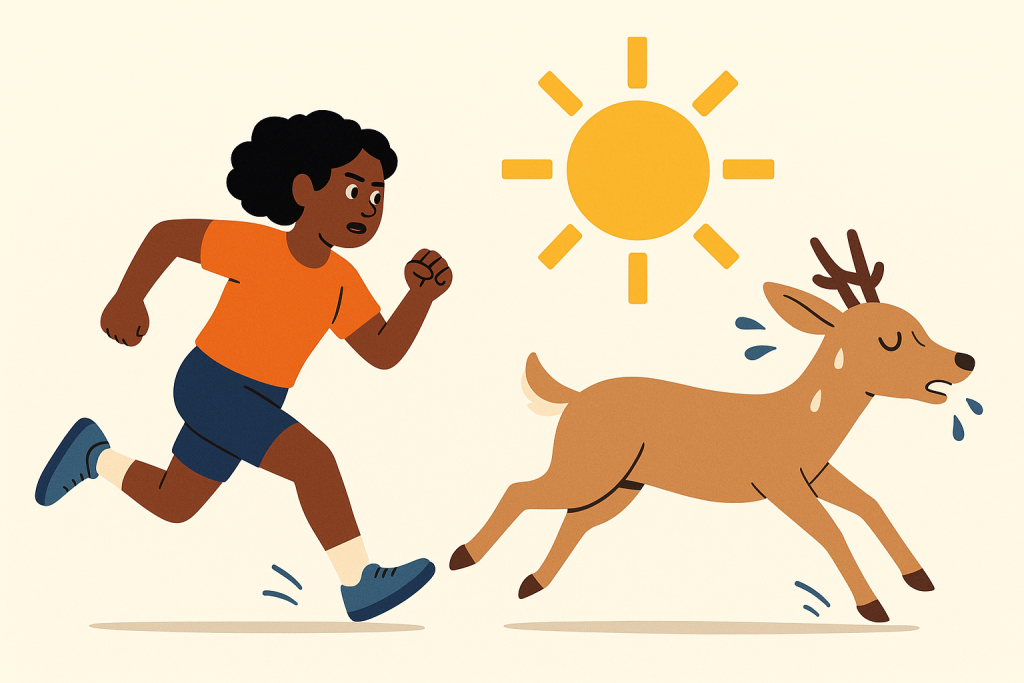
The midday sun beats down on the open savanna, an environment that wouldn’t seem conducive to a marathon. Yet, in this landscape, ancient humans may have mastered a surprising hunting method: running animals to exhaustion. While we often consider ourselves outmatched by many faster, four-legged creatures, this endurance hunting strategy could tilt the balance in favor of two-legged hunters.
In the realm of endurance, humans possess unique characteristics. Our muscles are adept at resisting fatigue, and we excel at dissipating heat through sweating. These traits are not common in most other mammals. The endurance pursuit (EP) hypothesis posits that early humans evolved these abilities not just for survival but to hunt effectively.
Breaking Down the Puzzle
The idea of running down prey seems counterproductive at first. Compared to a gazelle or a cheetah, humans are relatively slow over short distances. However, when it comes to long-distance running, humans shine. While a cheetah may sprint up to 29 meters per second, humans can keep marathon runners running for consecutive days.
The endurance pursuit hypothesis, which has puzzled scientists, suggests that these enduring traits evolved to enable humans to persistently hunt medium and large-sized mammals. But the question remains: when sprinting uses less immediate energy and poses fewer risks, would early humans really choose the grueling challenge of an endurance run?
What the Researchers Did
Researchers Eugène Morin and Bruce Winterhalder took on this mystery with a blend of mathematical models and a deep dive into ethnographic records. They analyzed nearly 400 cases of endurance hunting documented worldwide, drawing on an underutilized database of ethnographic observations. This database spanned 272 diverse locations and tapped into different ecological settings, all reinforcing endurance hunting as a potentially widespread and practiced method.
What They Found
Despite the apparent energetic costs, endurance pursuits can be surprisingly efficient under certain conditions. The mathematical modeling indicates favorable energy return rates from EP hunts, especially compared with other traditional hunting methods. These studies indicated that in environments conducive to overheating prey, humans could theoretically achieve a caloric return on par with more common hunting strategies.
Forests, Deserts, and Beyond
This isn’t just a game plan for open savannas. About 30% of documented endurance hunts occurred in forested environments, with conditions such as snow or rocky, unforgiving terrain. These environments either slowed down prey or allowed hunters to capitalize on environmental handicaps against their quarry.
Why It Matters
The implications of this research stretch beyond understanding ancestral hunting techniques. It sheds light on the evolution of human physiology, emphasizing traits such as our ability to sweat and run long distances without succumbing to heat stress. This knowledge enriches our appreciation of human evolutionary biology and our species’ resilience.
For modern endurance sports enthusiasts, these findings resonate with the understanding that running is not just a hobby but an activity deeply rooted in human evolution. It supports why activities like marathons are so uniquely human.
Limits and Knowledge Gaps
But how does this translate to today’s foragers or rural hunting strategies? Modern foragers often rely on other methods due to changes in prey distribution and modern technological advances. Furthermore, the evidence largely comes from historical accounts, leaving room for continued exploration of physiological adaptations and the full range of conditions in which endurance hunting might have been advantageous.
Let’s Explore Together
This exploration into the past uncovers not only the origins of human endurance but also challenges us to consider the adaptability that allowed humans to thrive in a wide range of environments. Through understanding our past, we can better appreciate the intricacies of our evolution.
Questions to ponder: How have modern environments altered our physical capabilities compared to our ancestors? Could insights from ancient hunting methods bring new ways of thinking about sustainability and food procurement today?
Do you live near me? Let’s do a 12-hour race this coming Labor Day weekend!