
Forests: Nature’s Acoustic Shield Against Road Traffic Noise
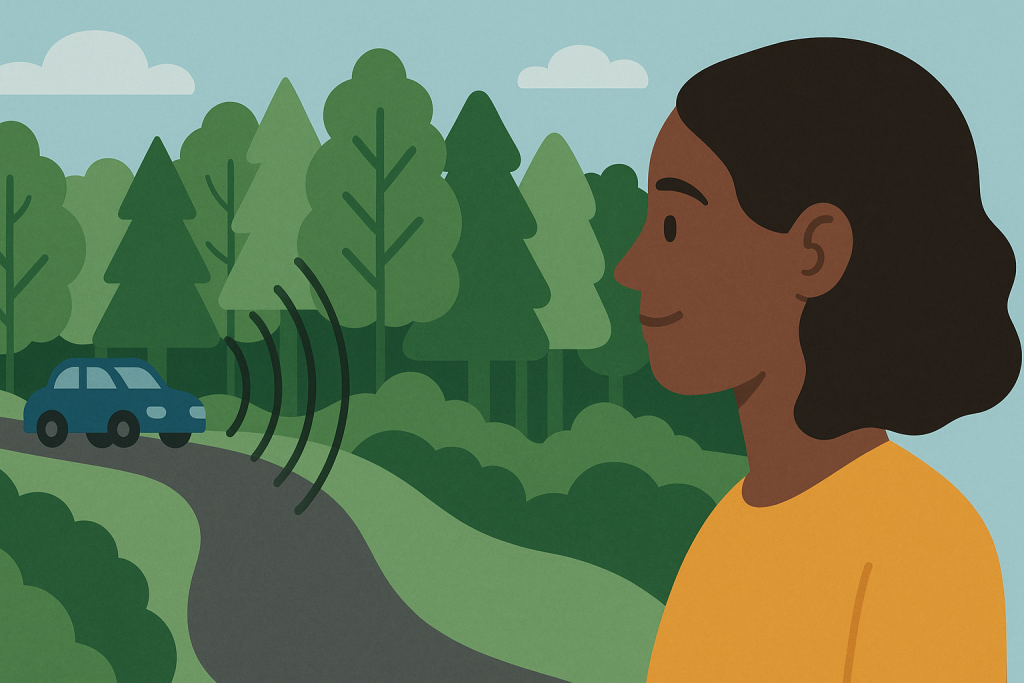
Picture a bustling highway caressed by the soft whispers of pine and beech trees. These natural giants do more than stand; they absorb, deflect, and scatter the relentless roar of traffic. In their quiet way, forests are the unsung heroes in the battle against noise pollution—a burgeoning issue in urbanized and natural landscapes alike.
Nature’s Silence Restorer
Imagine taking refuge in a forest to escape the clamor of everyday life, only to find that the hum of traffic still permeates the air. Forests, long cherished for their peace-inducing qualities, are our tranquil sanctuaries against noise pollution. But the question persists: How effective are they at silencing the world beyond?
The Puzzle of the Forest’s Sound Barrier
Researchers Tomasz Dudek, Gabriela Sędłak, and Hubert Tabor from the University of Rzeszów set out to decode this mystery. Their study, published in Scientific Reports, investigates the potential of forested areas to act as natural noise barriers. By focusing on south-eastern Poland, they examined various forest types and ages, questioning how well they mitigate road traffic noise.
Unveiling the Experiment
The research team conducted their study across four forest plots along a bustling road, monitoring noise from April to September using a sound level meter. They explored two primary variables: forest types—coniferous versus deciduous—and the age of the stands, whether young or mature. They also varied the distance from the road to see how it affected noise reduction.
This strategic approach allowed the researchers to grasp how forest composition influences acoustic attenuation. The hypothesis was simple yet profound: Coniferous forests and mature stands were hypothesized to outperform deciduous and younger counterparts.
Forests Speak in Decibels
The results were striking. Pine stands excelled, demonstrating a drop of nearly 30 decibels in noise within the first 50 meters—especially significant in mature areas. Deciduous beech forests, in contrast, were less effective, and their noise reduction capabilities were sometimes even surpassed by open terrain beyond 50 meters.
The study uncovered that noise fades logarithmically with distance, emphasizing the potent buffer the first 25 meters of forest provide against intrusive traffic sounds.
Why This Matters
In an age where urban areas constantly expand, the research suggests significant potential for natural green spaces as viable components of urban planning. Even modestly-sized green belts could temper noise pollution around roadways, helping to create quieter urban environments. This research underscores the value of investing in and preserving our forests, not only for ecological health but also for their economic and social benefits.
In resource-limited settings, this knowledge can guide policies in crafting affordable and sustainable noise mitigation strategies. Forests offer an accessible, aesthetically pleasing, and eco-friendly alternative to engineered sound barriers.
What We Still Do Not Know
Despite its insights, the study leaves some stones unturned. The research didn’t differentiate between types of vehicles and their specific noise frequencies, which could further illuminate how forests interact with sound waves. Moreover, while this study focused on specific forest compositions, broader studies across diverse climates and forest types would refine these findings for universal application.
Also, the terrain’s influence on acoustics hints at a layered complexity—the subtle rise in open areas may simulate noise dampening seen in forests, inviting further exploration of natural topography’s role.
Let’s Explore Together
Forests are more than just trees—they are the earth’s guardians of silence amid an escalating cacophony of urban noise. How might embracing the nuances of forestry shape our cities for the better? As we delve into the layers of this natural symphony, let’s explore the quiet potential of forests globally.
- Could understanding forest acoustics change urban planning in your community?
- What barriers would you face in implementing natural noise mitigation strategies in your area?
- How do different environments around the world adapt to the challenge of traffic noise?