The Hidden Costs of Automated Science
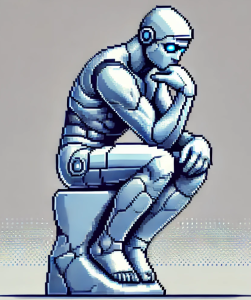
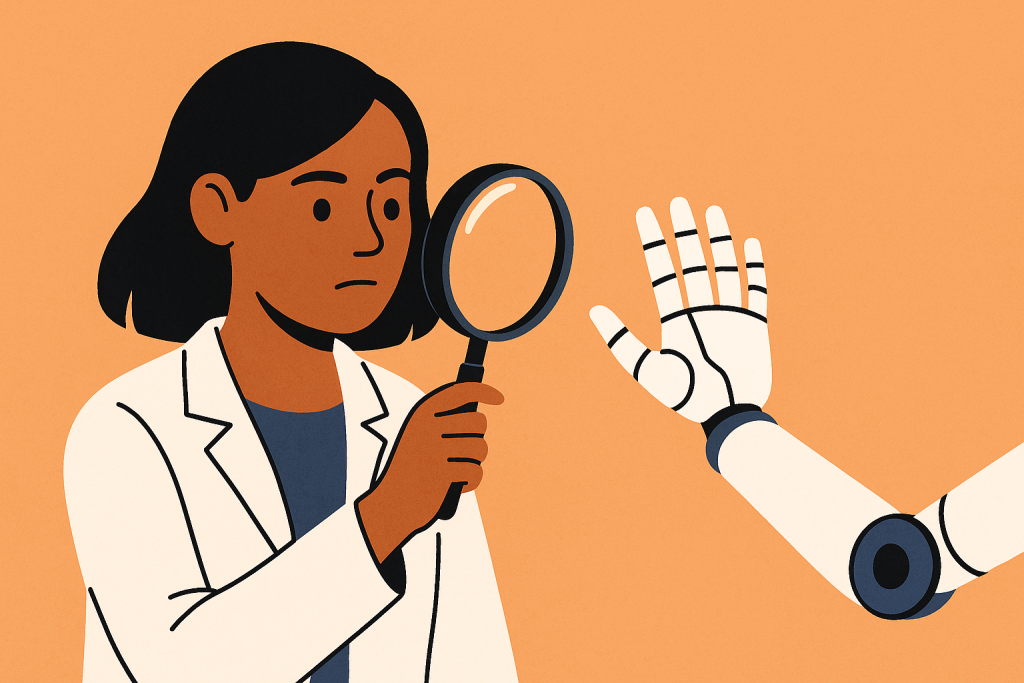
Not everything that glitters in the world of science comes from gold. Today, we’re venturing into the labyrinth of artificial intelligence and its ambitious promise to revolutionize how we do science. Picture drones conducting experiments, computers generating hypotheses, and robots drafting papers. It’s an attractive picture, but can these autonomous systems truly integrate into the complex fabric of scientific discovery?
The Lab Scene, Minus the Scientists
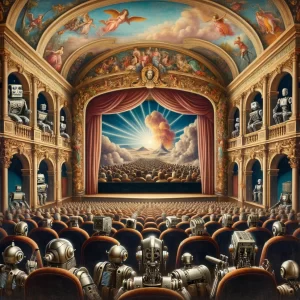
Imagine a bustling lab where beakers and microscopes are replaced by screens and circuits. Here, science unfolds at a pace impossible for human scientists to match. These aren’t scenes from a sci-fi movie; they’re part of a debate about the role of automated systems, also known as “end-to-end science” (ETES), where machines can theoretically handle everything from hypothesis to publication.
A Scientific Conundrum
Sandwiched between this shiny future and present practicalities is a weighty question: is faster always better? While AI is adept at processing data, critics argue that science isn’t merely a sequence of tasks to be optimized. Genuine scientific progress is akin to an ecosystem, flourishing on diversity, critique, replication, and evolution.
Researchers Julio M. Ottino and Brian Uzzi explore this tension in a recent study. They’re not denying AI’s capabilities but cautioning against its potential to narrow science’s beautifully chaotic complexity into something overly streamlined, like a factory line.
The Path Taken
To uncover this layered debate, Ottino and Uzzi examined the potential assimilation of artificial intelligence into the scientific process. They scrutinized the concept of autonomous AI systems conducting scientific work, from generating ideas to publishing papers, and questioned whether these machines could faithfully emulate the unpredictability and creativity intrinsic to human-driven research.
What They Unearthed
The researchers found that while AI can enhance efficiency and output, it often lacks the ability to generate the novel, disruptive discoveries that arise when humans venture off the beaten path. AI, they argue, tends to recombine existing knowledge in varied forms and may stifle those groundbreaking innovations that defy established frameworks.
Ottino and Uzzi underscore that science thrives on inefficiency. Redundant experiments, failures, and divergent methodologies are the bedrock of significant scientific breakthroughs. The optimization AI offers may lead to more paper outputs but fewer eureka moments.
Why This Matters
This exploration isn’t merely theoretical. With countries around the world pouring investment into AI research, the paper raises crucial questions about preserving the integrity of scientific discovery. Particularly in rapidly advancing economies or resource-constrained regions, automation could democratize access to science, but at the risk of homogenizing the diverse inquiry that drives long-term progress.
Moreover, concentrating scientific work on a few AI platforms could mimic digital markets. Such centralization might result in only a handful of AI systems generating a bulk of scientific output—a situation that could undermine the scientific community’s independence, creativity, and diversity.
What We Still Do Not Know
There are no simple answers here. The study sparks ongoing debates over AI’s scalability and the technological and institutional barriers that could remain. Such systems’ reliance on vast existing datasets may limit their capacity to generate truly new knowledge, posing a risk to future scientific innovation.
Let’s Explore Together
This is an ongoing conversation about the future of science itself, and it’s one we need to have globally and inclusively. How can we integrate AI innovations without losing the nuanced, exploratory magic of scientific discovery?
Reflect on these questions: How might AI-driven science shape the way we solve everyday problems? Could AI-powered tools improve accessibility to scientific resources in underfunded regions? Does the rise of AI challenge what you thought you knew about creative breakthroughs in science?