The Philadelphia Experiment: Could a Warship Really Disappear?
In late October 1943, something extraordinary was said to have happened at the Philadelphia Naval Shipyard.
According to one of the most enduring military legends of the twentieth century, a U.S. Navy destroyer escort simply… disappeared.
Not beneath the waves.
Not behind a curtain of fog.
Not under the cover of darkness.
It vanished.
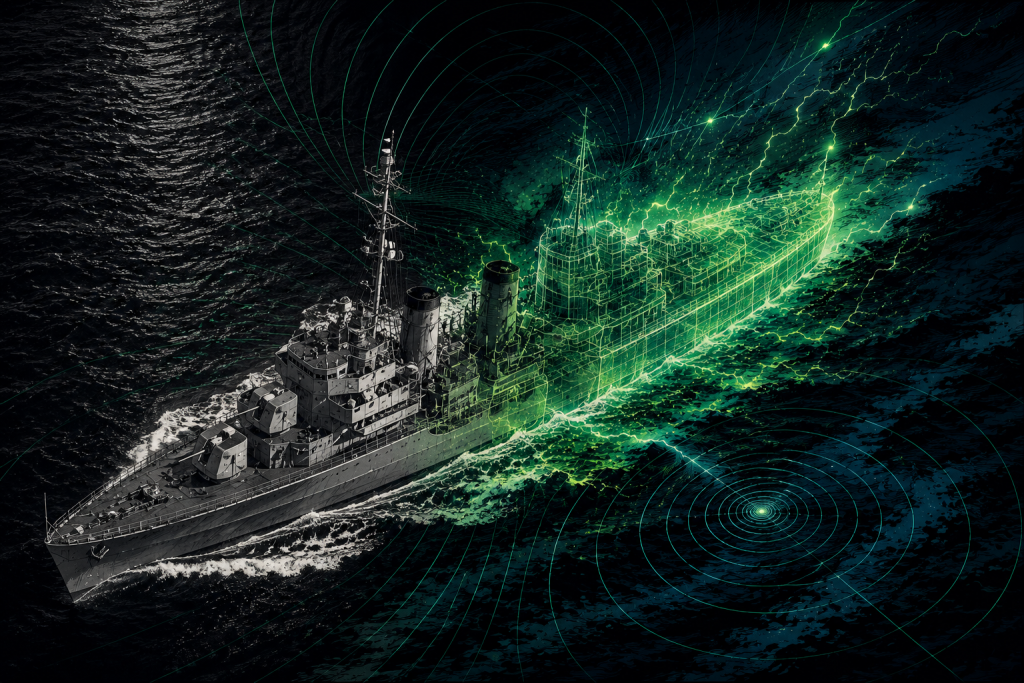
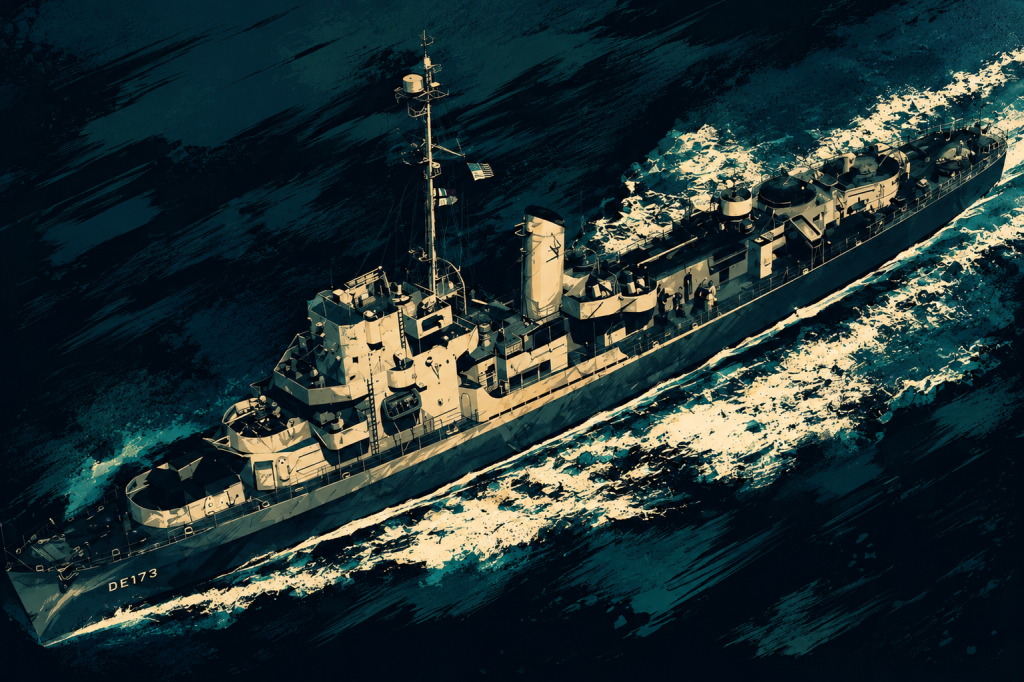
Witnesses would later claim that the USS Eldridge became engulfed in an eerie green glow as powerful electrical equipment hummed to life aboard the ship. Moments later, they said, the vessel was gone. Some accounts claimed it had become invisible. Others insisted it had instantly reappeared more than 200 miles away in Norfolk, Virginia, before returning to Philadelphia only minutes later.
The stories became even stranger with time.
Crew members were rumored to have suffered horrifying side effects. Some supposedly emerged confused or violently ill. Others were said to have gone insane. The most chilling versions claimed sailors had become permanently fused into the ship’s steel hull, as though the laws of matter themselves had broken down during the experiment.
Over the following decades, the legend expanded into something far larger than a disappearing ship. It became entwined with rumors of secret Navy research, Einstein’s unfinished unified field theory, time travel, extraterrestrial technology, interdimensional portals, and one of history’s greatest alleged government cover-ups. Books, documentaries, Hollywood films, and countless websites transformed the Philadelphia Experiment from an obscure rumor into one of the world’s most famous conspiracy theories.
Most historians dismiss the entire story. But that isn’t the question we’re asking.
Instead, let’s assume that someone genuinely wanted to make a warship disappear.
Could physics actually do it? Could electromagnetic fields bend light around a ship? Could they hide it from radar? Could they distort space itself? Could any technology, either in 1943 or today, instantaneously transport thousands of tons of steel across hundreds of miles?
Perhaps even more intriguing, could real wartime technologies have unintentionally created the perfect conditions for a myth that refused to die?
The answers lead somewhere far more interesting than a simple fact check. They take us into the worlds of naval engineering, stealth technology, electromagnetism, quantum physics, and the psychology of conspiracy theories. Along the way, we’ll discover that while the Philadelphia Experiment almost certainly never happened as described, modern science has achieved feats that would have seemed nearly as unbelievable to people living during World War II.
Sometimes the truth is less mysterious than the legend. And sometimes, it’s even more fascinating.
Following the Paper Trail
If a U.S. Navy warship had truly disappeared in a secret experiment during World War II, it would almost certainly have left traces beyond rumors. Ships kept deck logs. Officers filed reports. Convoys were tracked. Even highly classified military programs generated paperwork.
So where is the evidence?
That question has driven historians, journalists, conspiracy researchers, and curious readers for decades.
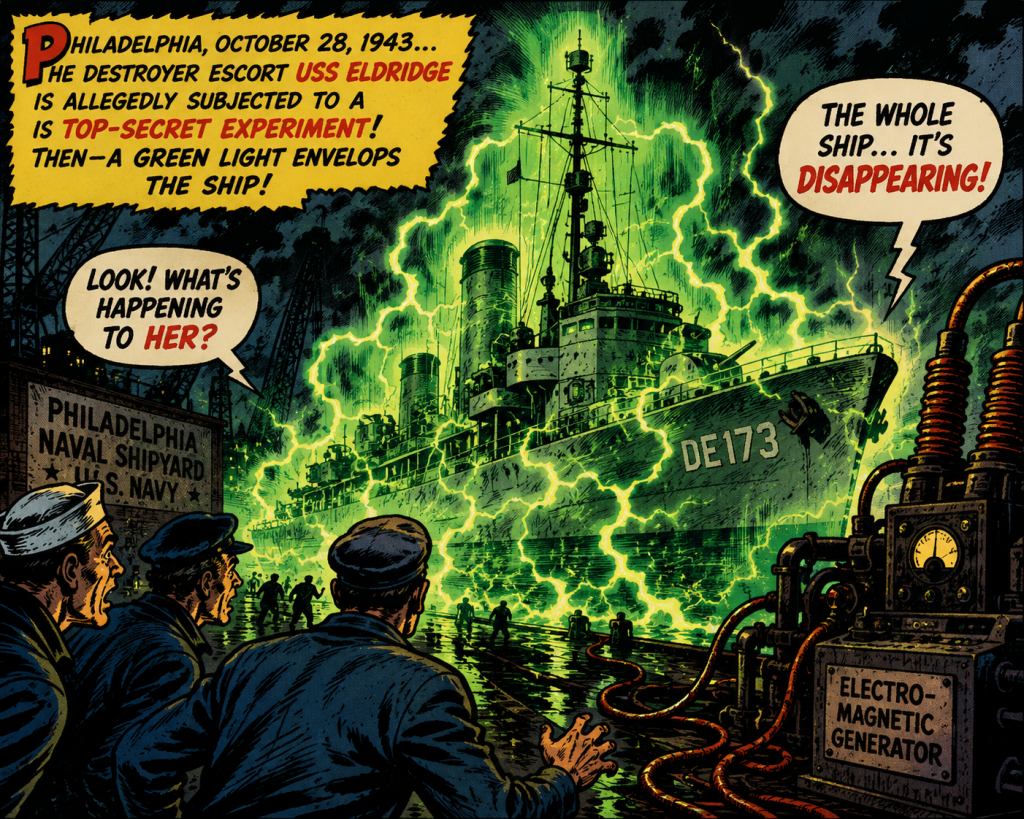
At first glance, the legend appears surprisingly detailed. Most versions place the event on or around October 28, 1943, when the destroyer escort USS Eldridge was allegedly subjected to a top-secret experiment at the Philadelphia Naval Shipyard. According to the story, powerful electromagnetic generators surrounded the ship with a glowing green haze before it vanished from sight. Some versions stop there. Others claim the vessel instantly reappeared more than 200 miles away in Norfolk, Virginia, only to return minutes later, leaving sailors burned, psychologically traumatized, or even fused into the ship’s steel hull.
The problem is that this remarkably specific story doesn’t appear in any known wartime records.
Instead, its documentary trail begins more than a decade later.
The U.S. Navy’s own historical summary traces the modern legend to Morris K. Jessup’s 1955 book on UFOs. Shortly after its publication, Jessup began receiving bizarre letters from a man identifying himself as Carlos Miguel Allende (also known as Carl Allen). The letters described a secret wartime experiment involving invisibility, teleportation, and advanced physics. In 1956, an anonymously annotated copy of Jessup’s book arrived at the Office of Naval Research (ONR), filled with cryptic handwritten notes expanding on the claims. Intrigued, two ONR employees privately arranged for a small number of copies to be reproduced. According to the Navy, this reflected personal curiosity, not official interest in a classified project.
If the legend begins in the 1950s, what do the actual wartime records show?
Here, the paper trail becomes surprisingly ordinary.
The Naval History and Heritage Command’s reconstruction of the Eldridge‘s deck logs and war diary shows the ship following a routine operational schedule. After commissioning in August 1943, it trained around New York and Long Island Sound before sailing to Bermuda for sea trials. It returned to New York in mid-October, remained there until November 1, entered Norfolk on November 2 as part of Convoy UGS-23, and departed the following day for Casablanca. The surviving deck logs preserved by the National Archives tell the same story.
In other words, the Navy’s own records place the Eldridge somewhere entirely different from where the legend says history changed.
The eyewitness testimony is equally fragile.
One of the story’s central claims is that sailors aboard the merchant ship Andrew Furuseth witnessed the Eldridge suddenly appear in Norfolk Harbor. Yet archived correspondence from Lieutenant (j.g.) William S. Dodge, the merchant ship’s wartime master, explicitly denied that he or his crew observed any such event. Navy historians also concluded that the two ships were not even present in Norfolk at the same time, removing one of the legend’s most frequently cited eyewitness accounts.
After decades of searching, the Navy’s official position has remained remarkably consistent. Historians at the Naval History and Heritage Command report that repeated archival searches have uncovered no documents describing an invisibility experiment, no evidence for the frequently mentioned “Project Rainbow,” and no indication that such a program ever existed. The Office of Naval Research goes even further, stating that it has never conducted research into making ships invisible and that, given our current understanding of physics, the alleged experiment belongs firmly in the realm of science fiction.
At first glance, this seems like the end of the story.
For many conspiracy theorists, however, the absence of evidence becomes evidence of an even larger cover-up.
That raises a more interesting question. If the historical record is so thin, why did so many people find the Philadelphia Experiment believable in the first place?
The Legend That Kept Growing
One of the most remarkable things about the Philadelphia Experiment is that it never remained the same story for very long.
The earliest versions were relatively modest by conspiracy-theory standards. They claimed only that the USS Eldridge had somehow become invisible during a secret naval experiment. Before long, however, invisibility wasn’t enough. New versions insisted the ship had actually teleported to Norfolk, Virginia. Later retellings added sailors driven insane by powerful force fields, crew members who vanished without explanation, men whose bodies fused with the ship’s steel hull, and, eventually, even time travel and interdimensional portals.
The legend evolved alongside science itself.
As radar became widely understood after World War II, the story shifted to include claims of radar invisibility. When Einstein’s attempts at a unified field theory entered popular culture, his name was woven into the narrative. Decades later, the rise of quantum mechanics and quantum teleportation inspired entirely new explanations, despite having little connection to the original story. Each generation seemed to update the Philadelphia Experiment with whatever cutting-edge science captured the public imagination.
In that sense, the legend behaved less like history and more like software receiving regular updates.
One of the few scholarly examinations devoted specifically to the Philadelphia Experiment comes from computer scientist and UFO researcher Jacques Vallée. Rather than finding evidence of a hidden military program, Vallée concluded that the story was better understood as an evolving hoax fueled by rumor, unreliable witnesses, selective memory, and the powerful mystique surrounding wartime secrecy and Einstein’s reputation (Vallée, 1994). The most extraordinary additions—particularly the claims involving time travel—rest almost entirely on later retellings rather than contemporary documents or primary evidence, an important warning sign for historians.
Once the various claims are separated, a clear pattern begins to emerge.
Some elements of the story are rooted in real science but are misunderstood. Others are inspired by genuine scientific concepts but stretch them far beyond what physics allows. A few collapse almost immediately when compared with either historical records or basic engineering principles.
For example, the idea that a ship could become invisible by generating a powerful electromagnetic field sounds superficially plausible until one asks a simple question: What kind of invisibility? Making a ship disappear from visible light is an entirely different engineering problem than reducing its radar signature, and both are fundamentally different from reducing its magnetic signature. The Philadelphia Experiment routinely treats these three very different phenomena as though they were interchangeable.
The same pattern appears elsewhere. Quantum teleportation is often cited as proof that teleporting a warship might someday be possible, yet the Nobel Prize-winning experiments behind quantum teleportation involve transferring the quantum state of individual particles—not transporting matter itself. Likewise, stories of sailors fused into steel make for unforgettable horror, but decades of research into strong electromagnetic fields show effects such as vertigo, nerve stimulation, and tissue heating—not spontaneous merging of human bodies with metal.
Ironically, the part of the legend that has the strongest connection to reality is also the least sensational. During World War II, the U.S. Navy genuinely used degaussing systems to reduce a ship’s magnetic signature and protect it from magnetic mines. Large electrical cables wrapped around steel hulls could certainly have appeared mysterious to outside observers unfamiliar with the technology. Even the Navy has suggested that these very real experiments may have provided the seed from which the much larger myth eventually grew.

A CRT monitor uses a process called degaussing to generate a brief, powerful magnetic field that removes unwanted magnetization from the metal shadow mask inside the screen, restoring accurate colors and preventing discoloration. Similarly, naval degaussing uses electrical coils to reduce a steel ship’s magnetic signature, making it harder for magnetic mines but not people or radar to detect the vessel.
That pattern is revealing. The closer the Philadelphia Experiment stays to documented naval engineering, the stronger both the historical evidence and the scientific explanation become. The moment the story ventures into optical invisibility, teleportation, time travel, or impossible biological effects, both the evidence and the underlying physics rapidly disappear.
And that raises perhaps the most interesting question of all:
If real wartime technology inspired the myth, what could that technology actually do? That’s where physics, not folklore, takes center stage.
Could the Philadelphia Experiment Actually Work?
The Philadelphia Experiment is really a bundle of different scientific claims disguised as a single story.
Some versions claim the USS Eldridge became invisible. Others say it disappeared from radar. Still others insist it teleported hundreds of miles or somehow slipped through space and time itself. Each of those claims sounds similar, but from a physics standpoint, they are completely different problems.
The easiest way to evaluate the legend is to ask a simple question: What would the Navy actually have needed to accomplish?
Could a warship be made magnetically “invisible”?
Ironically, this is the one part of the story rooted in real military technology.
Every steel ship disturbs Earth’s magnetic field, creating what engineers call a magnetic signature. During World War II, German magnetic mines were designed to detect that disturbance. To protect ships, the U.S. Navy installed large electrical coils inside their hulls. By carefully running electric current through those coils, a process known as degaussing, they could reduce the ship’s magnetic signature, making it much harder for magnetic mines to detect.
This wasn’t science fiction. It was standard naval engineering, and versions of the technology are still used today.
But there’s an important catch. Reducing a ship’s magnetic signature doesn’t make it disappear. It doesn’t bend light. It doesn’t fool radar.
It simply makes the vessel less noticeable to magnetic sensors underwater. In other words, degaussing can make a ship “invisible” to one very specific type of detection system, but it has nothing to do with optical invisibility or teleportation. The technology is real: it has simply been stretched far beyond its intended purpose.
Could electromagnetic fields hide a ship from radar—or from your eyes?
This is where the legend begins to drift away from reality. Radar doesn’t detect a ship’s magnetic field. It detects radio waves reflected from the ship’s surface. Modern stealth warships reduce those reflections through careful shaping, specialized materials, and radar-absorbing coatings, not by canceling Earth’s magnetic field.
The same is true for visible light.
Over the last two decades, physicists have built remarkable experimental “invisibility cloaks” using exotic materials known as metamaterials. These devices can redirect certain wavelengths of electromagnetic radiation around small objects under carefully controlled laboratory conditions. They represent a genuine scientific breakthrough.
But they are also a long way from making a 300-foot steel warship disappear.
The first successful demonstrations worked only at microwave frequencies. Later experiments achieved limited visible-light cloaking, but only under highly constrained conditions involving specially engineered materials and very small objects. Nothing remotely resembling the Philadelphia Experiment has ever been demonstrated, and no known technology could have produced such an effect using the electrical equipment available during World War II.
Ironically, modern cloaking research doesn’t rescue the Philadelphia Experiment.
It illustrates just how extraordinarily difficult true invisibility really is.
Could enormous electromagnetic fields teleport a ship?
Here, the legend leaves engineering almost entirely behind. If one imagines an electromagnetic field powerful enough to physically move a ship, the closest real-world analogy is magnetohydrodynamic propulsion, in which magnetic fields push against electrically conductive seawater to generate thrust.
Scientists have studied the idea for decades. The problem isn’t that it’s impossible. The problem is scale.
Analyses from the Naval Research Laboratory suggest that moving a ship this way would require magnetic fields exceeding 5 tesla, roughly the strength found inside today’s most powerful MRI scanners—maintained across enormous volumes of seawater using massive superconducting magnets.
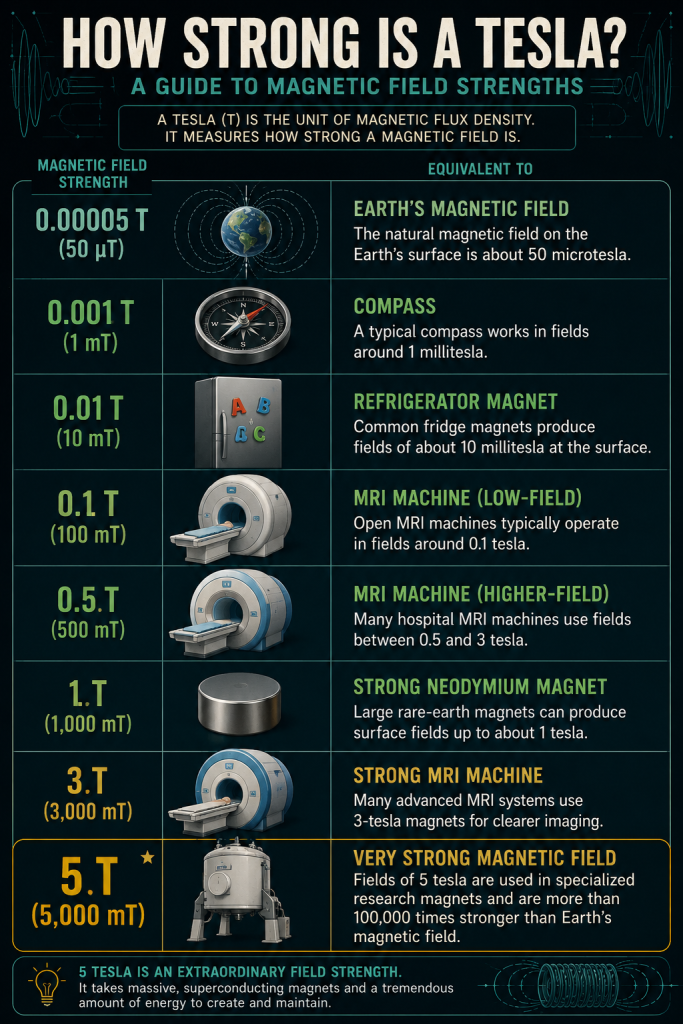
Those kinds of systems did not exist in 1943.
In fact, even by the 1960s, engineers were still struggling to build superconducting magnets capable of producing such fields in laboratory settings. The Navy’s own demonstration of superconducting degaussing technology would not occur until more than sixty years after the alleged Philadelphia Experiment.
The engineering gap isn’t small. It’s several generations of technological development.
What about Einstein’s “Unified Field Theory”?
No discussion of the Philadelphia Experiment is complete without Albert Einstein.
Many versions of the legend claim the Navy secretly weaponized his unfinished Unified Field Theory to manipulate gravity, electromagnetism, or even spacetime itself.
The historical record tells a different story. Einstein did consult for the U.S. Navy during World War II, but his work focused primarily on conventional military problems involving explosives and blast effects not invisibility or teleportation.
More importantly, his dream of a unified field theory was never completed. Einstein spent decades attempting to mathematically unite gravity and electromagnetism into a single framework, but never succeeded. Physicists continue searching for a “Theory of Everything” today.
Invoking Einstein’s name lends the Philadelphia Experiment an aura of scientific credibility. It does not provide a mechanism.
Could the crew have suffered strange medical effects?
This is one place where the legend brushes against genuine science. Powerful electromagnetic fields can affect the human body.
People exposed to sufficiently strong magnetic fields may experience dizziness, nausea, metallic tastes, flashes of light, or tingling sensations. Rapidly changing magnetic fields can stimulate nerves and muscles, while intense radiofrequency fields can heat tissue. Anyone who has worked around MRI systems knows that strong magnetic fields demand careful safety procedures.
None of those effects, however, resembles the stories told about the USS Eldridge. No known electromagnetic field can fuse a person into solid steel, cause spontaneous disappearance, or partially dematerialize the human body. Those ideas belong firmly to science fiction.
Interestingly, the Office of Naval Research describes a separate 1950s experiment aboard the USS Timmerman involving high-frequency electrical equipment that produced spectacular corona discharges and other dramatic electrical phenomena. Although no crew members suffered lasting harm, it provides a useful reminder that unusual electrical effects can easily fuel rumors when observers don’t understand what they’re seeing.
What about quantum teleportation?
Modern physics has only added fuel to the legend. When people hear that scientists have successfully demonstrated quantum teleportation, it sounds as though the Philadelphia Experiment might simply have been decades ahead of its time.
Unfortunately for conspiracy theorists, the word “teleportation” is doing almost all of the work.
Quantum teleportation does not move matter from one place to another.
Instead, it transfers the quantum state of one particle to another using quantum entanglement and conventional communication. The original particle doesn’t disappear and reappear elsewhere, and certainly no ship or people are transported through space.
Using quantum teleportation to explain the Philadelphia Experiment is a bit like using the term “computer virus” to explain why someone caught influenza. The same word appears in both contexts. The underlying phenomenon is entirely different.
The physics paints a remarkably consistent picture. Every time the legend approaches documented naval engineering, particularly degaussing, it encounters real technology that was both practical and historically documented. Every time it ventures into invisibility, teleportation, time travel, or impossible biological effects, the supporting evidence evaporates, and the required physics moves far beyond anything that existed in 1943—or, in most cases, even today.
That may not be as dramatic as a ship vanishing in a flash of green light. But it reveals something just as fascinating: how a kernel of genuine science can grow into one of history’s most enduring technological myths.
What Really Survives Scrutiny
After more than eighty years of investigation, countless books, documentaries, and internet debates, the Philadelphia Experiment leaves behind a surprisingly clear picture.
The first surviving piece is entirely real: the U.S. Navy absolutely experimented with degaussing. During World War II, engineers developed ways to reduce a ship’s magnetic signature to protect it from magnetic mines. Large electrical cables, powerful currents, and highly classified wartime research were all genuine parts of naval operations. What they did not do was make ships disappear.
The second surviving piece is also grounded in science. Strong electromagnetic fields can affect the human body. They can cause dizziness, tingling, nausea, nerve stimulation, and other temporary physiological effects under the right conditions. But decades of research offer no evidence that electromagnetic fields can teleport people, merge them with steel, or shift them through time and space.
Finally, there is the paper trail itself.
Rather than emerging from wartime documents, the Philadelphia Experiment appears to grow out of postwar correspondence, UFO literature, rumor, and repeated retellings. The historical record has been examined for decades by naval historians, archivists, journalists, and independent researchers. Despite persistent claims of a cover-up, no contemporary evidence has ever surfaced showing that the alleged experiment occurred.
Perhaps the most interesting lesson, however, has nothing to do with the USS Eldridge.
It is how conspiracy theories evolve.
The Philadelphia Experiment never stayed frozen in 1943. Instead, it absorbed whatever new scientific breakthrough captured the public imagination. During one era, it borrowed Einstein’s unfinished Unified Field Theory. Later, it adopted radar stealth. More recently, it has been retrofitted with quantum teleportation, wormholes, and ideas borrowed from modern physics. The legend continually updates itself, wrapping new scientific vocabulary around the same underlying story.
That is precisely why it has endured for generations.
Ironically, modern science has accomplished feats that would have sounded almost as unbelievable as the Philadelphia Experiment itself. We have built radar-evading warships. We have demonstrated experimental invisibility cloaks for carefully controlled wavelengths. We routinely manipulate individual quantum states and communicate using quantum entanglement. None of these achievements validate the Philadelphia Experiment, but they do illustrate an important truth: real science is often strange enough without inventing impossible physics.
The Philadelphia Experiment almost certainly never happened. But asking whether it could have happened turns out to be far more interesting than simply asking whether it did.
In chasing one of history’s most famous military conspiracies, we uncover something much more valuable: a deeper understanding of electromagnetism, naval engineering, quantum physics, and the remarkable human tendency to transform genuine scientific advances into enduring myths.
Sometimes the greatest mystery isn’t whether a ship disappeared.
It’s why we’re still fascinated by the possibility that it might have.