

Did the Internet Cause the UFO Reporting Boom?
What Can UFO Data Tell Us?
UFOs have fascinated people for generations. Whether they represent extraterrestrial visitors, misunderstood natural phenomena, or simply the quirks of human perception, millions of people have looked to the skies and wondered.
In this series, we’re taking a different approach. Using more than 80,000 documented UFO sightings, we’ll investigate one question at a time through the lens of data science. Rather than asking whether UFOs are real, we’re exploring what these reports reveal about human behavior, culture, and the ways we document the unexplained.
After all, even if the mystery remains unsolved, the data have a story to tell.
Previous Entries
Did Hollywood Make People See More UFOs? A Data Analysis
The Internet Hypothesis
If UFO sightings are partly shaped by reporting behavior, then the internet should matter.
Before online forms, searchable databases, forums, and email, reporting a UFO required more effort. You had to know where to send the report, make contact, and often write out the experience by hand or phone. Once reporting moved online, the barrier dropped dramatically.
So we divided the data into three eras:
| Era | Years |
|---|---|
| Pre-Internet | 1949–1994 |
| Early Internet | 1995–2004 |
| Broadband Era | 2005–2013 |
Then we asked: did UFO reports simply increase, or did reporting patterns change more fundamentally?
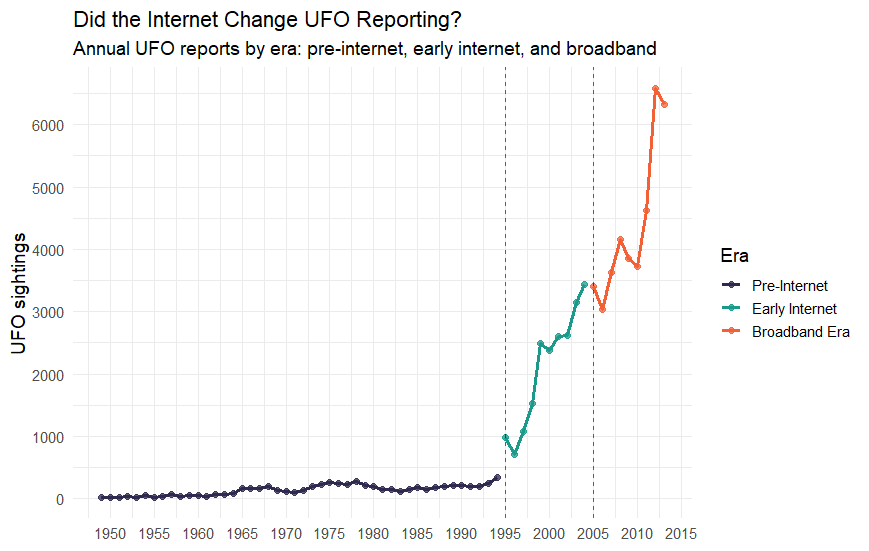
The UFO Boom Begins in the Internet Era
The change is striking.
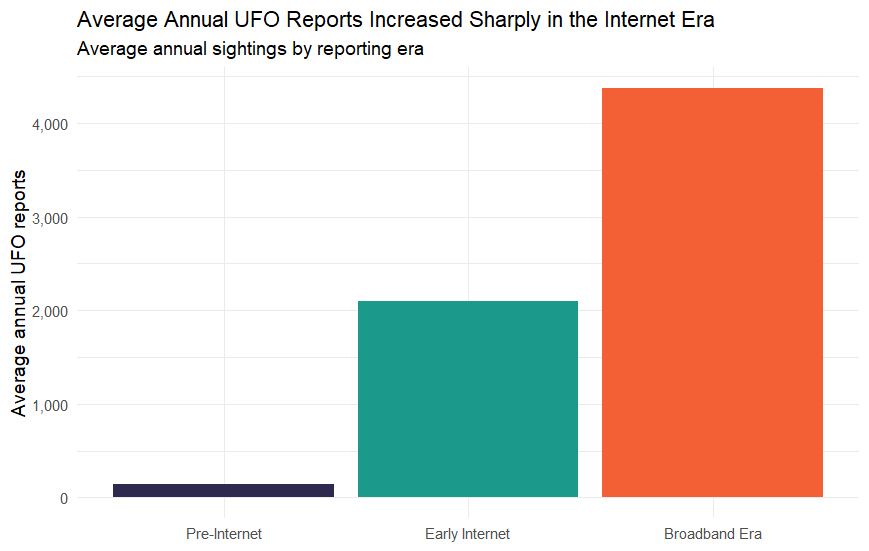
From 1949 to 1994, the dataset includes 6,418 total reports, or about 140 reports per year. During the early internet era, from 1995 to 2004, the number of reports jumped to 20,970, or about 2,097 per year. In the broadband era, from 2005 to 2013, the total climbed again to 39,372 reports, averaging 4,375 per year.
That means the average annual number of UFO reports was roughly 15 times higher in the early internet era than before the internet, and more than 31 times higher in the broadband era.
Reporting Did Not Just Increase. It Accelerated.
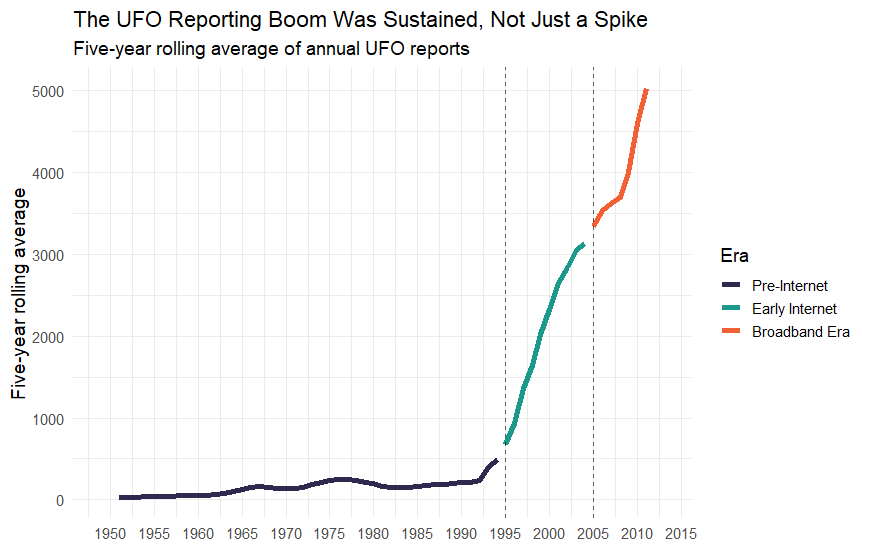
The slope tells an even stronger story.
During the pre-internet era, UFO reports increased by about 5 additional reports per year. During the early internet era, that rate jumped to about 303 additional reports per year. During the broadband era, it rose again to about 398 additional reports per year.
That is not a small change in level. It is a change in the speed of reporting growth.
In plain language: once the internet became part of everyday life, UFO reporting did not merely become more common. It began rising much faster.
But Reporting Also Became More Volatile
The internet did not make UFO reporting more consistent.
In the pre-internet era, the variance in annual reports was about 6,988. In the early internet era, it rose to about 910,160. In the broadband era, it exceeded 1.59 million.
That means the internet era produced both more reports and larger year-to-year swings.
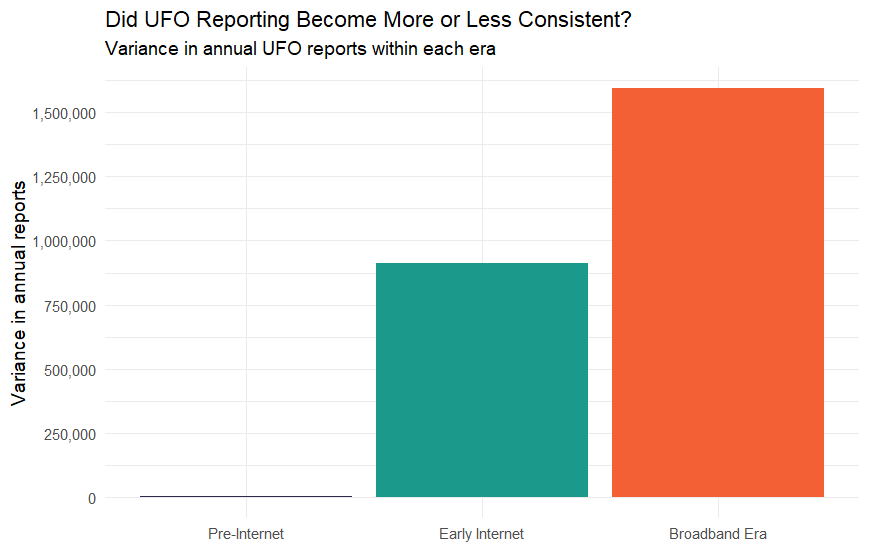
This makes sense. Online systems make it easier for people to report sightings, but they also make reporting more sensitive to news events, viral stories, media coverage, and collective attention.
The Broadband Era Looks Different
The broadband era had the highest average number of reports, but the yearly pattern was less smooth.
Average yearly change was still positive, about 321 additional reports per year, but the median yearly change was slightly negative. That tells us the era included major surges, especially around 2011–2013, rather than steady growth every single year.
In other words, the broadband era was not a calm upward climb. It was a high-volume, high-variability period.
So Did the Internet Cause the UFO Boom?
The data cannot prove causation. But the timing is hard to ignore.
The largest shift in UFO reporting does not appear in the 1950s flying saucer era or after a single Hollywood blockbuster. It begins in the mid-1990s, exactly when ordinary people gained new ways to find UFO communities, submit reports, and see that others were reporting similar experiences.
The internet likely changed UFO reporting in three ways:
- It reduced the effort required to file a report.
- It made UFO reporting more visible and socially reinforced.
- It allowed attention spikes to spread faster.
So the best answer is this: The internet probably did not make people see more strange things in the sky. It made it much easier for people to report them.
The Bigger Lesson
Every dataset is shaped by the world that produces it.
A rise in UFO reports could mean more unusual objects. But it could also mean better reporting tools, stronger communities, changing media attention, or lower barriers to documentation.
That is what makes UFO data so useful scientifically. It is not just a record of mysterious lights in the sky. It is also a record of how humans notice, interpret, and share unusual experiences.
And in this dataset, the internet may be the most important signal of all.