How Much Ocean Can You See? The Science of the Horizon
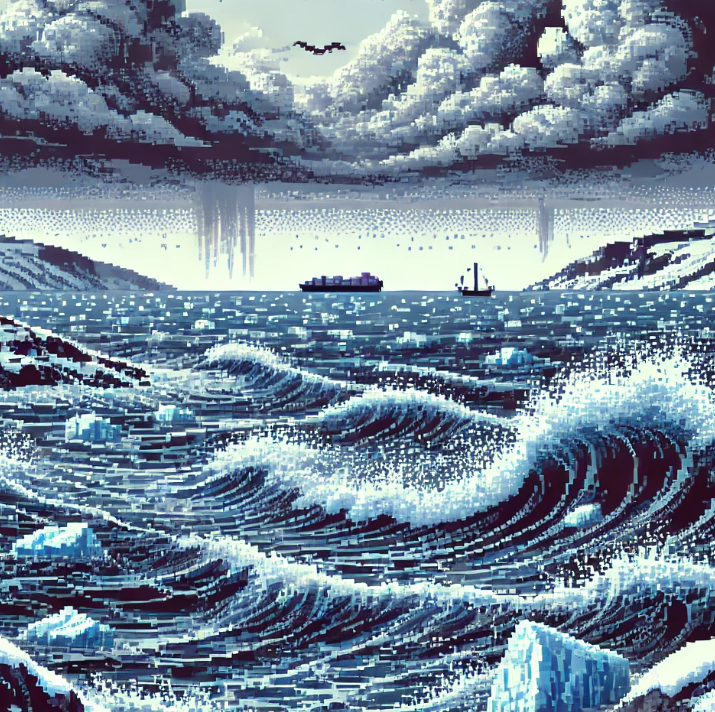
I was walking with my daughter on the beach yesterday, and we noticed a cargo ship that seemed to be fading in and out on the horizon under the humidity. She asked how far away it was. I had vaguely remembered that this horizon was very close; something like 6 miles or so. Turns out I had overestimated even that number.
If you’ve ever stood on a quiet beach and stared out over the water, you’ve probably wondered where the ocean ends. The horizon feels impossibly far away. But physics tells a different story.
So, it turns out that even on the clearest day, the curvature of the Earth places a surprisingly close limit on how much ocean you can actually see.
Let’s find out exactly how far.
How Far Away Is the Horizon?
Imagine a person who is 5 feet 10 inches (1.78 meters) tall standing at sea level on a perfectly flat beach. Ignoring waves, atmospheric refraction, and elevation changes, the distance to the horizon depends on only two things:
Your height above the Earth’s surface
The Earth’s radius
Using the standard horizon equation:
Distance ≈ √(2Rh)
where:
R = Earth’s radius (6,371 km)
h = observer height (1.78 m)
The result is:
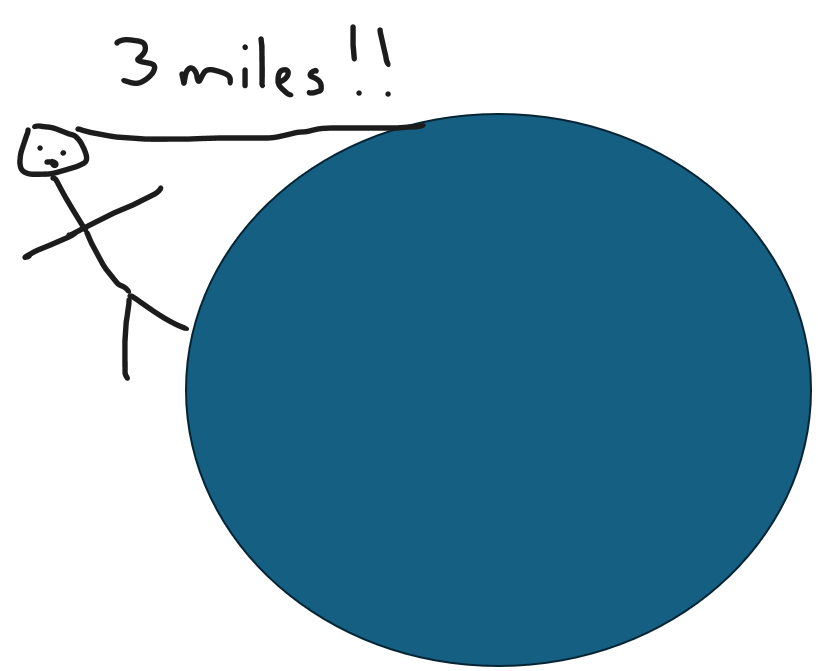
Distance to the horizon: approximately 2.96 miles (4.76 km).
In other words, no matter how clear the weather is, the ocean appears to end less than three miles away because the Earth’s curvature hides everything beyond that point.
A precise and accurate diagram
How Much Ocean Is Actually Visible?
Knowing the horizon distance lets us estimate the total ocean surface visible from that point.
The visible region forms a circular cap on the Earth’s surface. For someone standing 5 feet 10 inches tall, that works out to approximately:
27.5 square miles (71 square kilometers)
That sounds enormous until you compare it with the scale of Earth’s oceans.
The global ocean covers about 139 million square miles. From the beach, you’re seeing only about:
27.5 square miles visible
139,000,000 square miles total
That’s roughly:
0.00000002% of Earth’s oceans.
Your eyes can see only an extraordinarily tiny fraction of the water covering our planet.
Visual suggestion: A scale comparison showing a 27.5-square-mile circle next to the full area of Earth’s oceans.
Why Doesn’t It Feel That Small?
Our brains aren’t very good at judging enormous distances over featureless surfaces.
Because the ocean lacks landmarks, the horizon appears much farther away than it actually is. Add in the vast expanse of open water beyond the horizon—which remains hidden but strongly implied—and the ocean feels almost limitless.
This is one reason sailors historically disappeared “over” the horizon rather than simply becoming too small to see. The lower parts of a ship vanish first as the Earth’s curvature gradually blocks them from view.
Climbing Higher Changes Everything
The horizon depends almost entirely on elevation. If you climb:
A lifeguard tower, your visible ocean expands noticeably. A tower is about 20 feet above sea level. Standing atop one of these, the horizon extends to roughly 5.5 miles away instead of just under 3 miles. That nearly doubles your viewing distance, but because the visible area increases with the square of the radius, you actually see more than three times as much ocean surface.
A 100-foot cliff, your horizon stretches to roughly 12 miles away.
A commercial airliner cruising at 35,000 feet can see the horizon more than 200 miles away.
Every additional foot of elevation reveals more of the Earth’s curved surface.
The Curvature Is Always There
It’s easy to think of beaches as perfectly flat, but they only seem that way because Earth is so large.
The planet’s radius is nearly 4,000 miles, making its curvature subtle over short distances. Yet even someone under six feet tall experiences that curvature every time they look out across the sea.
The horizon isn’t simply where your vision fades. It’s where geometry wins.
The Takeaway
Standing on a beach at sea level, a 5-foot-10-inch person can see the horizon about 2.96 miles away, revealing approximately 27.5 square miles of ocean.
That may sound like a vast amount of water, but compared with the Earth’s oceans, it’s essentially nothing—a microscopic window into one of the planet’s largest and most mysterious environments.
The next time you stand at the shoreline, remember that the horizon isn’t the end of the ocean. It’s simply the point where the Earth curves away from view.
Free weekly newsletter
Discover something fascinating every Tuesday.
The most interesting science isn't always the science that makes the headlines. Every week, we dig into fascinating new research, strange scientific questions, surprising discoveries, and the evidence behind them.