
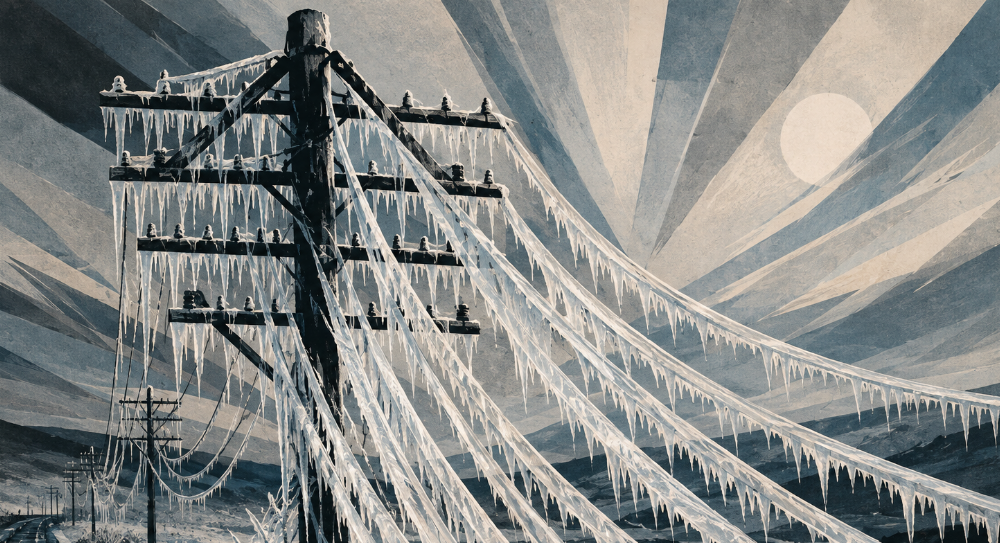
Predicting Ice on Power Lines
Transmission lines are like the arteries of our modern world, delivering electricity across vast distances to keep our lights on and our devices charged. But what happens when these vital cables become entombed in ice? It’s a question with global implications, especially in regions prone to severe winter weather.
In the race to predict and mitigate ice formation on these lines, researchers have long battled the elements. Traditional models, often limited to single types of data or algorithms, have proven imprecise against the complex dance of wind, humidity, and temperature. But a breakthrough from a team of engineers promises to revolutionize our understanding by weaving these elements together into a sophisticated multi-physics model.
Cracking the Icy Puzzle
Ice accumulation is more than just a nuisance for power transmission; it’s a potential catastrophe. It can weigh lines down until they break, lead to dangerous short circuits, and cause power outages. In essence, predicting and preventing this accumulation can safeguard both infrastructure and the uninterrupted flow of energy.
The puzzle isn’t just about catching ice accumulation early. It’s about understanding a web of conditions – how wind speed blows ice particles against wires, how temperature changes cause melting or freezing, and how humidity adds moisture to the mix. Each factor, a piece of this complex puzzle, needs to interact seamlessly to yield a reliable prediction.
The Birth of a Multi-Physics Model
Improvements in ice prediction started with a fresh approach: the multi-physics coupling model. Imagine a symphony orchestra, where each instrument must play in harmony to create beautiful music. Similarly, this model doesn’t just look at one or two aspects of weather; it harmonizes multiple environmental factors.
First, the research team created a three-dimensional simulation that accounts for various meteorological conditions affecting ice formation. They built this model using multi-physics boundary conditions, a sort of recipe combining temperature, humidity, and wind patterns, to understand how each affects the others.
This innovative approach branches away from singular methods that treat environmental factors in isolation. By using a support vector machine (SVM), this new model learned to connect the dots between complex weather data and the physics of ice formation.
What the Researchers Discovered
The results of the intensive testing were striking. The multi-physics model boasted an accuracy rate of over 98%, a significant leap over traditional methods, which often struggled to hit even 70%. By integrating various meteorological inputs, the model could provide near-real-time predictions of ice formation, allowing for advanced warnings and better-prepared responses.
What was truly groundbreaking was the model’s adaptability. It wasn’t just a one-trick pony; it demonstrated robust performance across different climates and topologies, from the icy gales of Mongolia to the humid fronts in southern China.
Why This Matters
The stakes for this research are enormous. As climate change brings more unpredictable weather patterns, tools that can accurately predict ice formation are critical. They help power companies maintain their networks without resorting to costly and environmentally damaging emergency measures like heating lines with electricity to remove ice.
This model doesn’t just offer a way to keep the lights on; it offers a blueprint for future predictive technologies in other sectors, enhancing grid resilience globally.
The Road Ahead: What Remains Unknown
While this model represents a leap forward, scientists recognize its limitations. For one, the model relies heavily on accurate meteorological data, which may not always be available, especially in remote or resource-limited areas. Additionally, the ongoing refinement of kernel functions and computational models means there’s still much to explore in making the model more accessible and cheaper to operate.
Perhaps more provocatively, combining this technology with machine learning and real-time data from IoT devices integrated into modern power grids could push its capabilities even further.
Let’s Explore Together
The journey of understanding and predicting nature’s formidable power continues, with exciting strides being made in the field of ice prediction on transmission lines. Would this innovative model inspire similar advances in other areas like agriculture or transportation? How might we adapt this model for regions where technology and resources are more limited? This breakthrough isn’t just about preventing blackouts; it’s about continuing the human legacy of understanding and overcoming the forces of nature.
- How might this discovery change the way we think about energy infrastructure in extreme climates?
- What would it take to implement this model in regions lacking sophisticated weather tracking capabilities?
- Could the principles of this model be adapted for use in fields like aviation or maritime navigation?