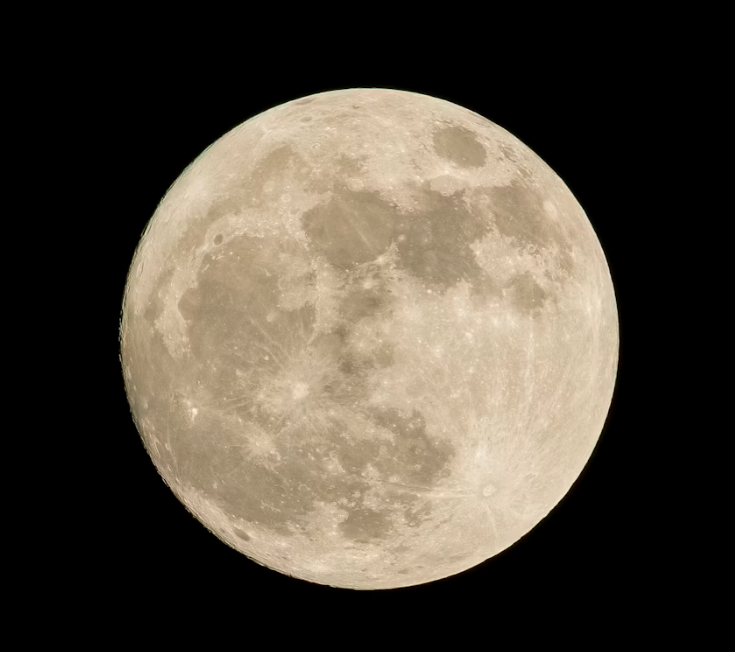
Does a Full Moon Really Change Human Behavior?
On a full-moon night, the sky performs a very old magic trick.
A familiar landscape turns silver. Shadows sharpen. Clouds glow around a bright white disk hanging over the horizon. Somewhere, a nurse jokes that the emergency room is going to be busy. A police officer remembers the last bizarre shift that happened beneath a full moon. A parent looks through the window at 2 a.m., hears a child stirring down the hall, and wonders whether the Moon has something to do with it.
We have been telling versions of this story for centuries.
The idea is so deeply embedded in Western culture that the word lunatic carries the Moon inside it, descending from the Latin luna. For generations, people have blamed lunar cycles for madness, seizures, violence, strange behavior, accidents, sleeplessness, fertility, and crowded maternity wards.
It is also an unusually testable piece of folklore.
The Moon follows a predictable cycle. Hospitals keep records. Police departments count calls. Scientists measure sleep. Births have dates. Researchers can take decades of human behavior, line those records up against the lunar calendar, and ask a wonderfully simple question:
Does anything actually happen when the Moon is full?
Scientists have been doing exactly that for decades.
The answer is mostly no.
Then we get to sleep.
And things become a little weird.
A Myth Written in Moonlight
Humans were watching the Moon thousands of years before anyone invented a p-value.
Ancient societies used lunar cycles to organize calendars, religious observances, travel, agriculture, and ritual life. It was natural to wonder whether something so enormous and regular in the night sky might influence life on Earth.
Medical beliefs eventually became entangled with those observations. Lunar phases were associated with epilepsy, fever, fertility, menstruation, and disturbed behavior. Some historical accounts connect these ideas with classical physicians such as Hippocrates and Galen, although historians have cautioned that modern retellings sometimes make those connections cleaner than the historical evidence allows.
The association survived anyway.
European medical and legal language eventually incorporated the idea of lunacy, reflecting a belief that episodes of mental disturbance could rise and fall with the Moon.
Modern medicine moved on. The story did not.
Part of the reason may be sitting directly above us.
The Moon is visible.
That sounds trivial, but it gives the lunar myth an enormous psychological advantage. Most of the possible causes of a chaotic night are invisible. Stress, staffing, random variation, sleep debt, alcohol use, weather, local events, illness, and thousands of other factors do not announce themselves by appearing as a glowing disk in the sky.
A full moon does.
A terrible Tuesday is just a terrible Tuesday.
A terrible Tuesday beneath an enormous full moon becomes a story.
By the twentieth century, researchers had the tools to find out whether those stories represented something real. They began comparing lunar phases with psychiatric hospitalizations, suicides, homicides, crimes, births, emergency visits, surgical complications, and almost anything else that could plausibly become strange when the Moon became bright.
One of the landmark efforts arrived in 1985, when psychologists James Rotton and I. W. Kelly combined 37 published and unpublished studies examining supposed lunar effects.
If the folklore was right, this was where the Moon should finally reveal itself.
It didn’t.
Across outcomes such as psychiatric disturbance, suicide, homicide, and crime, lunar phase explained less than 1% of the variation. Some apparent effects seemed to arise from methodological and statistical problems rather than a powerful lunar influence.
Four decades of additional research have given the Moon many more opportunities to prove itself.
Most of the time, it still refuses to cooperate.
Where Are the Full-Moon Psychiatric Emergencies?
Psychiatric hospitals provide one of the most obvious places to look.
The popular version of the full-moon story predicts something noticeable. If people really become significantly more unstable, aggressive, impulsive, or psychologically distressed around a full moon, psychiatric emergency departments should see some evidence of it.
Researchers have looked.
In 2026, investigators analyzed 69,764 psychiatric emergency consultations in Paris recorded between 2016 and 2023. One particularly useful feature of the study was that the researchers did not rely on a single definition of “full moon.” They tested four ways of defining lunar exposure.
That is important because a surprisingly slippery question hides inside most lunar research.
What exactly counts as a full moon?
Is it the calendar date containing the astronomical full moon? The day before and after? A three-day window? A five-day window? The entire period of high lunar illumination?
Different definitions can produce different statistical results.
In the Paris data, they didn’t.
The researchers found no significant association between lunar phase and the number of psychiatric consultations, psychiatric admissions, reasons for presentation, or diagnoses.
A Swiss study involving 17,966 psychiatric inpatient cases reached a similar conclusion. Researchers tested several lunar windows and found no association with admissions, discharges, or length of stay.
Another U.S. study examined 1,857 psychiatric emergency presentations across 41 months. The numbers were almost suspiciously boring: 464 presentations during new moon, 483 during first quarter, 449 during full moon, and 461 during third quarter.
The overall statistical comparison produced a p-value of .89.
In other words, the psychiatric emergency department appeared remarkably uninterested in what the Moon was doing.
Not every study has been negative. A 2021 investigation at an Indian hospital reported increases in several restraint and sentinel-event outcomes around full- and new-moon periods. Interesting findings like these deserve attention, especially if independent researchers can reproduce them.
That last part is crucial.
A single surprising dataset is the beginning of a scientific question. Repeated findings across settings are what begin to make a scientific answer.
So far, large psychiatric datasets have not produced a reproducible surge in crises beneath a full moon.
Surely Crime Gets Weirder
If psychiatric hospitals disappoint the werewolf enthusiast, perhaps police records can save the legend.
The crime version of the lunar myth practically writes its own movie trailer: an empty street, a full moon, a distant siren, something moving in the shadows.
Researchers have tested this version too.
A particularly useful study examined five years of police calls in San Antonio, Texas. Researchers analyzed 1,826 nights between 2001 and 2005, looking at assaultive violence, burglary, theft, drugs and vice, traffic incidents, disturbances, and overall police activity.
They also accounted for some of the ordinary things that can make one night different from another, including weekends, seasons, temperature, and precipitation.
The full moon did not produce a general crime surge.
There were occasional statistical relationships scattered across individual models, but they did not form a coherent pattern in which brighter lunar phases reliably meant more crime.
That illustrates one of the central problems with testing the Moon.
Cities already have rhythms.
Friday night is different from Tuesday morning. A warm summer evening is different from a freezing January night. Holidays change behavior. Sporting events change behavior. Alcohol changes behavior. Weather changes behavior. Police staffing and deployment can change recorded crime.
The Moon has to compete with all of them.
Once researchers account for those much larger forces, the cinematic full-moon crime wave tends to disappear.
The Emergency Room Isn’t Howling Either
Emergency departments have their own lunar folklore.
Ask enough physicians, nurses, paramedics, or emergency workers and someone will eventually tell you about a full-moon shift when everything seemed to happen at once.
The stories are memorable.
The datasets are less dramatic.
Research on trauma admissions has generally failed to uncover a meaningful lunar effect. A 2025 study specifically examining emergency trauma admissions reported no influence of Moon phase.
Another analysis followed 27,914 general, visceral, and vascular surgery patients across roughly nine years and 111 lunar cycles. Researchers looked for changes in emergency frequency, blood loss, perforated aneurysms, and gastrointestinal perforations.
Again, the full moon failed to deliver.
That does not mean emergency departments never have chaotic full-moon nights.
Of course they do.
They also have chaotic nights when the Moon is half full, barely visible, or nowhere above the horizon.
The scientific question is whether those full-moon disasters happen more often than we would expect from ordinary variation.
That pattern has been remarkably difficult to find.
What About All Those Full-Moon Babies?
Maternity wards may host the most persistent lunar legend of all.
The idea sounds almost intuitive. The Moon influences tides. Human reproductive cycles are roughly monthly. Pregnancy involves fluids. Surely something about the full moon must help trigger labor.
It is a beautiful story.
It also has a problem.
When researchers count enormous numbers of actual births, the babies seem largely indifferent to lunar astronomy.
One study analyzed 564,039 births spanning 62 lunar cycles and found no predictable influence of lunar phase on either delivery frequency or birth complications.
Other studies have occasionally reported differences associated with particular lunar phases, delivery types, or subgroups. Those isolated findings have not added up to a reproducible full-moon baby boom.
Human scheduling creates an additional complication. Modern birth patterns are influenced by inductions, planned cesarean deliveries, weekends, holidays, staffing practices, and medical decisions. Those forces can reshape the calendar far more dramatically than moonlight.
By this point, our lunar investigation is beginning to look grim.
Psychiatric crises? Mostly no.
Crime? No consistent surge.
Trauma? Nothing convincing.
Emergency surgery? No.
Births? No baby boom.
After centuries of accusations, the Moon appears to have a remarkably solid alibi.
Then scientists started watching people sleep.
The Moon’s Strangest Remaining Case
In 2013, Christian Cajochen and colleagues published a small sleep study that became one of the most famous pieces of modern lunar research.
The circumstances made it especially intriguing.
The researchers had data from 33 healthy adults who had spent nights in a tightly controlled sleep laboratory. The original experiment had not been designed to investigate the Moon. Participants were not lying in bed staring through a window at lunar light, and the investigators had not been collecting data while expecting a full-moon effect.
Later, the researchers went back and aligned those laboratory nights with the lunar cycle.
Something appeared.
Near the full moon, participants slept approximately 20 minutes less. They took about five minutes longer to fall asleep. Their subjective sleep quality declined. Evening melatonin levels were lower.
Most intriguingly, EEG measurements showed about 30% lower delta activity during non-REM sleep, a brain-wave pattern associated with deep sleep.
Suddenly the Moon had a pulse.
The result attracted enormous attention because it seemed difficult to explain with ordinary moonlight. These people had been sleeping under controlled laboratory conditions. The full moon was not simply shining through their bedroom windows.
Could humans possess some faint internal rhythm tied to the lunar cycle?
Maybe.
But there was another possibility.
Maybe 33 people were simply not enough to settle a question this strange.
The File Drawer Opens
A year later, another group of sleep researchers published a response with an unusually revealing title: Lunar Cycle Effects on Sleep and the File Drawer Problem.
Maren Cordi and colleagues examined independent sleep datasets and could not find a consistent lunar pattern.
Their point went beyond the Moon.
Imagine ten laboratories analyze old sleep data according to lunar phase. Nine find nothing interesting. Those results remain on computers, disappear into dissertations, or never become papers.
The tenth laboratory finds something bizarre.
That study gets written.
It gets published.
It gets covered by newspapers.
Suddenly the visible scientific literature contains one fascinating lunar result even though nine invisible analyses found nothing.
That is the file-drawer problem.
Null results disappear into metaphorical filing cabinets while positive results escape into the world.
Lunar research is especially vulnerable because “Scientists Find No Effect of Full Moon” has a certain lack of werewolf energy.
The disagreement between the 2013 and 2014 sleep papers turned the Moon into something more interesting than a paranormal curiosity. It became a lesson in how science handles uncertain findings.
One experiment produces an unexpected result.
Another group looks.
Then another.
Eventually, the shape of the evidence becomes more important than any individual paper.
Thousands of Children and Five Missing Minutes
A much larger experiment arrived in 2016.
Researchers examined sleep and activity among 5,812 children between the ages of 9 and 11 across 12 countries. Instead of relying on parents’ memories of whether their children slept well, the researchers used 33,710 twenty-four-hour accelerometer recordings.
This was now a very different kind of evidence.
And the Moon returned.
Sort of.
Children slept about five minutes less during the full-moon period than during the new-moon period.
Five minutes.
The difference was statistically significant.
It was also roughly 1% of total sleep duration.
The researchers themselves questioned whether such a small difference had any meaningful clinical importance.
This is one of the great tricks that enormous datasets can play on us. A very large sample can detect extremely small differences. The mathematics may tell us that a difference is unlikely to be explained entirely by sampling variation, while the actual size of that difference remains tiny.
A statistically detectable Moon is not necessarily a biologically powerful Moon.
Five minutes of sleep certainly does not explain centuries of stories about madness, murder, psychiatric crises, or supernatural behavior.
Still, something had appeared again.
The sleep mystery wasn’t dead yet.
Then Researchers Found Something Before the Full Moon
The most interesting twist arrived in 2021.
Researchers led by Leandro Casiraghi studied sleep among Toba/Qom communities in Argentina with different levels of access to electric lighting. They used wrist devices to track sleep over time rather than examining a single laboratory night.
They later looked for a similar pattern among hundreds of university students in the Seattle area.
People tended to fall asleep later and sleep less as the full moon approached.
But the strongest change wasn’t necessarily on the full-moon night itself.
It appeared roughly three to five days earlier.
That odd timing may contain a clue.
Several nights before the full moon, the waxing Moon is already bright and sits high in the sky during the evening. That means moonlight is available precisely when people are deciding whether to remain active or go to sleep.
Now we have a mechanism that does not require mysterious lunar energy.
Imagine a world before electricity.
A dark night limits what humans can do after sunset. A bright waxing Moon provides additional evening light. People remain active longer. Bedtime shifts later. Total sleep gets a little shorter.
Moonlight changes behavior because moonlight is light.
The pattern appeared across Toba/Qom communities with different levels of electrical access, and researchers found a related rhythm among Seattle students.
That does not prove that modern humans possess a universal lunar sleep cycle. The research is observational, and light exposure, social activity, culture, and other factors are difficult to separate completely.
Still, this is where the lunar story becomes scientifically interesting.
The strongest clue may not involve the full moon at all.
It may involve what people do during bright evenings before it.
Moonlight Is a Better Suspect Than Lunar Gravity
Once people hear that the Moon might influence sleep, another familiar explanation usually appears.
Humans are mostly water.
The Moon moves the oceans.
Therefore, the Moon must move the water inside us.
The analogy feels powerful because tides are powerful.
The physics does not cooperate.
Ocean tides occur because the Moon’s gravitational pull differs slightly across enormous distances. The side of Earth closer to the Moon experiences a slightly different gravitational attraction than the center and far side. Across the diameter of a planet, that difference becomes meaningful.
A human body is only a meter or two across.
The difference in lunar gravitational acceleration between your head and your feet is extraordinarily small.
There is another problem.
The gravitational geometry associated with strong spring tides occurs during both full moons and new moons, when the Sun, Earth, and Moon become aligned.
If lunar gravity causes strange human behavior specifically during a full moon, why wouldn’t we expect a similar effect during a new moon?
A full moon is primarily a feature of illumination. It tells us how sunlight is striking the Moon relative to our position on Earth.
The Moon does not suddenly switch on its gravity when it becomes round and bright.
Moonlight is a much more plausible biological suspect because we already know that light influences human circadian systems, sleep timing, melatonin, and alertness.
No exotic mechanism is required.
The chain could be wonderfully ordinary:
Bright evening moonlight encourages later activity. Later activity delays sleep. Delayed sleep shortens the night.
The Moon gets its effect without moving a single drop of water inside your body.
Except for One Annoying Detail
Remember that 2013 laboratory experiment?
Moonlight wasn’t shining directly on the participants while they slept.
That complicates a pure light explanation.
Cajochen and colleagues proposed that humans might possess an internally maintained circalunar rhythm, perhaps synchronized by environmental signals before people entered the laboratory.
Nature certainly contains lunar clocks. Marine organisms, including corals and worms, synchronize important behaviors with lunar or tidal cycles.
Humans unquestionably possess circadian clocks synchronized with Earth’s roughly 24-hour light-dark cycle.
A dedicated human lunar clock is another question.
No established molecular lunar pacemaker has emerged from these sleep studies. The laboratory result could reflect previous environmental exposure, ordinary statistical variation, individual differences, an unknown biological mechanism, or some combination of them.
For now, the Moon has given sleep researchers a tantalizing clue without giving them a clean solution.
Which is much more interesting than a simple yes or no.
How to Accidentally Discover a Lunar Effect
There is another reason the full-moon literature is so fascinating.
It is almost perfectly designed to create statistical ghosts.
Suppose you have ten years of hospital data and want to test whether the Moon influences human behavior.
First, define “full moon.”
Do you examine only the exact date?
The day before and after?
Two days on either side?
Four days?
The entire waxing period?
Illumination percentage?
Full versus new moon?
Four lunar quarters?
Days before full moon separately from days after it?
Already, you have many scientifically plausible choices.
Now choose your outcomes.
Admissions. Aggression. Restraint. Medication. Suicide attempts. Injuries. Length of stay. Sleep. Diagnosis. Age. Sex. Time of night.
Then perhaps divide the sample again.
Men versus women.
Young versus old.
Winter versus summer.
Weekdays versus weekends.
Psychiatric diagnoses versus medical diagnoses.
Suddenly, one simple question has generated dozens or hundreds of statistical tests.
Even if the Moon does absolutely nothing, something unusual will eventually appear.
Imagine conducting 20 completely independent statistical tests when every null hypothesis is actually true. At the conventional 5% significance threshold, the probability of obtaining at least one false positive is roughly 64%.
Run 100 independent tests and that probability approaches 99.4%.
Real research is more complicated because statistical tests are often related to one another, but the basic principle remains.
Search enough places and noise eventually produces something that looks like a signal.
Nobody needs to fake data.
Nobody needs to twirl a mustache and announce a plan to deceive the scientific community.
Researchers can make perfectly reasonable decisions about which groups to examine, which dates to include, which outcomes to emphasize, and which statistical models to run. Those choices create what scientists sometimes call researcher degrees of freedom.
The lunar cycle provides an extraordinary number of them.
This helps explain why one study can find something strange while several larger studies find nothing.
The Moon Has an Excellent Publicist
Statistics are only part of the Moon’s survival strategy.
Human memory helps too.
Imagine working in an emergency department.
One night is complete chaos. A bizarre injury arrives. Two patients become aggressive. Someone mentions the full moon. On your drive home, you see it hanging enormous and yellow over the horizon.
You remember that night.
Three weeks later, another shift is equally chaotic.
There is no spectacular Moon overhead.
Nothing connects the events.
The second night slowly dissolves into hundreds of other workdays.
This is fertile territory for confirmation bias. Once we expect an association, examples supporting it become easier to notice and remember.
The media can strengthen the effect.
“Moon Linked to Strange Human Behavior” practically demands to be clicked.
“Researchers Analyze 70,000 Psychiatric Consultations and Find Nothing Particularly Lunar” has a harder time competing.
Scientific publishing can contribute too. Surprising positive findings are interesting. Null findings often feel less exciting, even when the null result is exactly what we need to understand whether a phenomenon is real.
Then sleep research adds one final complication.
There may actually be a small signal.
A study showing that children slept five minutes less during one lunar period can easily mutate in popular retelling.
Five minutes of sleep becomes “the Moon affects sleep.”
That becomes “the Moon affects the brain.”
Then “the Moon affects human behavior.”
Before long, we are back to emergency rooms, crime, madness, and werewolves.
Those are separate scientific claims.
Evidence for one does not automatically support the others.
The Full Moon’s Real Trick
After decades of research, the strangest thing about the full moon may be how little happens.
Large psychiatric datasets do not show a reliable surge in consultations, admissions, diagnoses, or length of stay. Police research does not reveal a consistent crime wave. Trauma and surgical studies do not show emergency departments suddenly filling when the Moon becomes full. Hundreds of thousands of birth records do not reveal a predictable lunar baby boom.
The dramatic version of the lunar-effect story has had an enormous number of opportunities to reveal itself.
It keeps failing.
Sleep is different.
There, researchers have found just enough to keep the scientific mystery alive.
A small laboratory study found approximately 20 fewer minutes of sleep near the full moon along with changes in deep-sleep brain activity. A huge international study of children found only about five fewer minutes. Independent researchers have reported null results. Field studies have detected shifts in sleep timing several days before the full moon, when bright moonlight is available during the evening.
The evidence does not support the idea that everyone becomes restless when the Moon is full.
It does support a more interesting question.
Could humans retain a faint sensitivity to a nighttime environment that shaped our behavior for thousands of years before electric lighting?
That possibility does not require lunar madness.
It requires light, biological clocks, behavior, and a species that spent most of its history living beneath a much darker sky.
Try the Full-Moon Experiment Yourself
There is a wonderfully simple experiment hiding in all of this.
If you are convinced that the full moon ruins your sleep, don’t wait until the next bright night and see how you feel.
Write down your prediction first.
For example:
“My total sleep time will be at least 20 minutes shorter within two nights of the full moon.”
Then stop checking the lunar calendar.
For the next six months, record when you go to bed, when you wake up, how often you wake during the night, how well you think you slept, and anything else that might interfere with sleep, including caffeine, alcohol, exercise, stress, illness, travel, temperature, and unusual noise.
Only after you have collected the data should you add the lunar dates.
Then see what happened.
Maybe you really do sleep differently.
Maybe you don’t.
Either result teaches you something.
More importantly, the experiment removes one of the Moon’s greatest advantages: knowing that it is there.
You are no longer waking at 3 a.m., seeing a brilliant full moon through the blinds, and assigning it responsibility for the crime.
You are making the Moon compete against your own data.
Perhaps We Owe the Moon an Apology
For thousands of years, humans have blamed the Moon for an impressive collection of offenses.
Madness. Murder. Epilepsy. Sleeplessness. Psychiatric crises. Accidents. Emergency-room chaos. Strange behavior. Babies arriving at inconvenient hours.
Science has spent decades investigating the accusations.
Most have not held up particularly well.
The Moon does not appear to transform cities into zones of chaos once every 29.5 days. Hospitals do not reliably fill with psychiatric emergencies. Police departments do not encounter a predictable lunar crime wave. Maternity wards do not suddenly overflow.
Yet the Moon may not be entirely innocent.
There are hints that lunar cycles can interact with sleep, especially through the timing of bright evening moonlight. Those effects appear small, inconsistent, and much more interesting scientifically than the old stories about lunacy.
That leaves us with a wonderfully strange conclusion.
The full moon probably isn’t making people crazy.
It may occasionally be keeping some of us awake a little longer.
After several thousand years of accusations, that might be the weirdest result of all.