
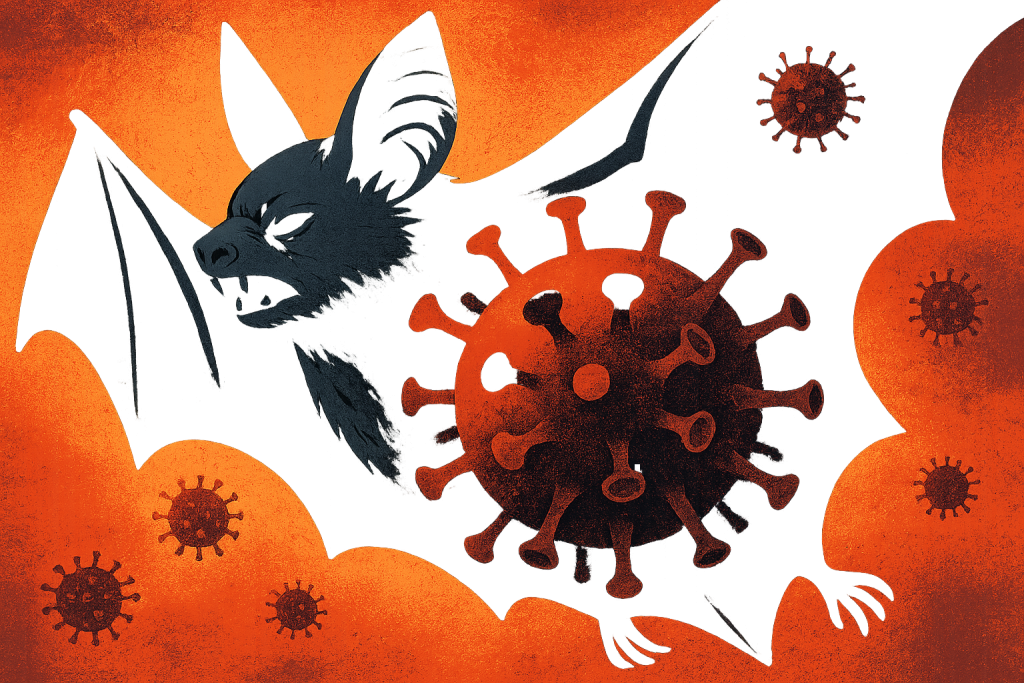
New Bat Coronaviruses in South America?
In the dense forests of Brazil, a scientific discovery is challenging our understanding of coronaviruses and their potential to cross the species barrier. Researchers have identified a new type of betacoronavirus in South American bats that could deepen our understanding of the viral diversity lurking within the animal kingdom.
The Unexpected Find
Researchers discovered the coronavirus, named BRZ batCoV, in the Pteronotus parnellii species, commonly known as Parnell’s mustached bat. Unlike its relatives, this virus contains a unique spike protein configuration previously unseen in known coronaviruses, raising intriguing questions about viral evolution and zoonotic potential.
A Peculiar Protein Feature
A surprising feature of the new virus is a distinctive furin cleavage site in the spike protein. This site, essential for viral entry into host cells, shows a different amino acid sequence — ‘RDAR’ — varying by just one amino acid from the ‘RRAR’ found in the infamous SARS-CoV-2. Scientists have long believed this feature aids in the virus’s infectivity and pathogenicity, hinting at complex evolutionary processes that could impact how diseases leap from animals to humans.
Why This Matters
The discovery of BRZ batCoV not only expands the spectrum of known bat coronaviruses but also adds a new layer to the story of viral spillovers. Because regions like South America have been less studied than Asia or Africa, this finding underscores the importance of global viral surveillance in understanding potential pandemic threats.
Peering into the Viral Past
Phylogenetic analyses place BRZ batCoV in a previously unclassified lineage, suggesting it represents a new subgenus among betacoronaviruses. This sparks questions about how these viruses evolve structural features like the furin cleavage site, potentially through recombination or insertion mutations. Such understanding can illuminate the pathways and risks of viral transmission across species.
The Global Insight
With this virus arising from a biodiversity-rich hotspot, it reminds us of the vast, untapped microbial diversity in similar underexplored ecosystems. This necessitates comprehensive metagenomic studies worldwide to uncover other potential pathogens.
Ongoing Mysteries
Despite these exciting discoveries, much remains unknown about BRZ batCoV, particularly its host interactions and potential for human infectivity. While the discovery of the furin site is significant, evaluating the zoonotic risk tied to this feature requires further research into its receptor-binding capabilities and effect on host cell dynamics.
Ultimately, this exploration into South American bats could rewrite the textbooks on coronavirus diversity and evolution. As scientists continue to decode the complexities of bat viruses, they unravel not just a single ecological narrative but an entire chapter of biology that could shape our response to future viral threats.
Build Your Own Science Issue
Tell us what fascinates you. We’ll search today’s science and build a personalized issue just for you.
Your science issue is being built.
We’re searching today’s research for stories that match your interests. Your personalized issue will arrive in your inbox shortly.
Something went wrong.
We couldn’t build your issue right now. Please try again in a moment.