Why Do Ouija Boards Seem to Work? The Science Behind the Moving Planchette
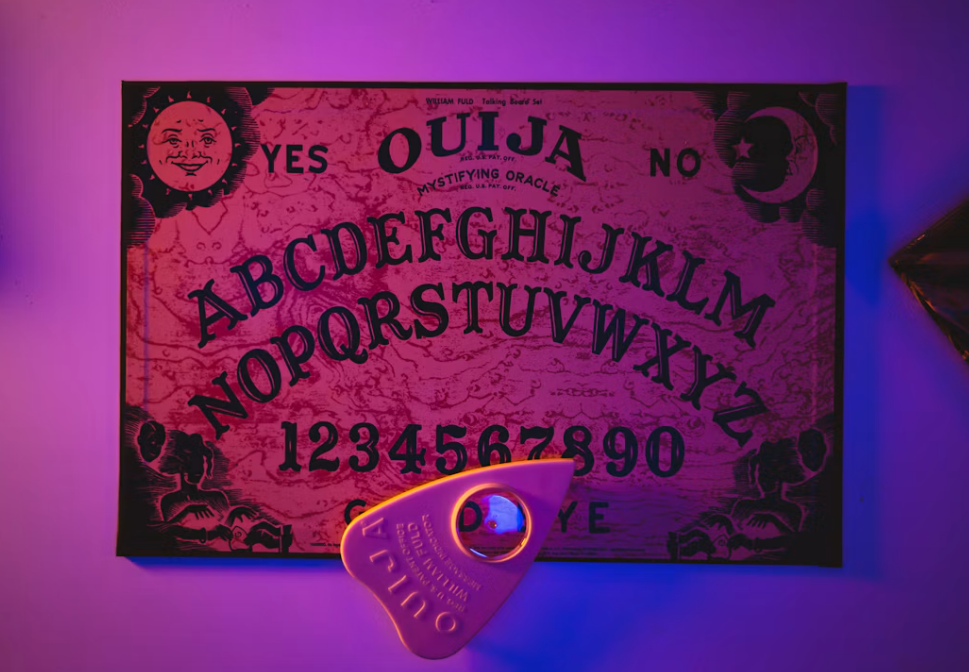
Two people sit across from each other with their fingers resting lightly on a small wooden pointer.
Someone asks a question.
For a few seconds, nothing happens.
Then the pointer begins to move.
Slowly, it slides toward a letter. Then another. Soon, it appears to be spelling a word.
Neither person claims to be moving it.
So who is?
For more than a century, that simple experience has helped make the Ouija board one of the most famous objects associated with ghosts, séances, and the paranormal. It is also a fascinating demonstration of how the human brain controls movement.
Psychologists have a name for one key process involved: the ideomotor effect.
Our thoughts, expectations, and attention can influence tiny muscle movements without those movements feeling fully intentional. Put two people together, give them an object that slides easily, ask them a question, and those tiny movements can combine into something that appears surprisingly purposeful.
The result can feel as though an outside force has taken control.
But the science of Ouija boards reveals something more interesting about us: we can act without fully experiencing ourselves as the author.
Where Did the Ouija Board Come From?
The Ouija board emerged from the nineteenth-century Spiritualist movement.
During this period, séances, table turning, automatic writing, and attempts to communicate with the dead became popular in the United States and Europe. Talking boards eventually turned those practices into something people could use at home.
We even have an early U.S. patent describing how one worked.
Elijah J. Bond received U.S. Patent No. 446,054 in 1891 for what he called an “Ouija or Egyptian luck-board.”
The board included letters, numbers, “Yes,” and “No,” along with a movable pointer. Players placed their hands lightly on the pointer and allowed it to travel around the board, supposedly answering questions.
One detail in the patent is especially revealing.
The pointer is described as being “operated by the hand.”
That simple design creates ideal conditions for tiny movements to become surprisingly noticeable.
Why the Planchette Moves So Easily
Imagine placing your fingertips on a shopping cart that rolls with almost no effort.
Now imagine someone else doing the same thing.
Neither of you needs to push very hard. A slight change in pressure from either person can move the cart. Once it starts moving, both people can unconsciously adjust their hands in response.
A Ouija planchette works in a similar way.
Several fingers rest lightly on an object designed to slide easily across a smooth surface. Tiny movements from different people become combined into one larger movement.
No single person needs to give the planchette an obvious shove.
That is one reason the motion can feel so strange.
You feel the planchette moving beneath your fingers, but you do not experience yourself deliberately pushing it.
To understand how that can happen, we need to look at something called the ideomotor effect.
The Ideomotor Effect: Moving Without Realizing It
“Ideo” refers to an idea or mental representation. “Motor” refers to movement.
The basic idea is simple:
Thinking about a movement or its result can influence your muscles without you consciously deciding to make that exact movement.
Your nervous system constantly makes small adjustments that never become the focus of conscious attention.
Imagine asking a Ouija board:
“Will I get the job?”
The word “Yes” is sitting on the board.
Maybe you desperately hope the answer is yes.
Maybe your friend thinks the answer will be yes.
Neither of you consciously decides to push the pointer toward it.
But simply thinking about an outcome can influence tiny muscle movements.
A small change in pressure gets the planchette moving.
Once it starts moving, your eyes see its direction. Your fingers feel the motion. Your brain uses that new information to make more tiny adjustments.
The planchette keeps traveling.
And it can feel as though you are following the pointer rather than helping move it.
You Can Feel the Ideomotor Effect Without a Ouija Board
There is an easy way to experience a similar effect.
Tie a small weight to a string and hold the string between your fingers like a pendulum.
Try to keep your hand still.
Now imagine the weight swinging from left to right.
Watch carefully.
For many people, the pendulum begins to move.
It can feel surprisingly independent, especially because you are actively trying to hold your hand still.
Researchers have studied this effect experimentally.
In a controlled study involving 60 college students, Robert Easton and Ronald Shor found that a handheld pendulum could begin oscillating in ways that seemed self-generated to the person holding it. Attention and visual information influenced the movement.
The mysterious force was coming from tiny muscle movements.
The person simply did not experience those movements as deliberate.
Can Ouija Boards Reveal Things You Know Without Realizing You Know Them?
This is where Ouija research gets especially strange.
Researchers Hélène Gauchou, Ronald Rensink, and Sidney Fels used a Ouija board to study unconscious knowledge.
Participants answered yes-or-no general knowledge questions in two different ways.
Sometimes they answered normally.
Other times they responded using a Ouija board.
When participants believed they knew the answer, the two methods produced similar results.
But something interesting happened when participants believed they were only guessing.
Their normal verbal answers were about 50 percent accurate, which is what you would expect from guessing between two choices.
Their Ouija responses reached 65 percent accuracy in the study.
The researchers suggested that ideomotor movements might sometimes express information that is available somewhere in the brain but is not easily available to conscious recall.
Imagine your brain as a huge office building.
Your conscious awareness is the front desk.
You ask the receptionist a question and hear:
“I don’t know.”
But someone elsewhere in the building may actually have the information.
An unconscious motor response may sometimes reflect information that never made it to the front desk.
That does not mean a spirit knows the answer.
It suggests that you may know more than you realize you know.
Why Two People Make the Effect Even Stranger
A Ouija session usually involves more than one person.
That complicates everything.
When two people move an object together, each person receives several signals at once.
You feel pressure created by your own muscles.
You also feel pressure created by the other person’s movements.
Then you respond to those movements.
The other person responds to yours.
Very quickly, the final path of the planchette belongs to the pair rather than obviously belonging to either individual.
Researchers have actually watched this process unfold.
Scientists Tracked Ouija Players’ Eyes
Marc Andersen and his colleagues studied 40 experienced or interested Ouija users at a Ouija conference.
Participants worked in pairs while wearing mobile eye trackers.
First, researchers asked them to intentionally move the planchette to known targets, including “Yes,” “No,” and the letters needed to spell “Baltimore.”
Then participants used the board normally and asked it questions.
The researchers watched where their eyes moved.
When people deliberately spelled a word, their eyes tended to look toward the next letter before the planchette reached it.
That makes sense.
If you know you are spelling “Baltimore,” you know which letter comes next.
During ordinary Ouija sessions, something different happened.
Participants were much worse at predicting where the planchette would go next.
They were participating in the movement, but they could not predict it in the same way they could predict a deliberate action.
That helps explain why the planchette can feel as though it has a mind of its own.
How Random Movement Can Turn Into a Message
The eye-tracking experiment revealed another fascinating pattern.
As answers became longer, the players became better at anticipating which letters would come next.
Think about autocomplete on your phone.
If someone types:
H
Thousands of words are possible.
If they type:
HEL
The possibilities shrink dramatically.
“Hello” suddenly becomes an obvious candidate.
Something similar can happen on a Ouija board.
The first movements may be difficult to predict.
But once several letters appear, the players’ brains begin recognizing possible words.
Those expectations can influence the next tiny movements.
Imagine the planchette has already selected:
H…E…L…
Neither player has to consciously think, “I am going to push this toward L and then O.”
Their brains are already predicting likely patterns.
Tiny movements from both people can begin pushing the planchette toward letters that complete the emerging word.
The message appears to create itself.
In reality, two interacting brains may be building it together.
Why It Feels Like Someone Else Is Moving the Planchette
Another piece of the puzzle is at play.
Moving your body and feeling that you caused the movement are not exactly the same thing.
Neuroscientists call this feeling the sense of agency.
Normally, your sense of agency works beautifully.
You decide to pick up a glass.
Your arm moves.
Your hand grabs the glass.
The glass rises.
Everything happens roughly as your brain predicted, so there is little confusion about who caused the action.
You did.
A Ouija session creates a much messier situation.
You are deliberately trying not to control the pointer.
Another person’s fingers are touching it.
The pointer moves in directions you may not expect.
Sometimes it accelerates.
Sometimes it changes direction.
Sometimes it spells something surprising.
Your brain now has a much harder time determining exactly how much of the movement came from you.
“I Swear I Wasn’t Moving It”
This explains one of the most common statements people make after using a Ouija board:
“I wasn’t moving it.”
They may be completely sincere.
Conscious awareness doesn’t monitor every tiny muscle adjustment the nervous system produces.
If the movements are small enough and the outcome unpredictable enough, a person can contribute to the planchette’s movement without feeling strongly that they caused it.
Andersen’s Ouija study captured part of this process.
Participants were less able to predict upcoming movements during normal Ouija sessions than when intentionally spelling words.
People who already believed that Ouija boards could contact supernatural entities also reported feeling less responsible for the movement.
The physical movement and the explanation for that movement are two different things.
Your muscles can contribute to an action while your brain concludes:
Something else did that.
Expectations Can Shape What Happens
People also bring expectations into a Ouija session.
You rarely sit down with a Ouija board believing that absolutely nothing unusual could happen.
The entire setting suggests otherwise.
There may be candles.
The room may be dark.
Someone may tell a ghost story.
You may ask whether a dead relative is present.
Movies and popular culture have spent decades teaching audiences what a Ouija session is supposed to look like.
All of that information enters the situation before the planchette moves a millimeter.
Expectation does not mean someone is deliberately faking the experience.
It means the brain is already predicting what might happen.
Those predictions can influence attention, interpretation, and tiny movements.
Once the planchette begins moving, the effect can reinforce itself.
Why Meaning Appears So Quickly
Human brains are extremely good at finding patterns.
That ability helps us recognize faces, understand speech, read words, predict behavior, and make sense of incomplete information.
A Ouija board gives that pattern-finding system plenty to work with.
Imagine the pointer produces:
M…A…
What comes next?
Your brain immediately begins generating possibilities.
Maybe it is spelling “MARY.”
If someone named Mary is important to one of the people at the table, that possibility becomes even more noticeable.
As more letters appear, possible interpretations become narrower.
Participants can then unknowingly contribute movements consistent with the developing interpretation.
The answer can feel as though it is being revealed one letter at a time.
In some cases, it may actually be constructed one letter at a time by the people touching the board.
How Scientists Can Test Ouija Boards
Suppose someone claims that a Ouija board is receiving information from an outside intelligence.
That claim can be tested.
The key is to remove information the people touching the planchette could use.
Researchers might ask the board to identify a randomly selected word, number, or picture hidden from everyone participating.
The researchers would choose the target before the experiment.
The researchers would decide beforehand exactly what counts as a correct answer.
Researchers would record every attempt, including failures and meaningless strings of letters.
The experiment would then be repeated many times.
Visual information can also be manipulated.
Ouija players normally stare directly at the board.
The eye-tracking research showed that visual attention contains information about where the planchette is heading, especially as meaningful answers begin to form.
Researchers can therefore change the conditions.
What happens if players cannot see the letters?
What happens if the board is rotated without their knowledge?
What happens if the letters are rearranged?
If information truly comes from a source independent of the people touching the planchette, accurate answers should continue even when you remove ordinary visual guidance and participants’ knowledge.
These kinds of experiments help separate what feels mysterious from what can be reliably demonstrated.
Why Coincidences Can Feel Incredible
Suppose you ask a Ouija board for a name and it produces something meaningful.
That can be an unforgettable experience.
But there is another statistical problem hiding in the background.
If people ask enough questions, generate enough letters, and interpret enough ambiguous responses, coincidences eventually happen.
Some answers will look meaningless.
Some will almost form words.
Some will seem vaguely relevant.
And occasionally, one will appear astonishingly accurate.
Those are the responses people are most likely to remember and tell other people about.
A strong experiment records everything.
The impressive answers count.
So do the failures.
That is how researchers determine whether the board is producing information more accurately than we would expect from chance, expectation, visual guidance, and human movement.
So, Why Do Ouija Boards Work?
Ouija boards bring together several fascinating features of the human mind.
Thoughts can influence small muscle movements without those movements feeling fully intentional.
Two people can combine their movements without either person knowing exactly how much they contributed.
The brain constantly predicts what will happen next.
As letters appear, those predictions become easier.
And when an action becomes unpredictable, our normal sense that “I caused this” can weaken.
Put all of those processes together and something remarkable happens.
A small pointer moves across a board.
It begins spelling words.
The people touching it sincerely feel that they are barely moving.
And the resulting message can appear to come from somewhere else.
Current research provides strong psychological and motor-control explanations for this effect. The Ouija board becomes an unusually effective demonstration of the ideomotor effect, unconscious movement, shared prediction, pattern recognition, and the brain’s imperfect awareness of its own actions.
Perhaps the strangest thing about a Ouija board is not that an invisible force seems to move it.
It is how easily our own brains can make it feel that way.
Build Your Own Science Issue
Tell us what fascinates you. We’ll search today’s science and build a personalized issue just for you.
Your science issue is being built.
We’re searching today’s research for stories that match your interests. Your personalized issue will arrive in your inbox shortly.
Something went wrong.
We couldn’t build your issue right now. Please try again in a moment.
Sources
Andersen, M., Nielbo, K. L., Schjoedt, U., Pfeiffer, T., Roepstorff, A., & Sørensen, J. (2019). Predictive minds in Ouija board sessions. Phenomenology and the Cognitive Sciences, 18, 577–588. https://doi.org/10.1007/s11097-018-9585-8
Bond, E. J. (1891). Toy or game (U.S. Patent No. 446,054). U.S. Patent Office.
Easton, R. D., & Shor, R. E. (1976). An experimental analysis of the Chevreul pendulum illusion. The Journal of General Psychology, 95, 111–125. https://doi.org/10.1080/00221309.1976.9710871
Gauchou, H. L., Rensink, R. A., & Fels, S. (2012). Expression of nonconscious knowledge via ideomotor actions. Consciousness and Cognition, 21(2), 976–982. https://doi.org/10.1016/j.concog.2012.01.016
Haggard, P. (2017). Sense of agency in the human brain. Nature Reviews Neuroscience, 18(4), 196–207. https://doi.org/10.1038/nrn.2017.14
Shin, Y. K., Choe, S., & Kwon, O.-S. (2023). Strong evidence for ideomotor theory: Unwilled manifestation of the conceptual attribute in movement control. Frontiers in Psychology, 14, 1066839. https://doi.org/10.3389/fpsyg.2023.1066839
Vyse, S. (2024). How does the Ouija board work? Skeptical Inquirer, 48(6), 23–27.