
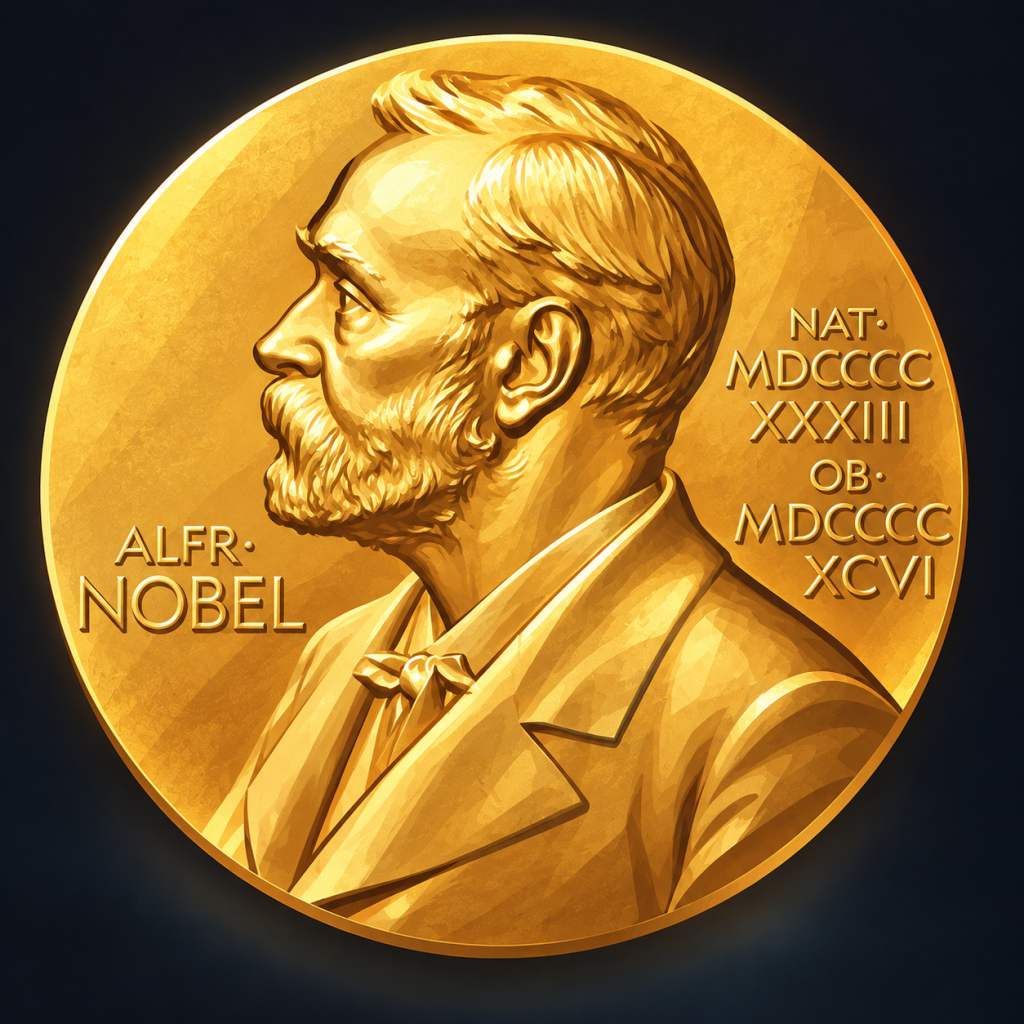
The 2026 Nobel Prizes: Four Discoveries That Could Change Our World
From controlling brain cells with light to detecting mysterious particles from space, this year’s Nobel Prize winners show how surprising discoveries can transform science, medicine, and even the economy.
Every October, scientists worldwide wait to hear who will receive one of research’s highest honors: the Nobel Prize.
The 2026 winners have explored some extraordinary questions. Can we turn brain cells on and off using light? What can particles buried in Antarctic ice tell us about the universe? Why does the shape of a molecule matter? And how can governments prevent economic crises from getting worse?
Medicine: Controlling Brain Cells With Light
Imagine being able to switch individual brain cells on and off, almost like flipping a light switch. That’s the idea behind optogenetics, a revolutionary technique developed through the work of this year’s Medicine winners, Karl Deisseroth, Peter Hegemann, and Georg Nagel
Scientists discovered special proteins in algae that respond to light. By introducing the instructions to make these proteins into certain nerve cells, researchers can control those cells with carefully directed light.
This allows scientists to investigate which brain cells are involved in movement, memory, emotions, and behavior.
Optogenetics has transformed neuroscience. It helps researchers study conditions such as Parkinson’s disease, depression, and epilepsy by identifying the brain circuits involved. Although the technique is mainly used in research, it could eventually help scientists develop more precise treatments.
Sometimes, a discovery about simple algae can change how we understand the human brain.
Physics: Catching Ghost Particles Beneath Antarctic Ice
Every second, tiny particles called neutrinos pass through your body. Most travel straight through Earth without hitting anything.
Scientists sometimes call them ghost particles because they are incredibly difficult to detect. Physicist Francis Halzen helped lead the development of the IceCube Neutrino Observatory, a massive scientific detector buried deep beneath the ice at the South Pole.
Instead of using an ordinary telescope, IceCube looks for tiny flashes of light produced when neutrinos interact with matter in the ice.
Some of these particles come from extremely powerful events far beyond our solar system.
Neutrinos offer scientists a new way to study the universe. They can carry information from violent cosmic environments that ordinary telescopes cannot fully reveal. By studying them, researchers hope to better understand the enormous natural particle accelerators found in space and the extreme forces shaping our universe. The next major discovery about outer space might come from looking deep beneath Earth’s ice.
Chemistry: Why Molecules Have a Left and Right Hand
Hold up your hands. They look almost identical, but you cannot place your left hand perfectly over your right hand.
Surprisingly, some molecules work the same way. These molecules come in two mirror-image forms. Scientists call this property chirality.
Here’s the strange part: Two molecules made from exactly the same atoms can behave very differently depending on their shape.
That is especially important when making medicines. One version of a molecule might help treat a disease, while its mirror image could have a different effect.
Winners Henri B. Kagan and Kenso Soai helped scientists understand how chemical reactions can favor one molecular shape over another. Soai’s work also showed how a tiny initial difference can grow through a reaction in which a product helps create more of itself.
Their discoveries help chemists design more precise chemical reactions, potentially making medicines easier and safer to produce. The research also addresses a mystery about life’s origins: Why do living things favor particular mirror-image versions of important molecules?
Understanding how one form becomes dominant could help explain how life’s chemistry developed in the first place.
Economics: How to Keep an Economy From Falling Apart
What happens when prices suddenly rise, people stop spending, or businesses start laying off workers? These problems affect millions of people, but responding to them is surprisingly difficult.
Economists Robert E. Hall and Michael Woodford developed research that helps explain how ordinary people and businesses shape the larger economy through their decisions.
For example, people don’t decide how much money to spend based only on what they earn today. They also think about how much they expect to earn tomorrow.
Businesses make similar predictions when deciding whether to raise prices, hire workers, or invest in new equipment. These expectations can influence whether an economic crisis becomes worse or begins to improve.
Woodford also helped explain how central banks can influence the economy by communicating their future interest-rate plans.
Their research has helped governments and central banks develop better tools for responding to inflation, recessions, and unexpected economic shocks.
These models cannot prevent every crisis. But they can help policymakers understand how their decisions might affect jobs, prices, and household finances. Economics might seem less exciting than ghost particles or light-controlled neurons, but its discoveries can influence everyday life just as much.
What Comes Next?
The impact of these discoveries will continue long after the Nobel ceremonies are over. Researchers are already using optogenetics to better understand the brain, neutrino detectors to investigate distant events in space, and advances in chemistry to develop new ways of making medicines. Meanwhile, economic research continues to shape how governments respond to inflation and financial uncertainty.
There are still plenty of unanswered questions. Can light-based techniques eventually help treat neurological disorders? What else might neutrinos reveal about the universe? Could understanding molecular chirality help explain how life began?
We may not know the answers for years, or even decades. But that’s part of what makes these discoveries worth following. The Nobel Prize recognizes work that has already changed its field, while much of its practical impact may still lie ahead.
Build Your Own Science Issue
Tell us what fascinates you. We’ll search today’s science and build a personalized issue just for you.
Your science issue is being built.
We’re searching today’s research for stories that match your interests. Your personalized issue will arrive in your inbox shortly.
Something went wrong.
We couldn’t build your issue right now. Please try again in a moment.