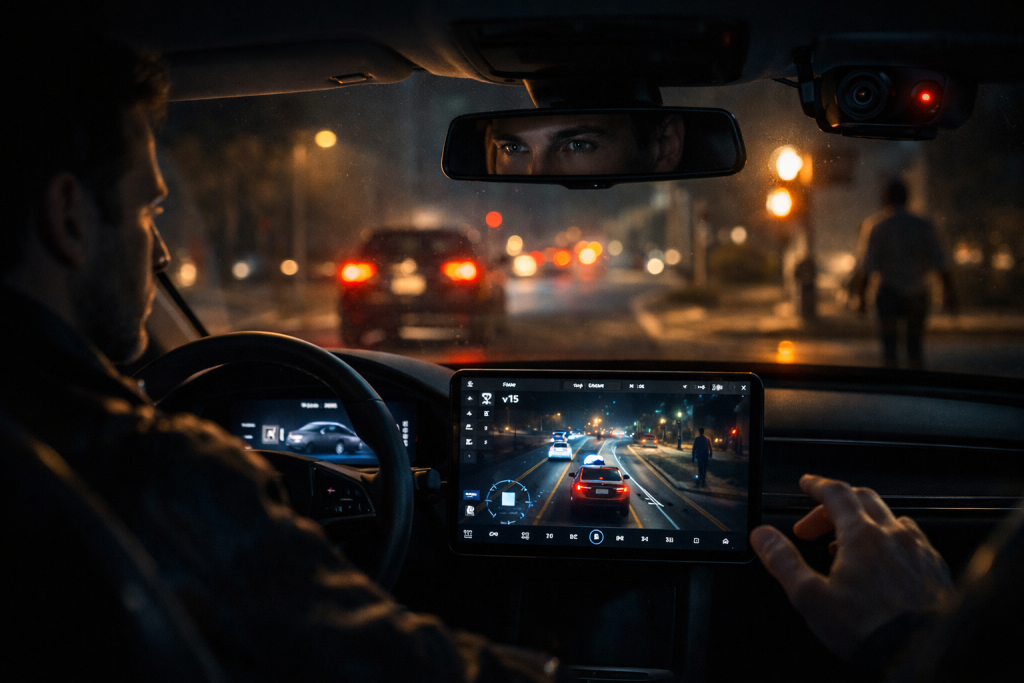
Tesla FSD v15 Is Rolling Out, but the Most Interesting Science Is Still Human Attention
A car that gets smarter while it sits in your driveway sounds like science fiction. That is part of what makes Tesla’s latest Full Self-Driving update, FSD v15, so fascinating. The software appears to be rolling out now to early users, with a wider release expected soon. But the biggest science story is not that cars are suddenly driving themselves. It is that humans and software are learning to share control in one of the hardest settings possible: real roads.
The company calls it Full Self-Driving (Supervised). That last word does a lot of work. It means the driver must stay alert, keep attention on the road, and be ready to take over at any moment. So even as FSD v15 generates buzz, the real question is not whether this is autonomous driving. It is whether better software can make supervised driving safer, smoother, and easier for human brains to manage.
A software update with very physical consequences
Most software updates fix bugs, change menus, or add a feature or two. Driving software is different. When it changes, it can alter how a two-ton machine moves through traffic, handles turns, reacts to people, and chooses paths through a messy world.
Tesla says customers receive over-the-air software updates, and release notes can be viewed on the car’s touchscreen. That means systems like FSD can evolve without anyone replacing hardware in the driveway. In simple terms, the same car can behave differently next month than it did this month.
That is a remarkable idea in science and engineering. Cars used to improve slowly, one model year at a time. Now some of the most important changes arrive like a phone update. For drivers, that creates excitement. For scientists, it creates a live experiment in how humans adapt when machines around them keep changing.
Why “supervised” may be the most important word in the whole story
People often talk about self-driving technology as if the goal were just better code. But the harder challenge may be human attention.
When a person drives normally, their brain is busy every second: watching lane lines, predicting what another driver might do, adjusting speed, and planning the next move. Supervised driving systems change that job. Instead of doing every action, the human becomes a monitor.
That sounds easier. Often, it is not.
Monitoring is mentally strange work. If the system handles long stretches smoothly, the driver may feel less urgency. But they still need to be ready for the rare moment when the software needs help. In other words, the task shifts from active control to steady vigilance, and humans are not always great at that kind of waiting game.
That is why Tesla’s continued use of the label Supervised is scientifically important. It keeps the focus where it belongs: on the partnership between person and machine, not on the fantasy that the human can disappear from the loop.
Billions of miles turn roads into a giant learning lab
Tesla says its FSD (Supervised) fleet has now logged more than 6.5 billion miles on public roads worldwide. That number is striking because driving is one of the most complicated things ordinary people do every day. Roads are full of surprises: bad weather, unclear lane markings, unusual intersections, cyclists, pedestrians, and drivers who behave unpredictably.
Each mile adds to a huge real-world test of what driving software can handle. It also shows why updates like FSD v15 attract so much attention. They are not just new features. They are part of a long-running effort to make a machine interpret a world that even humans often find confusing.
Think of it this way: a chess computer plays on a neat board with fixed rules. A driving system plays in a moving puzzle where the pieces don’t always follow the rules, some lines are faded, and the lighting can change every few seconds. That is why road behavior is such a hard scientific problem.
The brain science of trusting a machine that is not fully in charge
One of the most interesting parts of this story has nothing to do with motors or maps. It has to do with trust.
Humans constantly decide how much to trust tools. We trust elevators to stop at the floor. We trust autopilot systems in airplanes within clearly defined limits. We trust navigation apps to suggest routes, but we still glance up to make sure the road is actually there.
Supervised driving requires a very specific kind of trust: enough to let the system help, but not so much that the driver stops paying attention. That balance is delicate. If the system behaves well most of the time, people may begin to assume it will behave well all the time. That is exactly when supervision can weaken.
So the science challenge isn’t just making the car better at driving. It is helping the human stay mentally engaged at the right level. Too little trust, and the tool becomes stressful and annoying. Too much trust, and the person may not step in fast enough when needed.
Why FSD v15 matters even without changing the car’s legal or technical status
There is a temptation to treat every major update as a leap into full autonomy. That is not what Tesla’s official support language says. The company still describes FSD as a supervised driver-assistance system, not autonomous driving.
But that does not make the update unimportant. A supervised system can still matter a great deal if it improves how naturally the car moves, how clearly it handles routes, or how often drivers feel the need to intervene. In practical terms, the difference between a jerky, uncertain system and a smooth, predictable one can shape whether the human stays calm, attentive, and ready.
That is the real scientific frontier here. Not a magical switch from “not self-driving” to “self-driving,” but gradual changes in how well software and humans cooperate during complicated tasks.
Cars are becoming computers on wheels, and that changes what progress looks like
For most of automotive history, progress looked mechanical: stronger engines, safer frames, better brakes. Those things still matter. But systems like FSD show that some of the most dramatic changes in transportation now come from computation.
A modern vehicle can sense, predict, and update in ways earlier cars never could. That makes the car less like a fixed machine and more like an evolving platform. The science challenge becomes broader too. Engineers need to improve perception, decision-making, and control. Designers need to shape how people understand the system. And drivers need to learn how to work with a machine that can do a lot, but not everything.
That is why the story around Tesla FSD v15 reaches beyond one company or one product. It points toward a future where the biggest transportation breakthroughs may depend just as much on psychology and human factors as on code.
The road ahead is really about teamwork
FSD v15 is generating attention because people want to know how close cars are to driving themselves. But the more revealing science story is simpler and more human. We are living through a new phase of transportation where cars can assist in powerful ways, yet still rely on people to stay engaged.
That makes the driver’s brain part of the system.
If supervised driving becomes safer and more useful, it will not be because software replaced humans overnight. It will be because engineers got better at building a partnership: a machine that handles more of the routine work, and a person who can still step in when the world gets weird. On real roads, that teamwork may be the hardest problem of all.
Build Your Own Science Issue
Tell us what fascinates you. We’ll search today’s science and build a personalized issue just for you.
Your science issue is being built.
We’re searching today’s research for stories that match your interests. Your personalized issue will arrive in your inbox shortly.
Something went wrong.
We couldn’t build your issue right now. Please try again in a moment.
References
Tesla Support: Full Self-Driving (Supervised)
Tesla Support: Software Updates
Tesla: FSD (Supervised) Dashboard
Tesla North: reporting on FSD v15 release notes
Tesla Briefing: Musk says FSD v15 goes to wide release in December