Science Grab Bag! Why Positronium Acting Like a Wave, New Mars Organics, and DESI’s 47‑Million Galaxy Map Matter
Three stories, one thread: new ways to see matter, life, and the cosmos
This week delivered breakthroughs that operate at opposite extremes of scale but share a common consequence: they expand what instruments — and human ingenuity — can reveal.
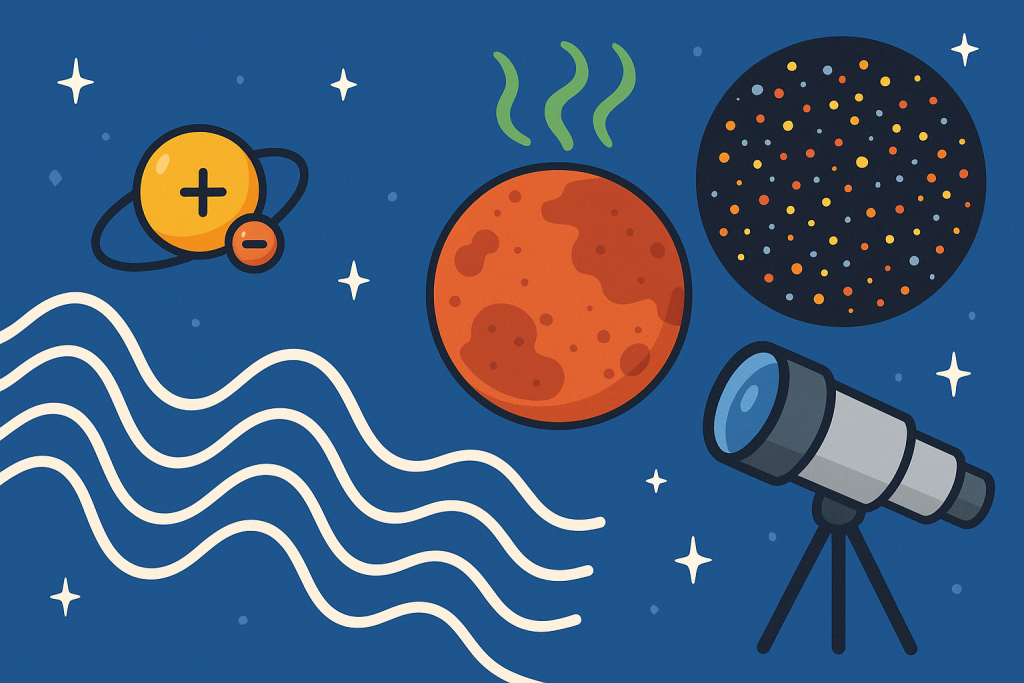
In labs, physicists coaxed an atom of antimatter to behave like a wave; on Mars, Curiosity detected organic molecules that echo the chemistry of life; and across the sky, the Dark Energy Spectroscopic Instrument (DESI) finished the largest high‑resolution 3D map of the universe to date, cataloging data from some 47 million galaxies and quasars.
Each result stands on its own; together they refocus a central question of modern science: how we verify the deepest theories, and what new experiments those verifications enable.
1) Antimatter shows wave interference: a quantum door opens
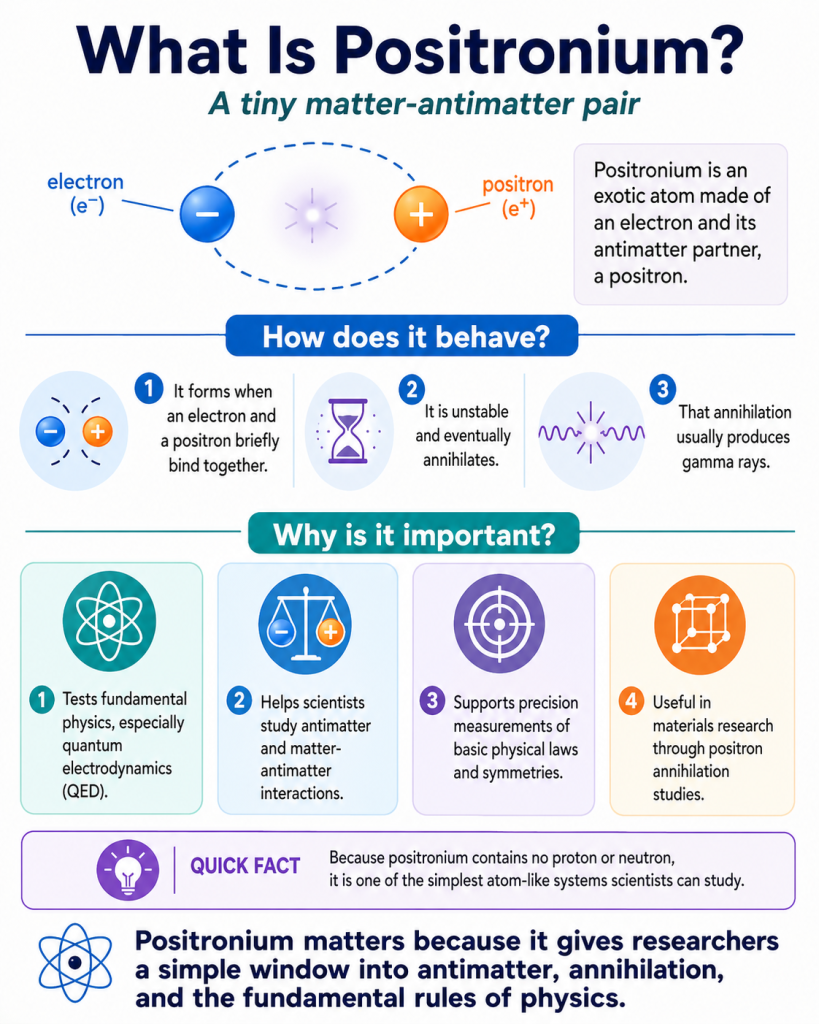
Researchers have, for the first time, observed wave‑like interference in positronium — a short‑lived bound state of an electron and its antimatter partner, the positron. The finding is reported as the first demonstration of wave behavior in an antimatter ‘atom’, and it does more than confirm quantum weirdness: it creates a new tool for precision experiments with antimatter.
Why that matters: experiments with positronium interference could be the route to direct tests that were previously impractical, including attempts to measure how antimatter responds to gravity. The ScienceDaily summary notes this breakthrough ‘opens the door to new experiments involving antimatter, including the possibility of testing how gravity affects it — something never directly measured before’ (ScienceDaily).
2) Curiosity finds diverse organics on Mars — not life, but a richer story
NASA’s Curiosity rover has detected a surprising variety of organic molecules in ancient clay‑rich rocks on Mars, including compounds that resemble building blocks of DNA. The discovery does not claim evidence of past life, but it raises the odds that early Martian environments were chemically capable of supporting prebiotic chemistry. ScienceDaily summarizes the result carefully: these organics may be billions of years old and preserved where water once existed (ScienceDaily).
Why that matters: finding robust, varied organics in a depositional environment increases the value of targeted sample collection and motivates future missions to return those samples for laboratory analysis on Earth. It also informs where astrobiologists should look next: clay‑rich, long‑lived wet environments remain top candidates for preserving biosignatures.
3) DESI’s 47‑million galaxy map rewrites the cosmic yardstick
The Dark Energy Spectroscopic Instrument collaboration has completed the most detailed 3D survey ever made, mapping spectra from more than 47 million galaxies and quasars. This dataset is a leap forward for cosmology: it sharpens measurements of how structure grows over cosmic time and offers new leverage for testing whether dark energy is truly constant or evolving.
ScienceDaily frames the scale and potential of the map: it could unlock new clues about dark energy — the mysterious force driving the universe’s expansion (ScienceDaily).
What links these breakthroughs?
At first glance, the lab table, the Martian outcrop, and the cosmic web are unrelated. But three themes connect them:
- Precision instruments expand the range of questions: novel measurement techniques — whether interferometers for exotic atoms, rover‑mounted mass spectrometers, or multi‑object spectrographs spanning the sky — enable experiments that were previously impossible.
- Cross‑scale logic: testing fundamental symmetries in particle physics feeds our models of cosmology, while better cosmological maps refine the context for high‑precision local tests.
- Data-to-idea pipeline: big, high‑quality datasets change the questions we ask. DESI’s map will produce statistical anomalies to chase; Curiosity’s organics set priorities for sample return; antimatter interference creates new experimental platforms.
Key takeaways for scientists, funders and curious readers
- Expect cross‑disciplinary follow‑ups: a precision antimatter interferometer suggests tabletop tests of fundamental physics that complement large facilities like DESI.
- Astrobiology remains cautious and optimistic: Curiosity’s organics are compelling, but terrestrial lab analysis of returned samples will be decisive.
- Big surveys scale new puzzles: DESI’s map sharpens tensions in dark‑energy measurements that could lead to new physics or better modeling of known processes.
Where to read more (primary coverage)
- ScienceDaily: Scientists catch antimatter “atom” acting like a wave for the first time
- ScienceDaily: NASA Curiosity rover finds mysterious life linked molecules on Mars
- ScienceDaily: This massive 3D map of 47 million galaxies could unlock dark energy
- ScienceDaily: MIT scientists turn chaotic laser light into powerful brain imaging tool (instrumentation example)
What to watch next
Short term, look for:
- Follow‑on antimatter experiments aimed at gravitational tests or higher‑precision interferometry.
- Announcements from Mars sample‑return planning and any lab analyses of Martian organics.
- Cosmological analyses from DESI teams testing dark‑energy models and cross‑checks with other surveys.
Longer term, the week’s stories are a reminder that scientific progress advances on two axes: building instruments that see new signals, and building theories that explain the unexpected patterns those instruments reveal. When both move forward — from the subatomic to the cosmic — the result is a sharper, more testable picture of nature.
If you want a tight reading list to start today, begin with the ScienceDaily pieces linked above — they link to the primary research and provide balanced summaries of what each discovery does and does not claim.