Can We Predict When Galaxies Will Form Bars?
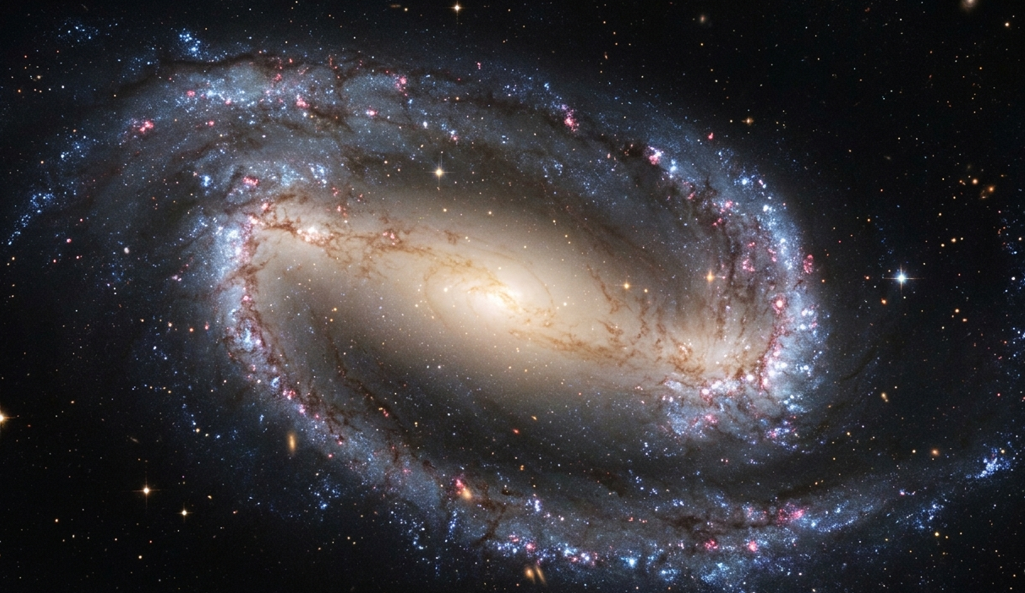
Did you know that two-thirds of spiral galaxies have mysterious structures in them called ‘stellar bars’? What if understanding when these bars form could tell us about how galaxies evolved over time?
Let’s bring this cosmic ballet down to Earth. Imagine you’re baking bread. The texture of your dough is like the different conditions in a galaxy’s disc. Some doughs are rolled out thin; others are thick and dense. If the environment in the galaxy’s disc is ‘right,’ something complex and beautiful emerges over time.
But how do scientists study something that’s millions of light-years away? Matthew Frosst and his team from the International Center for Radio Astronomy Research simulate 145 galactic discs in a computer to unravel this question. Imagine spinning a disc on a turntable. If you spin it too fast, it wobbles and destabilizes, but at the right speed, it settles into a balanced, predictable pattern. This is much like how stellar bars form over time.
Stellar bars were thought to form swiftly in calm, chilly galactic environments, but recent findings have suggested they can also appear in turbulent galactic settings. Why does this matter? Well, for experts trying to predict climate or design cities with less access to power, knowing when and why these bars form might explain past tumultuous eras in our universe.
And so, researchers like Frosst analyze how changes in a galaxy’s environment influence the speed at which these bars appear using three basic stability measures:
- Disc Mass Fraction: How much of the galaxy’s mass is in the disc?
- Rotation-to-Stability measures: The balance between how fast and how stable it is.
- Energy and Binding parameters: Do the stars stick together, or are they whirling outwards?
A Stellar Discovery
Frosst’s research breaks new ground by introducing thick, turbulent discs in simulations, more closely aligned with high-redshift or ‘primitive’ universe conditions. His models show stellar bars can grow even when galaxies seem ‘too wild’ for stability. Picture a windy day at the beach with weather too chaotic for a sandcastle to form. Their findings prove sometimes chaos and collaboration can coexist.
The scientists realized that any galaxy supporting a dense enough disc mass could see bars emerge within a cosmic blink, given the right parameters. Disc-dominated galaxies behave like tightly rolled dough, ready to form shapes quickly when spun.
Furthermore, his study highlights the role of velocity dispersion, which the speed at which stars deviate from their usual paths, vertically or radially. Higher dispersions slow bar emergence, functioning like a ‘cosmic break,’ just like a dough that’s under-kneaded.
Ripple Effects on Our Real Lives
Why should you care about stellar bars? Consider living in a rapidly urbanizing environment or planning agriculture amidst climate change. Stellar bars help galaxies transfer angular momentum through gravitational interactions with dark matter haloes. These concepts aligned with how we might think about energy exchange in cities or crops adjusting to wind patterns.
What’s next for this cosmic quest? Cosmologists need to integrate gas and stellar-wind feedback into galaxy models. Think of this as allowing for more accurate weather forecasting by understanding wind turbulence.
Let’s Explore Together:
- Could understanding galactic bars revolutionize insights into climate-based modeling or urban planning?
- How might advancements in simulating stellar movements provide perspectives on global changes closer to home?
- Will these models change how we perceive the universe’s past and future stability?
Beyond being celestial curiosities, stellar bars offer us windows into universal patterns we might apply here and now to our changing Earth. The story of our cosmos continues to unfold through each discovery, one bar at a time.
For more on this captivating galactic dance, delve into the full study by Frosst and his team, available through MNRAS.