
Breakthroughs in Energy, Cancer, and Agriculture
This week, science is spotlighting some of humanity’s toughest challenges — balancing energy needs with a warming planet, improving cancer care, and boosting food security. From China’s ambitious path to carbon peak in the Yellow River Basin to innovative ways to assess fitness in cancer patients, and cutting-edge AI tools to protect vital crops, these advances offer promising directions without overpromising quick fixes. Let’s unpack why these findings matter for all of us.
Revolutionizing Energy in China’s Heartland
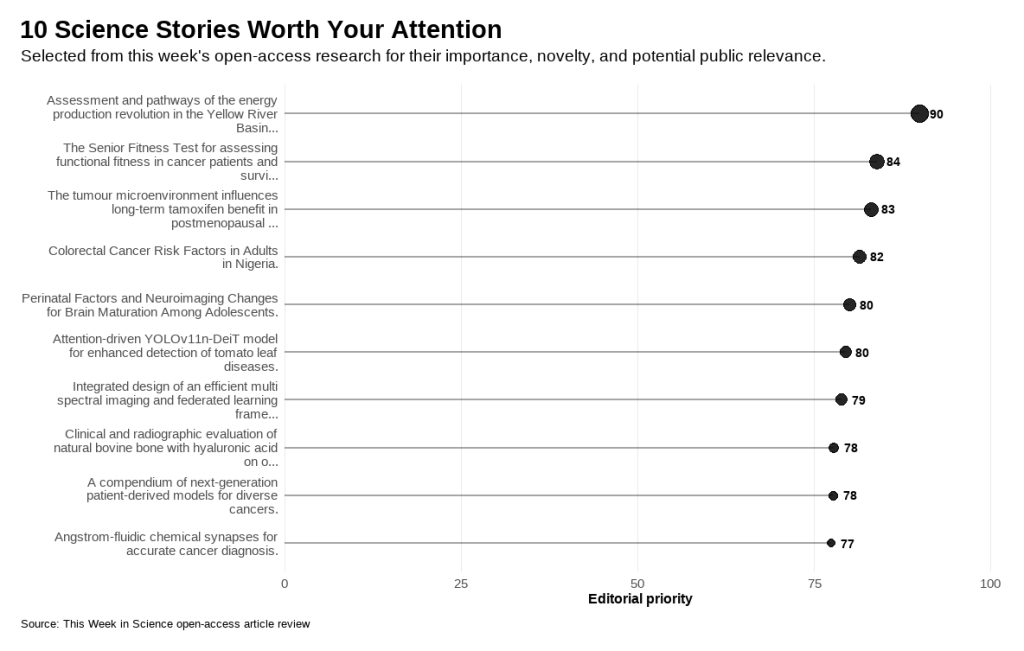
The Yellow River Basin in China is crucial not only for the country’s energy supply but also for achieving peak carbon emissions and progressing toward net-zero goals. A recent study has introduced an Energy Production Revolution Index that evaluates the cleanliness, low-carbon characteristics, security, and efficiency of energy production across different provinces. From 2010 to 2023, the index has shown a steady increase, although it has not yet reached optimal performance levels. The research predicts that by implementing optimal strategies in wind-rich regions and encouraging innovation in areas abundant in hydro and solar energy, the basin could achieve carbon peaking between 2027 and 2030. By 2045, energy production in certain areas could reach “Excellent” levels, significantly improving sustainability.
This issue is critical because the Yellow River Basin represents the global challenge of transitioning to sustainable energy, balancing economic growth, environmental protection, and energy security. The study offers detailed insights that suggest region-specific strategies, supported by machine learning, can effectively guide the energy transition, avoiding a one-size-fits-all approach. This provides policymakers with practical tools to manage the energy revolution in a realistic and efficient manner.
Better Measuring Cancer Patients’ Physical Health
Cancer survivors often experience ongoing declines in physical function, which can negatively impact their quality of life. However, commonly used clinical tools, such as the ECOG Performance Status, provide only subjective assessments of a patient’s condition. Researchers have tested the Senior Fitness Test (SFT), a series of standardized physical assessments, on cancer patients who are undergoing or recovering from treatment. The results indicated that these patients had a “fitness age,” a comparison of their physical function to healthy individuals, that was nearly nine years older than their actual age. Importantly, this decline in fitness was not fully captured by traditional ECOG ratings, nor was there a significant difference in fitness levels between patients currently undergoing treatment and those who are survivors.
These findings emphasize the necessity of objective fitness testing in cancer care. Understanding specific functional deficits can help in designing targeted exercise programs and rehabilitation strategies to improve long-term health outcomes. This serves as a reminder that survivorship care should extend beyond simply controlling cancer; it must also address patients’ overall well-being.
Tumor Microenvironment’s Role in Breast Cancer Treatment Success
New insights have emerged from a large trial involving postmenopausal women with estrogen receptor (ER)-positive, HER2-negative breast cancer who were treated with tamoxifen. Scientists analyzed the populations of immune and stromal cells within the tumors to understand how these components of the tumor microenvironment influence long-term treatment benefits. They discovered that tumors with low levels of immune cells but intermediate levels of blood vessels (endothelial cells) and certain stromal cells responded better to the treatment.
This research suggests that the surrounding cells play a significant role in how effectively the drug works, highlighting the importance of personalized therapy. The significance of this study lies in its focus on the tumor’s ecosystem, rather than just tumor genetics. Understanding the interactions between immune and structural cells and therapies like tamoxifen could lead to better predictions of patient outcomes and guide new approaches for customizing treatment.
AI and Imaging Innovations Transforming Crop Disease Management
Food security relies significantly on protecting crops from diseases that can severely reduce yields. Two recent technological advances offer promising solutions, especially for farmers in resource-limited settings:
- A deep learning system that combines YOLOv11n and transformer AI models has been developed to detect tomato leaf diseases. This system has been tested on public datasets and achieved impressive accuracy, with precision rates of up to 97.8%. It allows for rapid analysis and outperforms previous methods, enabling early disease detection to help save crops.
- Another framework integrates multispectral imaging with federated learning, a privacy-conscious AI training approach, to diagnose diseases in low-resource farming communities.
This system achieves about 95% accuracy in identifying various stresses and can forecast disease progression. This capability helps farmers adjust their treatments dynamically. Why it matters: These AI-powered tools can democratize advanced crop disease diagnostics, addressing infrastructure gaps and preventing losses that threaten livelihoods and food supplies. Real-time, accurate identification combined with scalable learning models has great potential for promoting sustainable agriculture worldwide.
Putting It All Together: Why These Advances Matter Today.
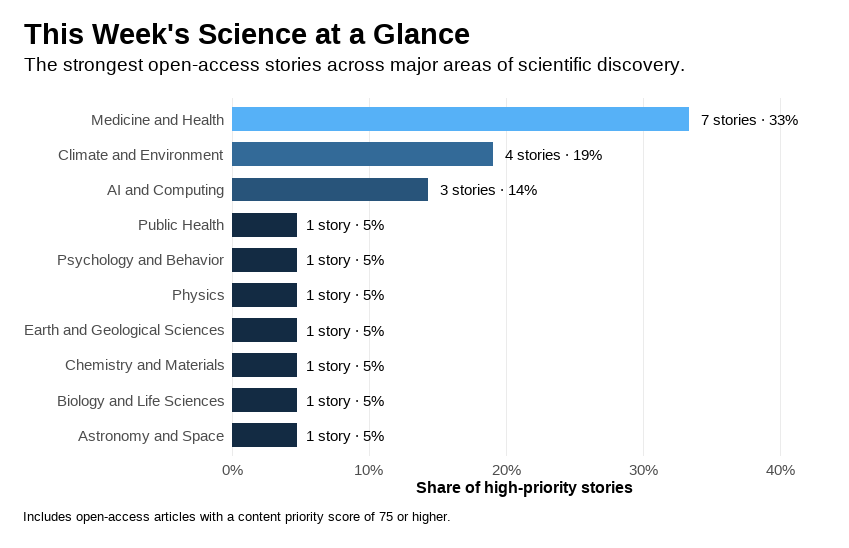
Studies across various fields, including energy, health, and agriculture, highlight practical, data-informed (not driven) innovations that address real-world complexities. Rather than relying on simplistic “silver bullet” solutions, these studies outline incremental, evidence-based pathways for progress. For example, they explore China’s energy strategies enhanced by machine learning, improved physical fitness assessments that support cancer survivorship, a refined understanding of tumor microenvironments that enhances breast cancer treatment, and AI tools that help safeguard crucial crops. Each of these efforts contributes to our capacity to thoughtfully and effectively tackle urgent challenges. Science is steadily laying the groundwork for a healthier and more sustainable future—one carefully measured step at a time.