
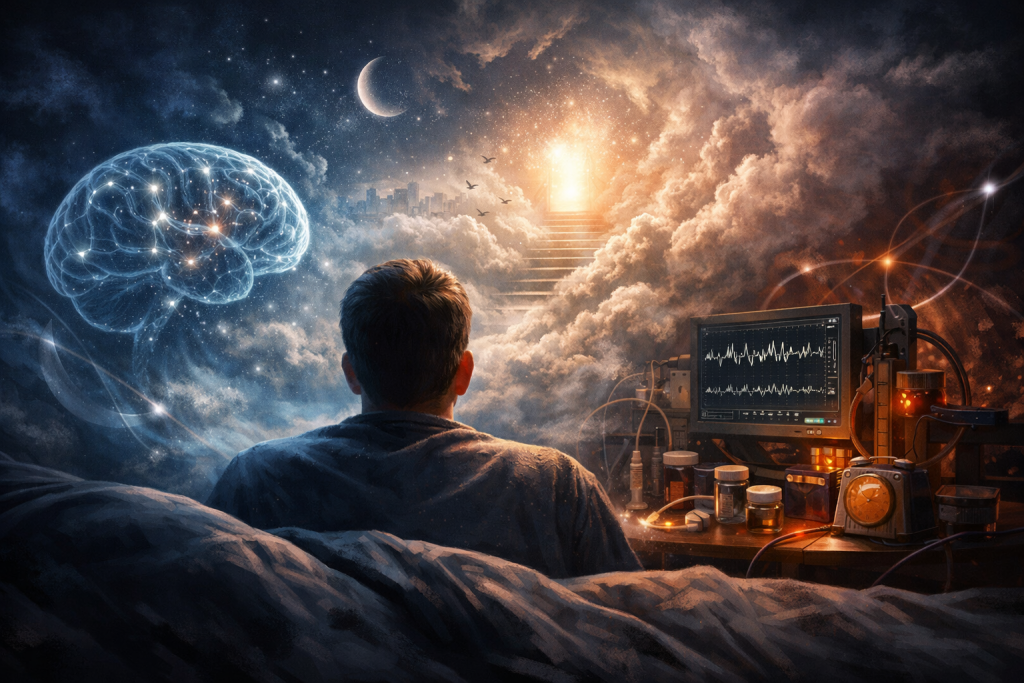
Why Do We Dream? Science Has Clues, but No Final Answer
Why do we dream? It seems like a simple question. After all, almost everyone dreams. But neuroscience still does not have one final answer.
That may be the most surprising part of dream science: researchers have learned a great deal about sleep, brain activity, memory, and emotion, yet the exact purpose of dreams remains an open question. The strongest ideas suggest dreams may be linked to memory processing and emotional regulation. At the same time, scientists also know that dreaming does not happen only in one kind of sleep, and that outside sights, sounds, and sensations can sometimes shape what we dream about.
In other words, dreams are familiar to us, but scientifically, they are still mysterious.
Dreaming is common, but its purpose is still unsettled
Researchers do not agree on a single explanation for why humans dream. Reviews of the evidence describe dream function as unresolved, not solved. That means scientists are still testing several ideas rather than pointing to one proven answer.
This is important because dreams can feel meaningful, strange, emotional, and vivid. People have long wondered whether they are messages, mental housekeeping, rehearsal for danger, or simply a side effect of a sleeping brain. Modern science has not confirmed any one of those explanations as the full story.
Instead, the evidence suggests that dreaming may be tied to several brain processes at once.
Dreams are strongly linked to REM sleep, but not limited to it
Many people learn that dreams happen during REM sleep, the stage in which the eyes move rapidly and brain activity looks more wake-like. That is partly true: dreams are often reported during REM sleep, and REM is closely associated with vivid dreaming.
But dreaming is not exclusive to REM. People can also report dreams during non-REM sleep. This matters because it shows that dreaming is not a switch that flips on in just one stage. Sleep is made up of multiple phases, and dreaming appears across more than one of them.
That means scientists have to be careful. A finding about REM sleep is not automatically a finding about dreaming itself. REM and dreaming overlap, but they are not identical.
One leading idea: dreams may reflect memory processing
One of the strongest lines of research connects dreaming with memory. During sleep, the brain is thought to process and organize information gathered during the day. Some researchers propose that dreams may reflect parts of that activity.
This does not mean scientists have proved that dreams exist in order to store memories. The evidence is more careful than that. A better way to say it is that dream content may be related to memory processing or consolidation happening in the sleeping brain.
That idea fits with studies showing that sleep supports learning and memory. It also fits with reports that dreams can weave together recent experiences, older memories, and unusual combinations of both. Still, the field has not shown that dreaming itself is the mechanism that saves memories. The connection is suggestive, but not final.
Another major hypothesis: dreams may help process emotion
Dreams are often emotional. They can be joyful, confusing, scary, or deeply personal. That’s why many scientists think dreaming may be involved in emotional processing.
NIH sources and research reviews note that dreaming may help the brain work through emotions. Stress and anxiety are also associated with more frightening dreams, which supports the idea that dream content is shaped by emotional life.
Even so, association is not proof. Scientists can say that emotion and dreaming are closely connected. They cannot yet say that the main purpose of all dreams is emotional regulation.
Outside sensations can sometimes enter dreams
Dreams may feel sealed off from the outside world, but they are not always. A recent systematic review found that sensory stimulation during sleep can influence dream content.
In plain language, what your brain hears, feels, or senses while you sleep can sometimes become part of the dream. This suggests dreams aren’t just fixed movies playing inside the mind. They can be shaped in real time.
But this area of research is still complicated. Studies vary widely, and the review describes the field as highly heterogeneous. So while the basic idea has support, scientists still aren’t sure exactly how and when sensory input changes dreams.
Why the mystery remains
If people dream so often, why is the science still uncertain?
One big reason is that dreams are hard to study directly. Researchers usually depend on dream reports collected after someone wakes up. That means the evidence depends on memory, timing, and how the question is asked. A person may forget a dream quickly, remember only part of it, or describe it differently from one moment to the next.
Another challenge is that several theories may be partly right. Dreams could be linked to memory, emotion, and sleep-stage brain activity all at once. Some theories even suggest that parts of dreaming may be byproducts of other brain processes rather than a single special function.
Right now, no one theory fully explains why dreams can be so vivid, so story-like, and so emotionally powerful.
What science can say right now
At this point, the most accurate scientific answer is not that dreams have one proven purpose. It is that dreaming is a major open question in neuroscience.
The best-supported ideas suggest dreams are related to how the brain processes memories and emotions during sleep. Scientists also know that dreaming can happen in both REM and non-REM sleep, and that outside sensory cues can sometimes shape dream content.
But many big questions remain. Do dreams have one main function or many? Are they useful adaptations, byproducts, or both? And how much of dreaming comes from the sleeping brain’s internal work versus the world still reaching us from outside?
The bottom line
Dreams are one of the most universal human experiences, yet they remain one of the brain’s great mysteries. Science has moved past the idea that dreams are only random nonsense, but it has not reached a single grand explanation either.
For now, the clearest picture is this: dreams seem to be connected to important brain processes involving memory, emotion, and sleep-state dynamics. They may reveal something real about what the brain is doing overnight, even if researchers still cannot fully explain why those experiences feel the way they do.
So if you wake up wondering why your brain created such a strange nighttime story, science has an honest answer: it is still figuring that out.
Build Your Own Science Issue
Tell us what fascinates you. We’ll search today’s science and build a personalized issue just for you.
Your science issue is being built.
We’re searching today’s research for stories that match your interests. Your personalized issue will arrive in your inbox shortly.
Something went wrong.
We couldn’t build your issue right now. Please try again in a moment.
References
The Possible Functions of REM Sleep and Dreaming
How Sleep Works – Sleep Phases and Stages (NHLBI)
REM sleep may help the brain forget (NIH Research Matters)
Exploring Dreams and Memory (NIH Common Fund)
Influencing dreams through sensory stimulation: A systematic review