The Demographic Clock: The Year Humanity Becomes Older Than It Is Young
For as long as there have been human civilizations, children have outnumbered older adults.
Around 2063, that balance is expected to reverse.
For the first time in history, people over age 65 will outnumber children under age 15 worldwide.
Using the latest United Nations population projections, we explored how humanity’s age structure is expected to evolve over the remainder of the century. The results suggest that the most important demographic story of the next 75 years is not simply whether the world’s population grows or shrinks. It is that humanity is becoming fundamentally older.
Every major institution we have built—from schools and universities to labor markets, pension systems, housing, transportation, and healthcare—was designed for a world where young people greatly outnumbered older adults. Over the next century, many of those assumptions will gradually stop being true.
Our analysis identified two remarkable milestones.
In 2063, people age 65 and older are projected to outnumber children under age 15 worldwide for the first time. Just four years later, in 2067, people age 80 and older are projected to outnumber children under age five.
These represent one of the largest demographic transitions our species has ever experienced.
Humanity’s Average Age Is Rising
The world is still growing, but it is also aging. In 2025, the median age of a human being is expected to be about 30.9 years. By 2100, the median age rises to 42.1 years. Imagine if every person on Earth collectively became eleven years older without anyone actually aging faster. That is effectively what the world’s median age is projected to do over the remainder of the century.
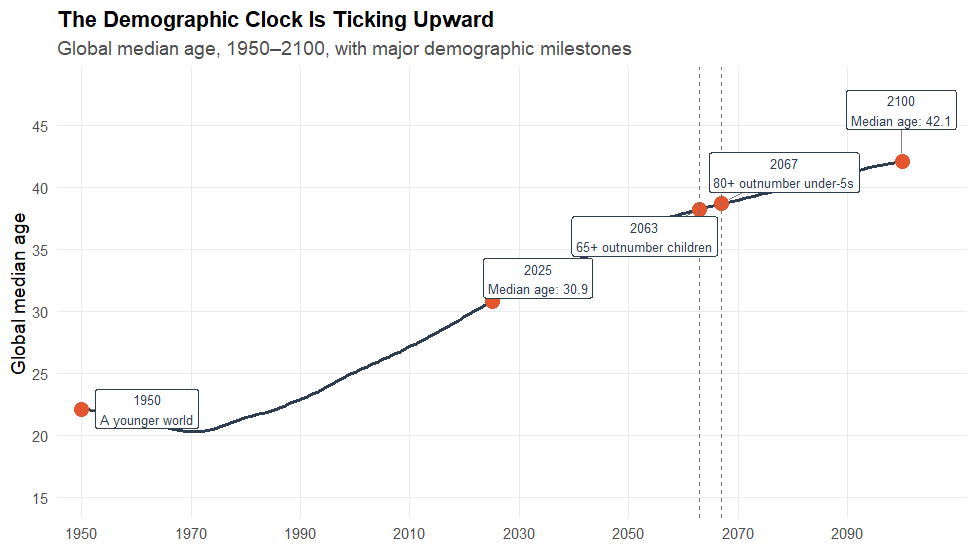
The rise in humanity’s median age is steady rather than sudden. There is no single event driving the trend. Instead, declining fertility, increasing life expectancy, and decades of demographic momentum combine to produce one of the largest shifts in human history. The annotations highlight moments when these gradual changes begin to reshape the world’s age structure in fundamental ways.
The Great Demographic Crossover
Demographers often focus on population size, but age composition can be just as important.
For thousands of years, children have outnumbered older adults by a wide margin. The latest projections suggest that balance is approaching a historic crossover.
Around 2063, the global population aged 65 and older is projected to exceed the number of children under 15. Four years later, people over age 80 are expected to outnumber children under five.
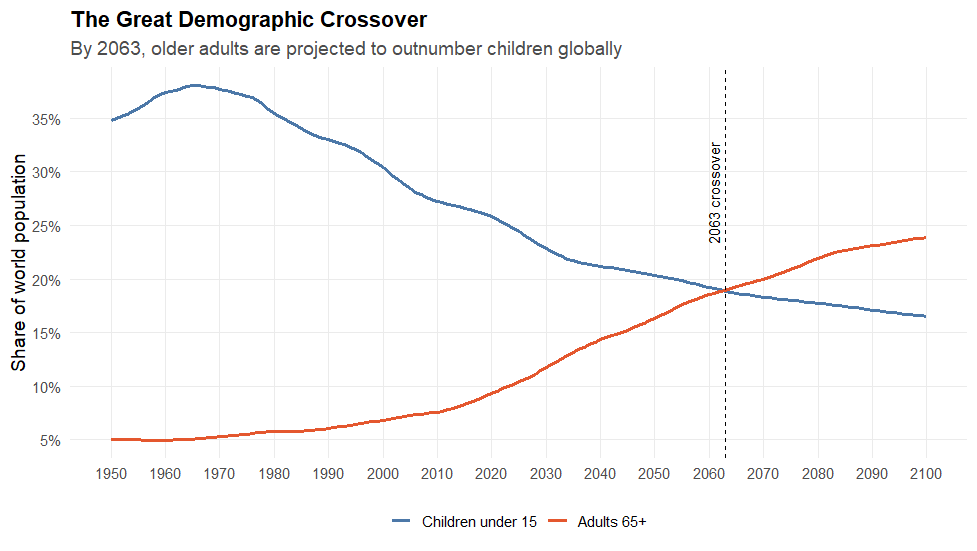
This is more than an interesting statistic. It marks the first time in human history that the world’s age pyramid no longer resembles a pyramid. Instead of being built upon a broad base of children, humanity begins to resemble a columnm, or eventually, in some countries, even an inverted pyramid.
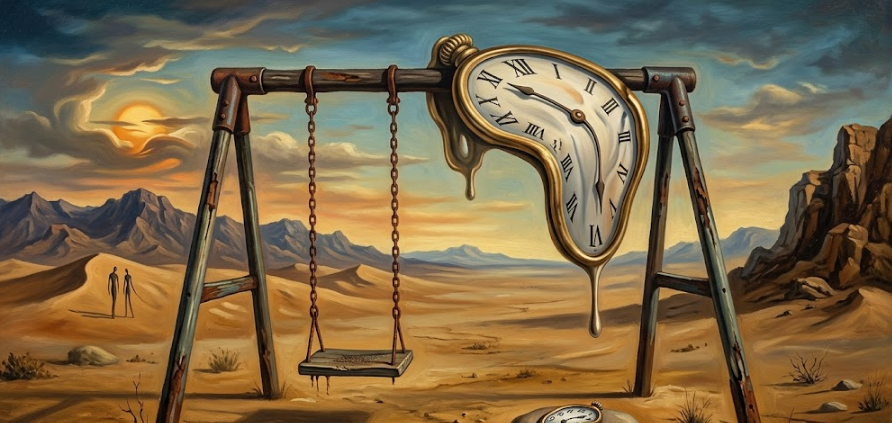
The demographic clock is still ticking, but toward a future unlike any previous era.
Humanity’s Age Structure Is Being Rewritten
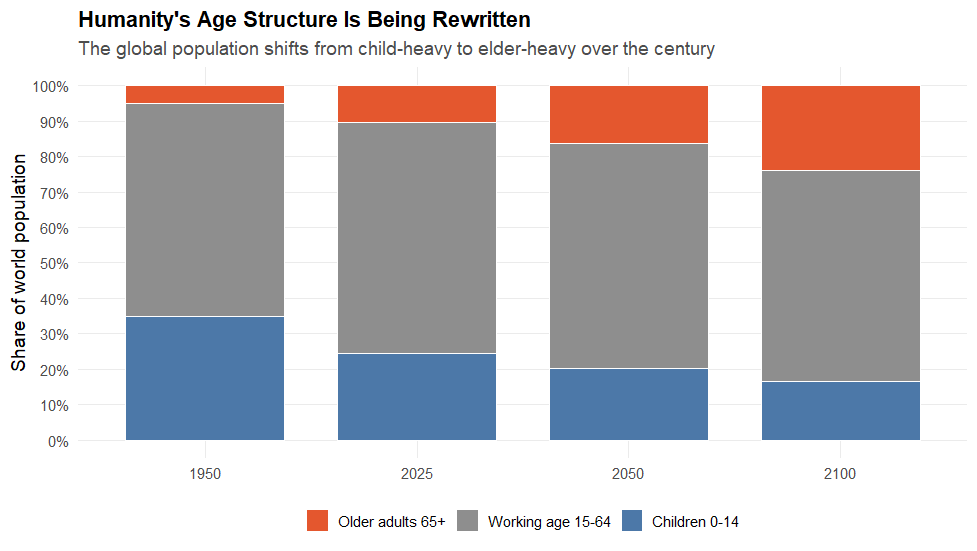
At the same time, the world’s age distribution changes dramatically. Put differently, the world is not simply adding more older adults. It is simultaneously producing fewer children.
Today, nearly one-quarter of humanity is younger than 15 years old. By the end of the century, that share falls from 24.4% to 16.5%. Meanwhile, the proportion of people aged 65 and older more than doubles, rising from 10.4% to 23.9%. Even more striking, the share of people over age 80 increases from 2.0% to 9.3%.
These changes reflect decades of declining fertility, improving survival, and increasing life expectancy. Humanity is not simply living longer—it is reshaping its entire age structure.
Not Every Country Is Aging at the Same Pace
Although the overall trend is global, countries are moving through the demographic transition at very different speeds.
Some societies are expected to age with remarkable speed over the next 75 years. According to the United Nations projections, places such as Hong Kong, Cabo Verde, Belize, Uganda, the State of Palestine, and Bangladesh are projected to experience some of the largest increases in median age. These countries begin the century at very different demographic starting points, yet all undergo dramatic shifts as fertility declines and life expectancy increases.
By the end of the century, some of the world’s oldest societies are projected to reach age structures that would seem almost unimaginable today. Hong Kong is expected to have a median age of 72.4 years—meaning half of its residents would be older than today’s typical retirement age. Mainland China is projected to reach a median age of 60.7 years, while the Republic of Korea approaches 60 years.
These figures reflect more than longer lives. They represent societies in which older adults become an unprecedented share of the population. In each of these places, nearly half of all residents are projected to be 65 years of age or older by 2100.
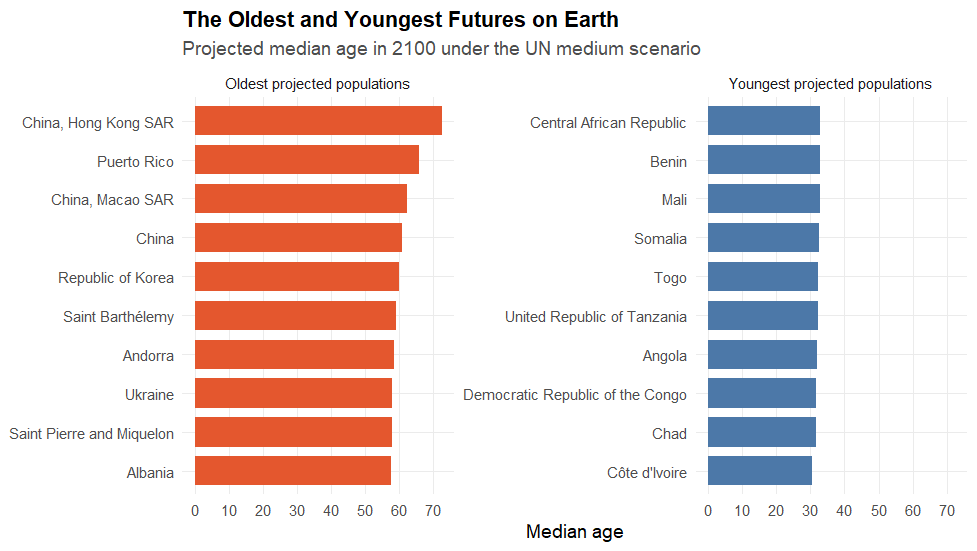
These projections illustrate how profoundly age structures can change within a single lifetime.
A Younger Future Still Exists
The demographic transition is not universal. While many countries become substantially older, others remain comparatively young throughout the century.
Countries such as Côte d’Ivoire, Chad, the Democratic Republic of the Congo, Angola, Tanzania, and Somalia are projected to retain median ages close to 30 years even by 2100. In many of these countries, roughly one-quarter of the population is still expected to be younger than 15 years of age.
Rather than converging toward a single demographic future, humanity appears to be diverging into multiple demographic realities.
Some societies will be characterized by very old populations and relatively few children. Others will remain youthful for decades to come.
Humanity is not moving toward one demographic future. It is moving toward several.
A Century of Demographic Flips
Perhaps the clearest way to appreciate the scale of this transformation is to look at which countries cross a historic demographic threshold.
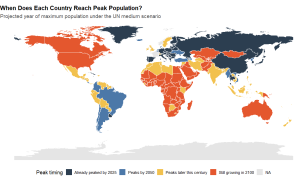
Today, most nations still have more children under the age of 15 than adults aged 65 and older. By the end of the century, that balance is projected to reverse in 113 countries. Places as diverse as Algeria, Argentina, Bangladesh, Brazil, Colombia, Iran, Mexico, Morocco, Thailand, and Türkiye are all expected to transition from predominantly young populations to ones where older adults outnumber children.
This shift was once largely confined to a small number of wealthy, industrialized nations. Over the coming decades, it is projected to become a defining feature of societies spanning every inhabited continent, reflecting a broad transformation in how populations grow, age, and renew themselves.
The implication is profound. For thousands of years, communities have been organized around the expectation that children would substantially outnumber older adults. By 2100, that assumption may no longer hold across much of the world. The demographic transition is no longer a regional phenomenon—it is becoming a global one.
Why This Matters
An aging population changes far more than retirement statistics. It affects who staffs hospitals, who pays taxes, who cares for aging parents, how many schools communities need, where homes are built, how quickly economies grow, and even how governments allocate resources.
Many of the institutions that define modern society were built for populations with large numbers of children and young adults. As that balance shifts, nearly every country will face difficult decisions about healthcare, pensions, housing, immigration, and workforce participation.
The demographic crossover represents a structural change in how human societies function.
How Can Scientists Predict This?
Population projections are sometimes mistaken for precise predictions of the future. They are better understood as carefully constructed scenarios based on what we know today.
Demographers combine information about fertility, mortality, migration, and the current age distribution of populations to estimate how societies are likely to change under different assumptions. Because births, deaths, and aging unfold gradually over decades, many long-term demographic patterns are surprisingly predictable.
Of course, no model can anticipate every future event. Wars, pandemics, technological breakthroughs, climate change, or major migration shifts could alter the trajectory.
Yet the broad direction of demographic change has remained remarkably consistent across successive generations of projections.
Looking Beyond Population Counts
History is often defined by wars, inventions, and political revolutions. Yet some of the most profound changes unfold so slowly that few people notice them while they are happening.
Humanity becoming older than it is young may be one of those moments.
No bells will ring in 2063. No celebrations will mark the day. Most people will wake up, go to work, and never realize that the age structure of our species has quietly crossed a threshold it had never crossed before.
Future historians, however, may look back on that moment as one of the defining transitions of the twenty-first century.