
Did Hollywood Make People See More UFOs? A Data Analysis
UFOs have fascinated people for generations. Whether they represent extraterrestrial visitors, misunderstood natural phenomena, or simply the quirks of human perception, millions of people have looked to the skies and wondered.
In this series, we’re taking a different approach. Using more than 80,000 documented UFO sightings, we’ll investigate one question at a time through the lens of data science. Rather than asking whether UFOs are real, we’re exploring what these reports reveal about human behavior, culture, and the ways we document the unexplained.
For decades, Hollywood has shaped how we imagine extraterrestrial life.
Flying saucers. Glowing lights. Massive motherships hovering silently over cities. From Close Encounters of the Third Kind to Independence Day, blockbuster films have transformed UFOs from isolated news stories into cultural icons.
But could these movies have done more than entertain us?
Could they have actually influenced how often people reported seeing unexplained objects in the sky?
To find out, we analyzed more than 80,000 documented UFO sightings spanning over a century, focusing on five of the most influential science-fiction releases between 1977 and 2005. Rather than debating whether UFOs are real, we asked a simpler scientific question:
Do major science-fiction events coincide with measurable changes in UFO reporting?
UFO Reports Have Exploded Over Time
Before examining Hollywood’s influence, it’s worth looking at the overall trend.
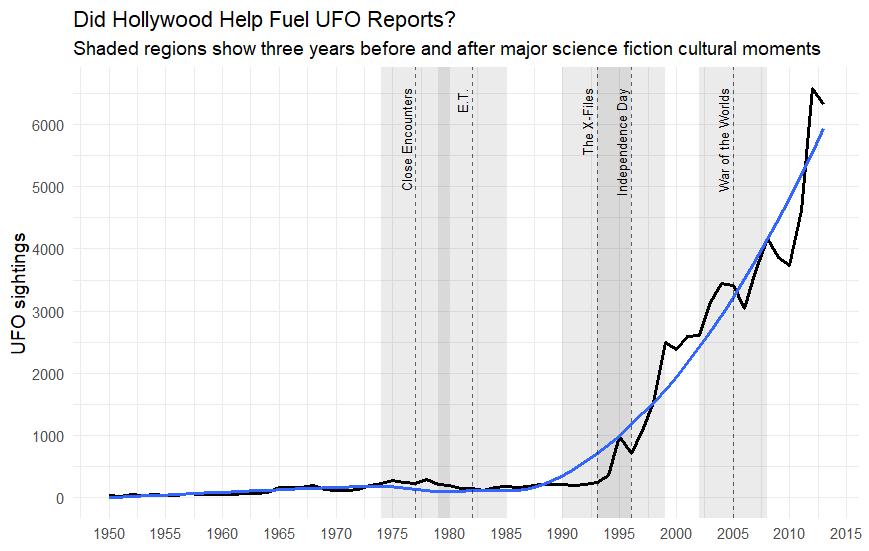
Early in the twentieth century, UFO reports were exceedingly rare. The database contains only isolated reports before the late 1940s, followed by a gradual rise through the 1950s and 1960s. Beginning in the mid-1990s, however, reports increased dramatically—from a few hundred per year to several thousand by the early 2000s. By 2012, the dataset recorded more than 6,500 reports in a single year, representing an extraordinary increase compared with previous decades.
This raises an obvious question.
What changed?
Testing the Hollywood Hypothesis
We selected five landmark moments in popular culture:
| Year | Cultural Event |
|---|---|
| 1977 | Close Encounters of the Third Kind |
| 1982 | E.T. the Extra-Terrestrial |
| 1993 | The X-Files premieres |
| 1996 | Independence Day |
| 2005 | War of the Worlds |
Hollywood’s Biggest Hits Didn’t Always Produce More UFO Reports
The two films most closely associated with UFO culture—Close Encounters and E.T.—were not followed by sustained increases in reported sightings.
Following Close Encounters, average annual reports actually declined slightly (−6.4%). After E.T., reports fell even further (−17.1%).
These findings challenge the simple idea that seeing aliens on the big screen immediately inspires thousands of additional UFO reports.
Instead, they suggest that public fascination alone may not be enough to substantially alter reporting behavior.
Then Something Changed in the 1990s
The picture changes dramatically beginning in 1993. Following the debut of The X-Files, average annual UFO reports increased by 228% over the next three years.
Three years later, after the release of Independence Day, reports increased by roughly 224% again.
At first glance, this appears to be overwhelming support for the Hollywood hypothesis.
But timing matters.
These cultural events occurred during exactly the same period that the public internet expanded rapidly, online discussion forums emerged, and organizations made it dramatically easier for witnesses to report sightings electronically.
In other words, the movies may have increased public attention—but they also coincided with an entirely new reporting infrastructure.
The Internet May Have Been the Real Game Changer
The annual trend provides an important clue.
Rather than showing isolated spikes after each blockbuster, UFO reports entered a sustained period of rapid growth beginning in the mid-1990s and continuing for nearly two decades. The five-year rolling average climbs steadily throughout this period, rather than returning to previous levels after each film.
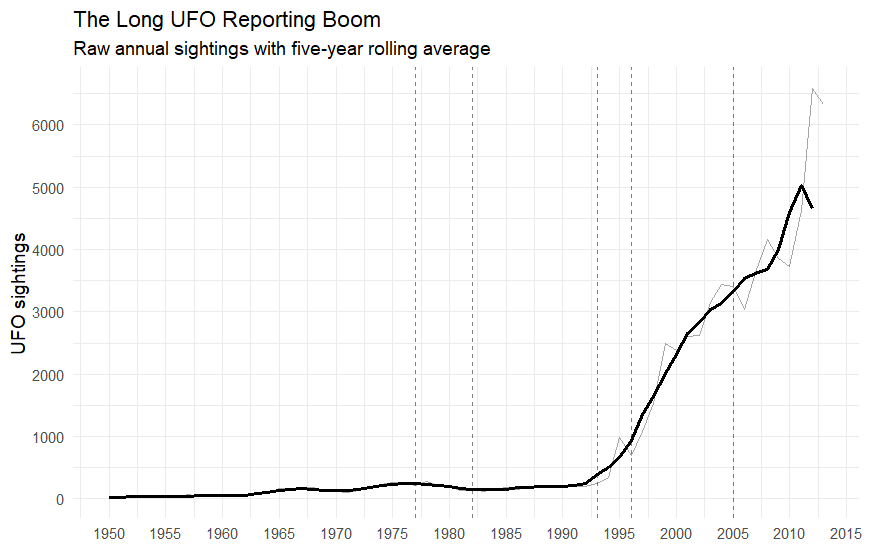
That pattern is exactly what researchers would expect to see from improvements in reporting systems, rather than a temporary burst of public excitement.
Once reporting moved online, filing a UFO report became far easier than writing letters or contacting investigators directly.
Not Every Movie Produced the Same Effect
When comparing individual films, three distinct patterns emerge.
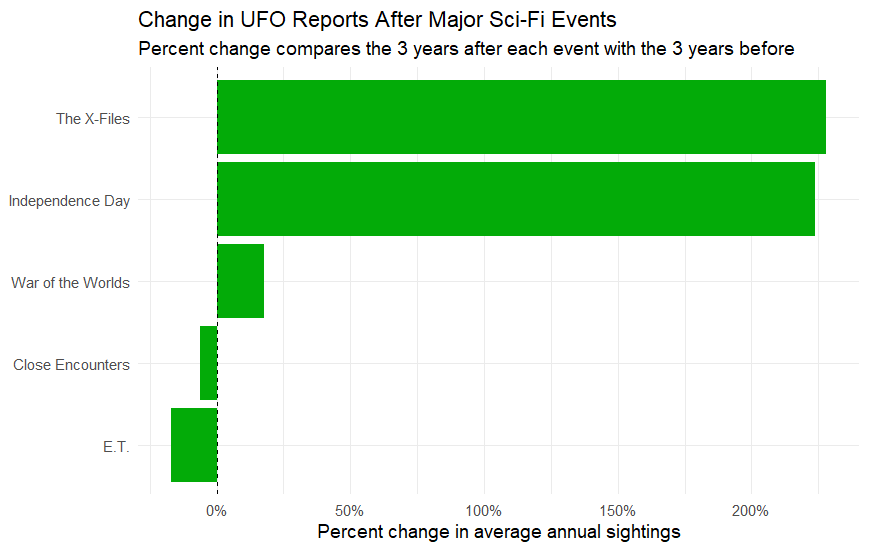
- Close Encounters was followed by a modest decline.
- E.T. was followed by an even larger decline.
- The X-Files and Independence Day coincided with explosive growth.
- War of the Worlds produced only a modest 18% increase despite being a major blockbuster.
If Hollywood alone drove UFO reports, we would expect every major release to generate similar increases.
That simply isn’t what the data show.
Looking Across All Five Events
When the five cultural events are aligned on a common timeline, an interesting pattern appears.
Average reports tend to increase during the years immediately following each event, but the variability is enormous. Some events occurred during periods when UFO reporting was already accelerating, while others happened during relatively stable decades.
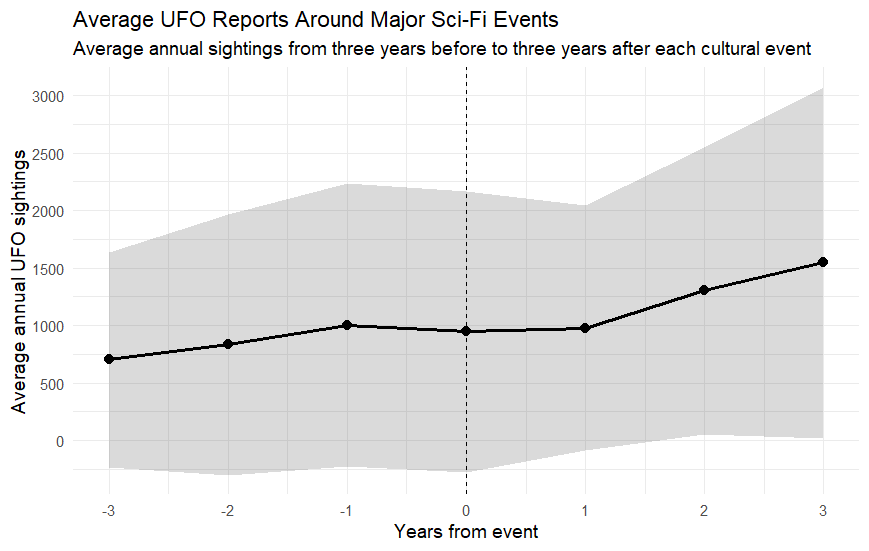
This wide variation reminds us that cultural events rarely happen in isolation. Movies, media coverage, technological innovation, and public interest all interact in ways that are difficult to disentangle.
So Did Hollywood Increase UFO Sightings?
The evidence suggests a qualified answer.
Hollywood probably influenced how people thought about UFOs, but it does not appear to have consistently increased the number of reported sightings.
Instead, the largest increases occurred during a broader transformation in communication technology. The rise of the internet, online reporting systems, and digital communities coincided almost perfectly with the most dramatic increase in UFO reports in the entire dataset.
The timing suggests that Hollywood may have provided the stories—but the internet provided the megaphone.
The Bigger Scientific Lesson
One of the most valuable aspects of historical datasets is that they allow us to separate compelling narratives from measurable evidence.
Hollywood undoubtedly shaped popular culture. But when we examined more than 80,000 UFO reports, the strongest signal wasn’t the release of blockbuster films.
It was the emergence of new ways for people to share extraordinary experiences.
That doesn’t make the mystery of UFOs any less fascinating.
If anything, it reminds us that every dataset reflects not only the phenomena being measured, but also the technology, culture, and human behavior that determine whether those phenomena are ever reported in the first place.