

Did Smartphones Change UFO Sightings?
What Can UFO Data Tell Us?
UFOs have fascinated people for generations. Whether they represent extraterrestrial visitors, misunderstood natural phenomena, or simply the quirks of human perception, millions of people have looked to the skies and wondered.
In this series, we’re taking a different approach. Using more than 80,000 documented UFO sightings, we’ll investigate one question at a time through the lens of data science. Rather than asking whether UFOs are real, we’re exploring what these reports reveal about human behavior, culture, and the ways we document the unexplained.
After all, even if the mystery remains unsolved, the data have a story to tell.
Previous Entries
- Did Hollywood Make People See More UFOs? A Data Analysis
- Did the Internet Cause the UFO Reporting Boom?
The Smartphone Hypothesis
The first iPhone was released in 2007. Within a few years, millions of people carried high-quality cameras everywhere they went.
That creates two competing hypotheses.
The first is intuitive: if everyone suddenly had a camera in their pocket, more unusual events would be photographed, and more UFOs would be reported.
The second is almost the opposite. Better cameras might actually reduce UFO reports because people could zoom in, capture clearer images, and identify objects that previously would have remained mysterious.
Our dataset allows us to test which of these possibilities better matches reality.
We compared two periods:
- Pre-smartphone era (1949–2006)
- Smartphone era (2007–2013)
We examined not only the number of reports, but also encounter duration, description length, and how quickly people documented their experiences.
UFO Reports Continued to Climb After Smartphones Arrived
At first glance, smartphones appear to support the first hypothesis.
During the pre-smartphone era, the database averaged 583 UFO reports per year. After 2007, that average increased to 4,703 reports annually—an eightfold increase.
The interrupted time-series model also detected a statistically significant upward shift beginning in 2007, followed by continued annual growth of roughly 447 additional reports per year. Rather than slowing after smartphones became widespread, UFO reporting accelerated.
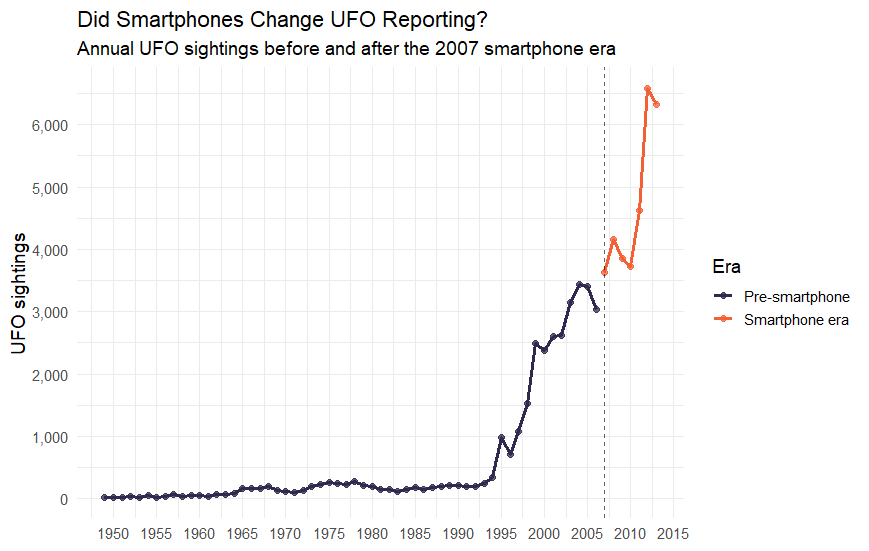
This finding alone suggests that better cameras did not lead to fewer reported UFO sightings.
But reporting frequency is only part of the story.
Surprisingly, UFO Encounters Didn’t Last Any Longer
One might expect smartphones to encourage people to observe strange objects for longer periods while attempting to record them.
That isn’t what the data show.
The median encounter duration remained exactly three minutes (180 seconds) before and after smartphones became common.
Even the upper end of the distribution became slightly shorter. The longest one percent of encounters declined from roughly four hours before smartphones to approximately three hours afterward.
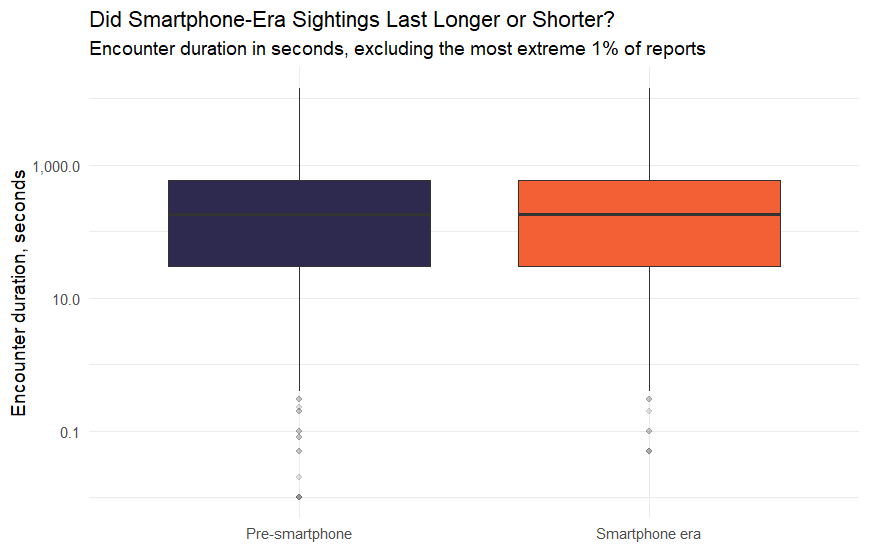
This suggests smartphones changed how people documented sightings far more than how long they observed them.
Reports Became Shorter, Not Longer
Perhaps the most unexpected finding involves the written descriptions.
One might assume that smartphones—with full keyboards, internet access, and online reporting forms—would encourage longer narratives.
Instead, descriptions became slightly shorter.
Median description length fell from 88 characters before smartphones to 73 characters afterward, while the average description also declined.
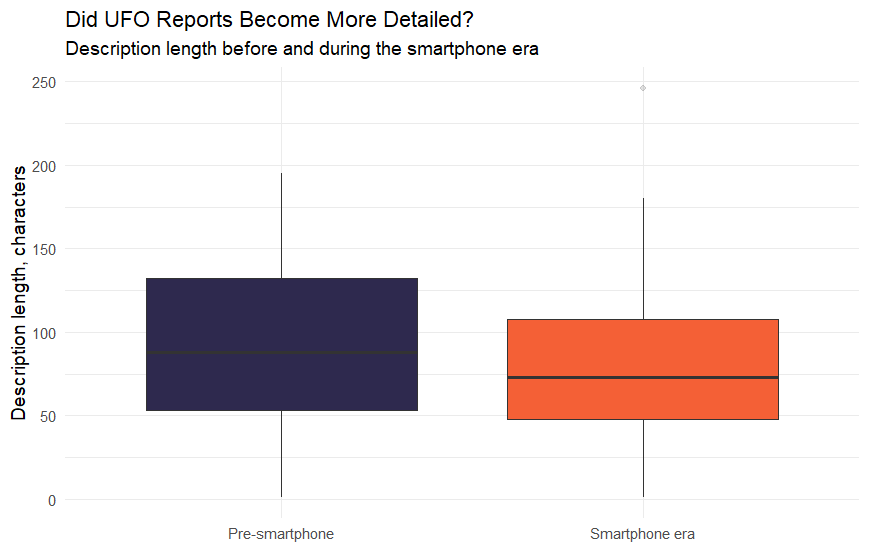
Why might this happen?
One possibility is that online reporting forms encouraged concise descriptions. Another is that witnesses increasingly expected accompanying photographs or videos to provide context that previously required a written explanation.
Regardless of the cause, smartphones appear to have changed not only how often people reported sightings but also how they described them.
Smartphones Dramatically Reduced Reporting Delays
The clearest effect appears in reporting speed.
Before smartphones, the median delay between a sighting and its documentation was 52 days.
After smartphones, that median dropped to just 19 days.
The average delay changed even more dramatically—from more than 2,200 days to just 56 days.
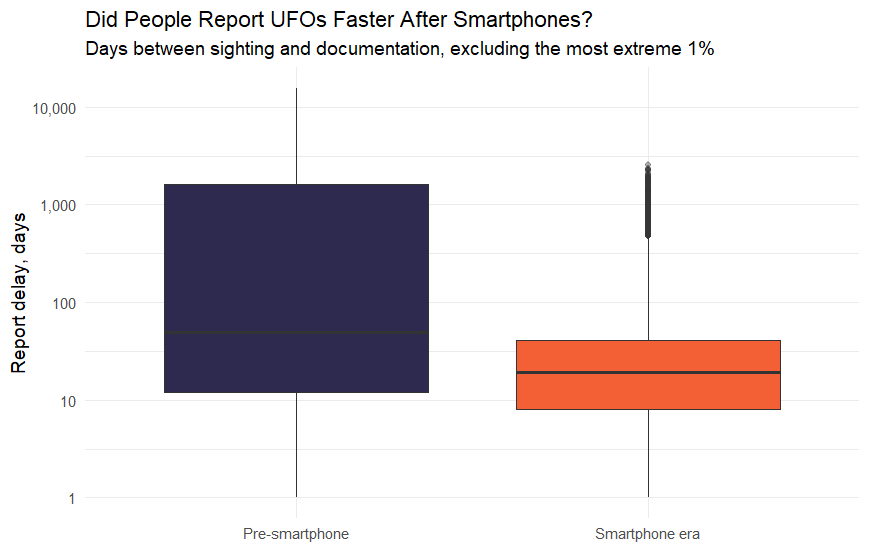
The enormous difference between the averages reflects a handful of extremely old reports being entered into modern databases. The median tells a cleaner story.
People began documenting unusual experiences almost immediately.
That is exactly what we would expect from technology that allows someone to photograph an object and submit a report from virtually anywhere.
Better Cameras Didn’t End the Mystery
One popular argument is that smartphones should have eliminated UFO reports.
“If everyone carries a camera,” the reasoning goes, “why are there still so many unidentified objects?”
Our analysis suggests that this expectation misunderstands how reporting systems work.
Smartphones appear to have lowered the barriers to documentation. Rather than discouraging reports, they made reporting easier, faster, and more accessible.
Better cameras may help identify many ordinary objects, but they also make it far simpler for witnesses to record experiences they still consider unusual.
The Bigger Lesson
Technology changes datasets.
When historians or scientists examine long-term trends, they must remember that increases in reported events do not necessarily mean the underlying phenomenon became more common.
Sometimes the biggest change is simply that people gained a better way to record their experiences.
The smartphone revolution transformed photography, communication, and social media. Our analysis suggests it also transformed one of the world’s largest collections of UFO reports—not by ending the mystery, but by making it easier than ever for people to share it.
Key Findings
- Annual UFO reports increased from 583 per year before smartphones to 4,703 per year afterward.
- Reporting continued to accelerate after 2007, with statistically significant increases in both the level and growth rate.
- Median encounter duration remained unchanged at 180 seconds.
- Written descriptions became modestly shorter during the smartphone era.
- The time between a sighting and its documentation dropped dramatically, suggesting smartphones made reporting substantially faster.
While smartphones may not have solved the UFO mystery, they clearly changed how people document it. That distinction is an important reminder that technological advances often reshape our data long before they resolve our questions.