
The Science of Cold Plunges: What Ice Baths Actually Do to Your Body
I’ve been training for a 50K, and at my age, the biggest problem isn’t fitness; it’s injury prevention. So, of course, I’ve been trying to find ways to keep my legs healthy.
And here, cold plunges are everywhere.
Professional athletes lower themselves into tubs of ice water after competition. Wellness influencers begin their mornings submerged to the shoulders in backyard plunge tanks. Social media videos promise that a few uncomfortable minutes in cold water can boost dopamine, reduce inflammation, strengthen the immune system, accelerate fat loss, improve mental health, and perhaps even help you live longer.
It is an unusually impressive list of benefits for something humans have spent most of history trying to avoid.
And there is real science behind cold exposure.
The problem is that the science doesn’t necessarily say what the internet says it does.
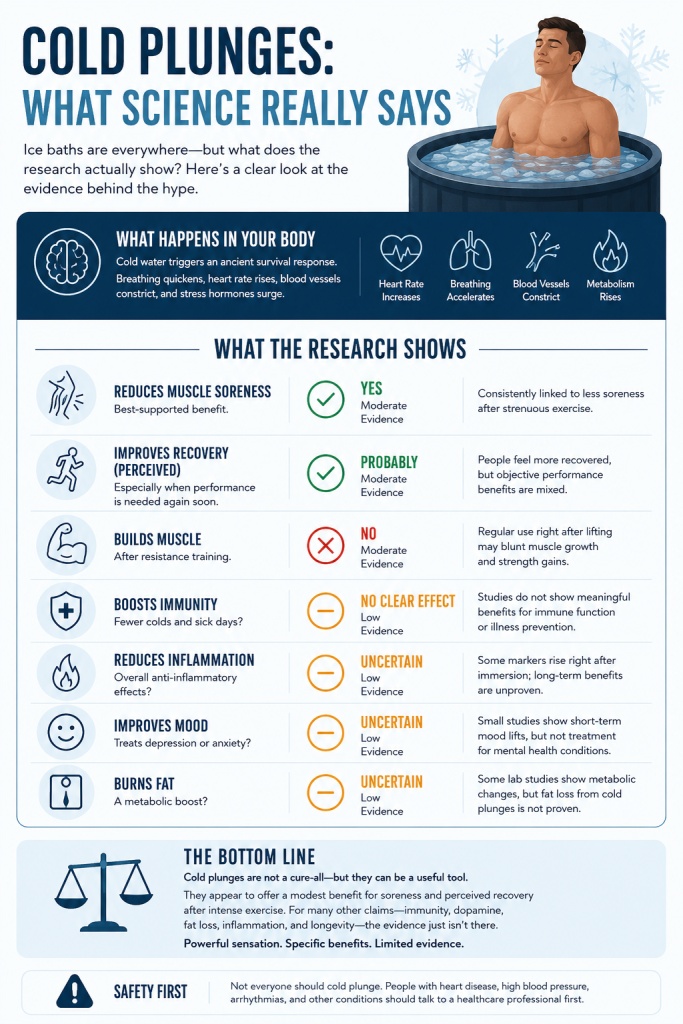
Cold water produces dramatic changes throughout the human body. Your heart speeds up. Your blood vessels constrict. Your breathing changes. Stress hormones surge. Metabolism increases. You become extraordinarily alert.
But a dramatic physiological response isn’t necessarily the same thing as a health benefit.
When researchers move beyond asking “What happens to the body when it gets cold?” and instead ask “Does regularly getting into cold water actually make people healthier?”, the story becomes much more interesting.
And considerably more complicated.
Why Cold Plunges Feel So Powerful
Imagine lowering yourself into a tub of 50°F water.
There is no gradual transition.
Within seconds, your body reacts as though something has gone terribly wrong. You gasp. Your breathing becomes rapid. Your heart begins beating faster. Blood vessels near your skin constrict, pushing blood toward the center of your body. Your blood pressure rises.
This is the cold-shock response, an ancient survival mechanism designed to help humans survive sudden exposure to dangerously cold environments.
Temperature-sensitive nerves in the skin immediately alert the brain that body temperature is threatened. The sympathetic nervous system—the same fight-or-flight system activated when you encounter danger—springs into action.
If the exposure continues, metabolism increases and eventually muscles begin shivering to generate additional heat. None of this is imaginary. Cold exposure really does produce a remarkable physiological response.
In one frequently cited laboratory experiment, immersion in 14°C, or about 57°F, water increased metabolic rate by roughly 350%. Circulating norepinephrine increased more than fivefold, while plasma dopamine rose by approximately 250%.
Those numbers are understandably irresistible to wellness influencers.
A “250% increase in dopamine” sounds very different from “your body is mounting an emergency response to prevent itself from becoming too cold.”
But scientifically, context matters. The researchers were measuring circulating chemicals during significant cold exposure. The study did not demonstrate that people’s brains remained flooded with dopamine for hours afterward. It did not show that participants became substantially happier. And it certainly didn’t demonstrate that cold plunges treat depression, ADHD, or other conditions involving dopamine.
The physiological changes are real. What they mean is another question entirely.
The Big Mistake We Make With Wellness Science
Cold plunges illustrate a problem that appears constantly in health and wellness marketing:
We confuse evidence that something changes the body with evidence that it improves the body.
Those aren’t the same thing.
Running a marathon dramatically changes hormone concentrations.
So does staying awake all night.
Giving a speech in front of hundreds of people can send stress hormones soaring.
Getting influenza produces enormous changes throughout the immune system.
Nobody would argue that these changes automatically make those experiences therapeutic. Physiological responses simply tell researchers that the body has encountered a challenge. To determine whether that challenge actually improves health, scientists need to look further downstream.
Do people perform better?
Do they get sick less often?
Does their metabolic health improve?
Does depression decrease?
Do injuries heal faster?
Do people live longer?
Once researchers begin asking those questions about cold plunges, one benefit stands out much more clearly than the others.
The Best Evidence for Cold Plunges Is Surprisingly Ordinary
Forget longevity.
Forget dopamine.
Forget “biohacking.”
The strongest argument for climbing into cold water is much less glamorous: You might be less sore tomorrow.
Cold-water immersion has been studied for decades as a recovery strategy following strenuous exercise. Across systematic reviews and meta-analyses, one finding appears relatively consistently: people tend to report less delayed-onset muscle soreness after using cold-water immersion.
A 2023 meta-analysis examining 20 studies found that cold-water immersion reduced muscle soreness following strenuous exercise compared with passive recovery and several alternative recovery strategies.
People also frequently report feeling more recovered and less fatigued. That might not sound revolutionary. For an athlete, however, it can matter enormously.
Imagine a soccer player competing in several tournament matches over a weekend. Or a basketball player facing three games in four nights. Or a cyclist trying to recover overnight during a stage race.
Their immediate goal isn’t necessarily to maximize the training adaptation produced by yesterday’s competition. They need to perform again tomorrow.
If cold-water immersion makes their legs feel less sore and helps them feel more prepared to compete again, even a modest benefit can be valuable.
This is probably why ice baths became embedded in elite sports long before they became a wellness trend. But there is an important catch.
Feeling Recovered Isn’t the Same as Being Recovered
Anyone who has experienced delayed-onset muscle soreness knows how convincing pain can be. If your legs hurt less, surely they must have recovered faster.
Not necessarily.
Cold exposure changes tissue temperature, circulation, and the way nerves transmit pain signals. That can change how muscles feel without necessarily meaning that every biological process involved in recovery has accelerated.
The distinction becomes especially obvious when researchers measure athletic performance rather than soreness.
Results for strength, sprinting, jumping, and other objective measures of performance are considerably more mixed than results for perceived recovery.
Immediately after a cold plunge, explosive performance can even temporarily decline because cold muscles don’t generate force as efficiently.
Think of a rubber band that has been sitting in the freezer. It still stretches, but it behaves differently until it warms up.
That is one reason cold plunges make considerably more sense after competition than immediately before an activity requiring maximum power or speed.
And this distinction between feeling recovered and actually adapting to exercise leads to one of the most important—and least advertised—findings in cold-plunge research.
Cold Plunges May Actually Work Against Muscle Growth
Exercise works because the body responds to stress.
When you lift weights, you’re not simply moving heavy objects. You’re creating a biological signal telling your body that its current capacity isn’t sufficient.
Muscle fibers experience mechanical tension. Cellular signaling pathways activate. Protein synthesis increases. Satellite cells participate in repair and remodeling.
Over repeated training sessions, those responses contribute to larger and stronger muscles. Some inflammation is part of that process. Cooling exercised muscles immediately afterward can alter several of those signals.
That creates an intriguing paradox.
The same intervention that helps you feel recovered may partially interfere with the biological processes that help you adapt.
Randomized trials and subsequent meta-analyses suggest that routinely using cold-water immersion immediately after resistance training may modestly reduce gains in muscle size.
In one influential 12-week experiment, participants completed the same resistance-training program but used different recovery strategies. One group spent 10 minutes in 10°C (50°F) water following each workout.
People who regularly used cold-water immersion experienced smaller improvements in muscle hypertrophy than participants who used active recovery. Later research has generally reinforced the concern, particularly for muscle growth.
This doesn’t make cold plunges “bad.” It makes them a tool. And tools need to match the job.
An athlete who needs to play again tomorrow may happily trade a small amount of long-term adaptation for less soreness today.
Someone trying to maximize hypertrophy probably has a very different objective.
The question shouldn’t be: “Are cold plunges good for you?”
It should be: “What are you trying to accomplish?” (remember, methods should follow the questions)
Do Cold Plunges Increase Dopamine?
This is where the cold-plunge story begins moving away from sports science and into wellness culture. One of the most repeated claims online is that cold exposure produces a massive dopamine increase that remains elevated long after you leave the water.
There is a kernel of truth here. Researchers have measured substantial increases in circulating dopamine during cold exposure.
But that observation has gradually been transformed into a much larger claim: that a cold plunge produces a sustained dopamine high that increases motivation, improves mood, and enhances mental performance for hours.
The evidence doesn’t currently establish that.
A blood measurement taken while someone is experiencing significant cold stress doesn’t tell us exactly what is happening within specific brain circuits. And even a temporary neurochemical change doesn’t automatically translate into a meaningful psychological benefit.
Cold plunges certainly can make people feel extraordinary afterward.
That experience deserves to be taken seriously.
You’ve just voluntarily remained inside an environment every instinct is telling you to escape. Your sympathetic nervous system is activated. Your attention is focused. Then the stress suddenly ends. Relief alone can feel wonderful. Add the satisfaction of completing something difficult and it isn’t particularly surprising that people emerge feeling energized, alert, or even euphoric.
Researchers have found some preliminary evidence consistent with these experiences. Small studies have reported improved positive affect following cold-water immersion and changes in communication among brain networks involved in attention and emotion.
Interesting? Absolutely.
Proof that cold plunges treat depression, anxiety, or ADHD? No.
Clinical evidence capable of supporting those claims simply isn’t there yet.
What About Inflammation?
“Cold reduces inflammation” seems almost self-evident. We’ve been putting ice on injuries forever. But inflammation is much more complicated than its reputation suggests.
Chronic inflammation is associated with numerous diseases, which has turned “anti-inflammatory” into one of wellness marketing’s favorite adjectives. Yet inflammation itself isn’t inherently harmful.
Without inflammatory signaling, wounds wouldn’t heal normally. The immune system couldn’t respond appropriately to infection. Muscles wouldn’t adapt properly to exercise.
The meaningful question isn’t whether something “causes” or “reduces” inflammation.
It’s which inflammatory process, where, for how long, and under what circumstances.
Cold plunges provide a wonderful example of why that distinction matters. Reviews of randomized trials have found that some inflammatory markers actually increase immediately after cold-water immersion before gradually returning toward baseline. That isn’t necessarily dangerous. Cold water is a physiological stressor, and the body responds accordingly.
Other studies conducted after strenuous exercise have found lower levels of certain markers associated with muscle damage later in recovery. Still others have found little meaningful difference.
This makes the sweeping claim that cold plunges “eliminate inflammation” difficult to defend. The human inflammatory response simply doesn’t work like an on-off switch. And once again, the outcome that appears most consistent isn’t a laboratory biomarker. It’s soreness. And people often feel better.
Do Cold Plunges Boost Your Immune System?
The immune-system claim follows a similar pattern. Cold exposure can temporarily alter immune activity. Researchers can measure changes in immune cells and other biological markers after exposure.
But seeing immune cells move around the bloodstream isn’t the same thing as demonstrating that the immune system has become “stronger.”
To establish that, we’d want evidence that people actually experience meaningful health outcomes—perhaps fewer infections or less illness.
So far, randomized studies haven’t provided convincing evidence of that kind.
One famous experiment involving more than 3,000 people did produce an intriguing result. Participants who ended their showers with cold water reported approximately 29% fewer days absent from work.
That sounds like an immune benefit. Except they didn’t actually report being sick less often. They simply took fewer sick days.
Perhaps the cold showers increased energy. Perhaps the people became more willing to work while mildly ill. Perhaps the type of person volunteering for a cold-shower experiment differed from other people in meaningful ways.
Whatever the explanation, the study didn’t demonstrate that cold water prevented infections.
“Fewer sick days” and “stronger immune system” are not interchangeable findings.
Can Cold Plunges Burn Fat?
Here, too, the biology is fascinating. Humans possess a special type of tissue called brown adipose tissue, or brown fat. Unlike white fat, which primarily stores energy, brown fat can burn energy to generate heat. Cold exposure activates this system.
Researchers have even demonstrated that repeated mild cold exposure can improve insulin sensitivity under certain experimental conditions. In one notable study, people with type 2 diabetes showed improved insulin sensitivity following a controlled cold-acclimation protocol.
That sounds promising. But look closely at the intervention. Participants weren’t doing two-minute ice baths in their backyard.
They underwent prolonged, carefully controlled exposure to mildly cold environments as part of a laboratory acclimation protocol. That’s a very different physiological intervention.
Research into brown fat and cold exposure may eventually produce important metabolic treatments. But we can’t assume that because prolonged mild cold exposure produces a particular metabolic effect, brief extreme cold exposure will produce the same one.
The evidence that occasional cold plunges produce meaningful long-term fat loss remains weak.
So How Cold Should a Cold Plunge Be?
This is where science becomes frustratingly unsatisfying. There isn’t a scientifically established “perfect” cold-plunge temperature. Nor is there an ideal number of minutes per week proven to optimize human health.
You’ve probably encountered very specific recommendations online—perhaps even claims that exactly 11 minutes of cold exposure per week provides an ideal dose. The research doesn’t justify that level of precision.
Eleven minutes in 59°F water is physiologically different from eleven minutes in nearly freezing water. A lean person may respond differently from someone with more body fat. Someone accustomed to cold exposure may react differently from a beginner.
Water depth, movement, temperature, body composition, and acclimatization all matter. Time alone isn’t a dose.
Studies examining athletic recovery commonly use temperatures around 10–15°C (50–59°F) for roughly 10–15 minutes. But those protocols were designed to study post-exercise recovery. They shouldn’t automatically be converted into prescriptions for longevity, immunity, mental health, or general wellness.
For someone simply curious about cold plunging, there is no evidence that the experience needs to become an endurance contest.
Colder isn’t automatically better.
Longer isn’t automatically better.
More miserable definitely isn’t automatically better.
The Part of Cold Plunging That Deserves More Attention: Safety
The first minute of cold-water immersion can be the most physiologically intense. And the immediate danger isn’t necessarily hypothermia. It’s cold shock.
The involuntary gasp that occurs when someone suddenly enters cold water can be followed by rapid breathing. Blood vessels constrict. Blood pressure rises. Heart rate changes. The cardiovascular system suddenly has much more work to do.
Most healthy adults can tolerate brief cold exposure. Not everyone can.
People with cardiovascular disease, heart failure, uncontrolled high blood pressure, previous heart attacks, or cardiac arrhythmias should discuss cold-water immersion with a healthcare professional before treating it like a casual wellness activity.
There is also one practice that deserves particular caution: breath-holding in cold water.
Cold exposure activates sympathetic responses that can increase heart rate. Facial immersion and breath-holding can simultaneously activate the diving reflex, which tends to slow the heart.
Researchers call the collision between these responses autonomic conflict, and it may increase susceptibility to abnormal heart rhythms.
Hyperventilating before entering the water introduces another risk because it can contribute to loss of consciousness. Cold water and unconsciousness are an exceptionally dangerous combination.
Keeping your head above water, breathing normally, ensuring you can exit easily, and avoiding solo cold-water swimming are considerably more important than chasing some supposedly optimal temperature.
Open-water swimming also deserves to be treated differently from a controlled plunge tub. Waves, currents, weather, slippery surfaces, fatigue, and loss of muscular coordination introduce risks that simply aren’t present in a bathtub.
The Cold-Plunge Paradox
This brings us back to the strange place cold plunges occupy in modern wellness culture. The enthusiasts aren’t imagining everything. Cold water really does produce profound physiological changes. It really does activate the sympathetic nervous system. Hormone concentrations really do change. Metabolism really does increase. And most importantly, cold-water immersion appears to provide a modest but legitimate benefit for soreness and perceived recovery following strenuous exercise.
But the skeptics have a point too.
The evidence becomes dramatically thinner when cold plunges are promoted as a way to strengthen immunity, treat depression, burn substantial amounts of fat, eliminate chronic inflammation, prevent disease, or extend lifespan.
Cold plunges have undergone a transformation familiar to anyone who follows wellness science. A specific finding becomes a general principle. The general principle becomes a health recommendation. And the health recommendation eventually becomes a lifestyle.
By the time it reaches social media, “cold-water immersion may modestly reduce perceived muscle soreness following strenuous exercise” has somehow become:
“Three minutes of freezing water every morning will transform your body and brain.”
Those aren’t remotely equivalent claims.
Are Cold Plunges Worth It?
For some people, absolutely. If you’ve just completed a marathon, finished an exceptionally demanding training session, or need to recover between tournament games, cold-water immersion may help you feel less sore and more recovered.
That’s a real benefit. It doesn’t need to cure every other human ailment to be useful.
If your primary goal is maximizing muscle growth, however, regularly plunging immediately after resistance training may be counterproductive.
And if you’re cold plunging primarily because you’ve been promised better immunity, dramatic fat loss, a massive sustained dopamine increase, disease prevention, or a longer life, the scientific evidence hasn’t caught up with those claims.
Perhaps future research will change that.
Cold-water immersion has become popular much faster than scientists have been able to study it. Researchers still need larger and longer trials involving more women, older adults, and people with different health conditions. We don’t yet know the ideal frequency of exposure, whether repeated plunging produces meaningful metabolic adaptations, or whether some of the short-term psychological effects translate into lasting improvements.
Those are fascinating questions. For now, though, the most defensible conclusion is considerably simpler.
Cold plunges are neither a miracle nor a fraud.
They’re a specialized recovery strategy with some credible benefits, several intriguing possibilities, and an enormous amount of marketing attached to them.
And perhaps that is the more interesting lesson.
The cold is real.
The physiological stress is real.
Some of the recovery benefits are real.
But many of the biggest promises are still, quite literally, on thin ice
Build Your Own Science Issue
Tell us what fascinates you. We’ll search today’s science and build a personalized issue just for you.
Your science issue is being built.
We’re searching today’s research for stories that match your interests. Your personalized issue will arrive in your inbox shortly.
Something went wrong.
We couldn’t build your issue right now. Please try again in a moment.
Sources
Bleakley, C. M., McDonough, S., Gardner, E., Baxter, G. D., Hopkins, J. T., & Davison, G. W. (2012). Cold-water immersion—cryotherapy—for preventing and treating muscle soreness after exercise. Cochrane Database of Systematic Reviews, 2012(2), CD008262. doi: 10.1002/14651858.CD008262.pub2
Buijze, G. A., Sierevelt, I. N., van der Heijden, B. C. J. M., Dijkgraaf, M. G. W., & Frings-Dresen, M. H. W. (2016). The effect of cold showering on health and work: A randomized controlled trial. PLOS ONE, 11(9), e0161749. doi: 10.1371/journal.pone.0161749
Cain, T., Brinsley, J., Bennett, H., Nelson, M., Maher, C., & Singh, B. (2025). Effects of cold-water immersion on health and wellbeing: A systematic review and meta-analysis. PLOS ONE, 20(1), e0317615. doi: 10.1371/journal.pone.0317615
Castellani, J. W., & Young, A. J. (2016). Human physiological responses to cold exposure: Acute responses and acclimatization to prolonged exposure. Comprehensive Physiology, 6(1), 443–469. doi: 10.1002/cphy.c140081
Datta, A., & Tipton, M. (2006). Respiratory responses to cold water immersion: Neural pathways, interactions, and clinical consequences awake and asleep. Respiratory Physiology & Neurobiology, 152(3), 330–343. doi: 10.1016/j.resp.2006.02.001
Fyfe, J. J., Broatch, J. R., Trewin, A. J., Hanson, E. D., Argus, C. K., Garnham, A. P., Halson, S. L., Polman, R. C. J., Bishop, D. J., & Petersen, A. C. (2019). Cold water immersion attenuates anabolic signaling and skeletal muscle fiber hypertrophy, but not strength gain, following whole-body resistance training. Journal of Applied Physiology, 127(5), 1403–1418. doi: 10.1152/japplphysiol.00127.2019
Glasgow, P. D., Ferris, R., & Bleakley, C. M. (2014). Cold water immersion in the management of delayed-onset muscle soreness: Is dose important? A randomised controlled trial. Physical Therapy in Sport, 15(4), 228–233. doi: 10.1016/j.ptsp.2014.01.002
Grgic, J. (2023). Effects of post-exercise cold-water immersion on resistance training-induced gains in muscular strength: A meta-analysis. European Journal of Sport Science, 23, 372–380. doi: 10.1080/17461391.2022.2033851
Hanssen, M. J. W., Hoeks, J., Brans, B., van der Lans, A. A. J. J., Schaart, G., van den Driessche, J. J., Jörgensen, J. A., Boekschoten, M. V., Hesselink, M. K. C., Havekes, B., Kersten, S., Mottaghy, F. M., van Marken Lichtenbelt, W. D., & Schrauwen, P. (2015). Short-term cold acclimation improves insulin sensitivity in patients with type 2 diabetes mellitus. Nature Medicine, 21(8), 863–865. doi: 10.1038/nm.3891
Machado, A. F., Ferreira, P. H., Micheletti, J. K., de Almeida, A. C., Lemes, Í. R., Vanderlei, F. M., Netto Junior, J., & Pastre, C. M. (2016). Can water temperature and immersion time influence the effect of cold water immersion on muscle soreness? A systematic review and meta-analysis. Sports Medicine, 46(4), 503–514. doi: 10.1007/s40279-015-0431-7
Malta, E. S., Dutra, Y. M., Broatch, J. R., Bishop, D. J., & Zagatto, A. M. (2021). The effects of regular cold-water immersion use on training-induced changes in strength and endurance performance: A systematic review with meta-analysis. Sports Medicine, 51(1), 161–174. doi: 10.1007/s40279-020-01362-0
Moore, E., Fuller, J. T., Bellenger, C. R., Saunders, S., Halson, S. L., Broatch, J. R., & Buckley, J. D. (2023). Effects of cold-water immersion compared with other recovery modalities on athletic performance following acute strenuous exercise in physically active participants: A systematic review, meta-analysis, and meta-regression. Sports Medicine, 53(3), 687–705. doi: 10.1007/s40279-022-01800-1
Piñero, A., Burke, R., Augustin, F., Mohan, A. E., DeJesus, K., Weisenthal, M., Coleman, M., Androulakis-Korakakis, P., Grgic, J., Swinton, P. A., & Schoenfeld, B. J. (2024). Throwing cold water on muscle growth: A systematic review with meta-analysis of the effects of postexercise cold water immersion on resistance-training-induced hypertrophy. European Journal of Sport Science. doi: 10.1002/ejsc.12074
Roberts, L. A., Raastad, T., Markworth, J. F., Figueiredo, V. C., Egner, I. M., Shield, A., Cameron-Smith, D., Coombes, J. S., & Peake, J. M. (2015). Post-exercise cold water immersion attenuates acute anabolic signalling and long-term adaptations in muscle to strength training. The Journal of Physiology, 593(18), 4285–4301. doi: 10.1113/JP270570
Shawe, J., Felton, M., Harper, J. C., Harper, C. M., Stidson, R., Tipton, M., Blowers, S., Fraser, K., Hingley, S., McGrath, E., Bainbridge, G., & Massey, H. (2025). Cold water swimming and pregnancy: A scoping review and consensus recommendations. Lifestyle Medicine, 6(1), e70009. doi: 10.1002/lim2.70009
Shattock, M. J., & Tipton, M. J. (2012). “Autonomic conflict”: A different way to die during cold water immersion? The Journal of Physiology, 590(14), 3219–3230. doi: 10.1113/jphysiol.2012.229864
Šrámek, P., Šimečková, M., Janský, L., Šavlíková, J., & Vybíral, S. (2000). Human physiological responses to immersion into water of different temperatures. European Journal of Applied Physiology, 81(5), 436–442. doi: 10.1007/s004210050065
Wang, H., and colleagues. (2025). Impact of different doses of cold water immersion—duration and temperature—on recovery from exercise-induced muscle damage: A systematic review and meta-analysis. Frontiers in Physiology.
Xiao, F., Kabachkova, A. V., Jiao, L., Zhao, H., & Kapilevich, L. V. (2023). Effects of cold water immersion after exercise on fatigue recovery and exercise performance: Meta-analysis. Frontiers in Physiology, 14, 1006512. doi: 10.3389/fphys.2023.1006512
Yankouskaya, A., Williamson, R., Stacey, C., Totman, J. J., & Massey, H. (2023). Short-term head-out whole-body cold-water immersion facilitates positive affect and increases interaction between large-scale brain networks. Biology, 12(2), 211. doi: 10.3390/biology12020211