
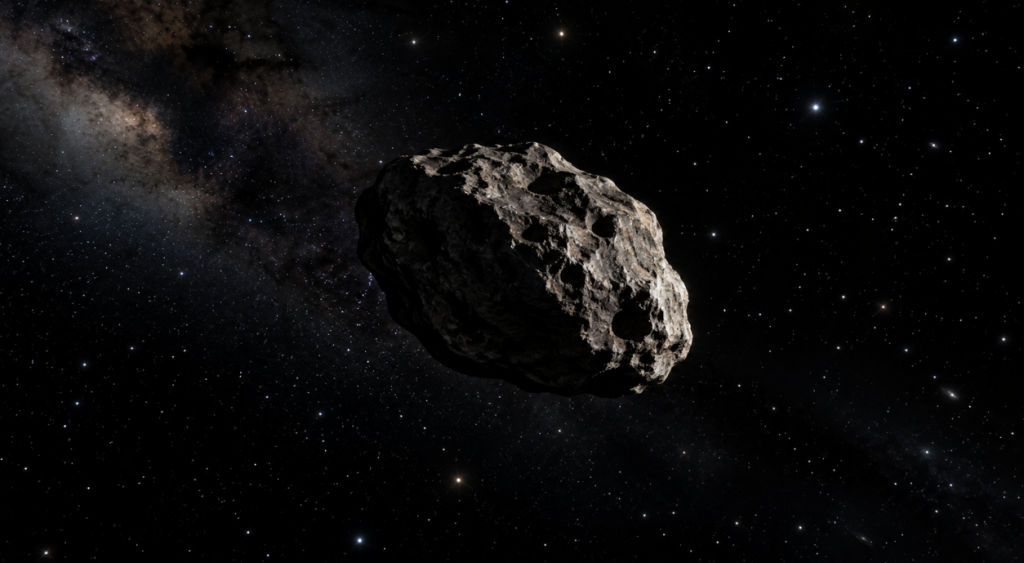
Briny Secrets of Asteroid Bennu: Eroding Stardust and Surviving Organics
Amidst the cold vastness of space, tiny ancient grains act as time capsules, preserving whispers of stars that existed long before our Solar System. These cosmic messengers are known as presolar grains. But what happens when they encounter an environment as volatile as the surface of a carbonaceous asteroid like Bennu?
Unlocking Bennu’s Hidden History
The OSIRIS-REx mission, tasked with probing the secrets of asteroid Bennu and returning valuable samples to Earth, has revealed fascinating insights into this question. Researchers found that while some of this presolar stardust has weathered the eons, others have not. Bennu’s tumultuous history, marked by cataclysmic disruptions and ancient fluid exchanges, has transformed and, in some cases, erased parts of this stardust record.
The Puzzle of Disappearing Stardust
The samples from Bennu revealed an intriguing mystery: a significant reduction in the abundance of presolar silicon carbide grains, especially in the ‘mottled’ particles. What caused this disappearance? Enter alkaline brines—fluid remnants of an aqueous past that crept through Bennu’s rocky exterior, selectively obliterating these silicate structures while leaving organic compounds curiously intact.
A Voyage Through Bennu’s Mineral Maze
To understand this process, researchers employed a series of sophisticated techniques. They used scanning electron microscopy (SEM) and energy-dispersive X-ray spectroscopy (EDS) to map out the mineralogical composition and petrology of these samples. They found a landscape of fine-grained phyllosilicates, sulfate minerals, and remnants of magnetite.
The samples, identified as ‘mottled’ because of their heterogeneous textures, showed reduced amino-acid diversity and lower carbon and nitrogen content than their counterparts. This suggests a history of interaction with oxidizing alkaline brines—a scenario that selectively preserves certain isotopic compositions while destroying others.
Why This Matters: A Cosmic Laboratory
Discoveries like this are more than just cosmic curiosities. They help us understand the evolutionary processes that shaped our solar system and those beyond. The alteration of presolar grains sheds light on the complex dance of chemistry and physics that governs celestial bodies.
In resource-limited settings on Earth, this knowledge could inspire new ways to utilize analogous processes in areas like mining or materials science, potentially leading to more efficient extraction or preservation techniques. It offers a nuanced perspective that challenges us to rethink assumptions about material resilience and transformative processes.
The Unanswered Questions
Yet, as with all scientific inquiry, this study opens doors to even more questions. Why do some organic molecules survive such harsh conditions unblemished? How do these same conditions erase some of the hardest substances known? What eventually happens to these molecules over astronomical timescales?
Much remains to be explored about the unpredictable influence of asteroid-based chemical processes on presolar grains. The multistage alteration history recorded in Bennu’s samples suggests complex episodes of chemical exchanges that defy simpler models of destruction and preservation.
Let’s Explore Together
As we continue to navigate this stellar journey through Bennu’s briny archives, we invite our readers to consider the broader implications. Could this research change how we study asteroids within and beyond our solar neighborhood? What larger truths about planetary formation and evolution might these diminutive grains of stardust reveal?
Questions to ponder:
- How might understanding Bennu’s aqueous past shape future asteroid exploration missions?
- In what ways could this knowledge inspire innovations in materials science on Earth?
- What other mysteries of the early Solar System remain hidden in the asteroids quietly orbiting our sun?
Build Your Own Science Issue
Tell us what fascinates you. We’ll search today’s science and build a personalized issue just for you.
Your science issue is being built.
We’re searching today’s research for stories that match your interests. Your personalized issue will arrive in your inbox shortly.
Something went wrong.
We couldn’t build your issue right now. Please try again in a moment.