Are Ghosts Real? What Science Says About Paranormal Experiences
You wake up in the middle of the night and feel like someone is standing beside your bed.
You hear footsteps upstairs when no one else is home. A shadow seems to move across the hallway. After someone you love dies, you briefly hear their voice or feel their presence beside you.
For thousands of years, people have described experiences like these as encounters with ghosts. Stories of spirits, apparitions, haunted houses, and unseen presences appear across cultures and throughout history. Even today, ghost stories remain popular because they touch on a question that science has not made any less fascinating:
Are ghosts real?
Science approaches that question a little differently than a ghost hunter might. Researchers do not have to assume that people are lying, confused, or imagining everything. A strange experience can feel completely real. The scientific question is what caused it.
That has led researchers into some surprisingly interesting areas of psychology and neuroscience. Scientists have studied sleep paralysis, hallucinations, grief, memory, suggestion, environmental conditions, and even the brain systems responsible for knowing where our bodies are in space. In laboratory experiments, researchers have even made healthy people feel as though an invisible person was standing nearby.
The result is a fascinating picture of why ghost encounters can feel so convincing.
Science has not established that ghosts are the surviving spirits of dead people. It has, however, discovered that many experiences associated with ghosts are real features of human perception. Understanding them tells us something remarkable about how our brains construct reality.
What Counts as a Ghost or Paranormal Experience?
In everyday language, a ghost usually means the surviving presence or spirit of a dead person that the living can somehow perceive.
Reported encounters take many forms. People describe seeing human figures or shadows, hearing footsteps or voices, feeling mysterious touches, noticing objects move, experiencing sudden cold sensations, or simply feeling that someone unseen is nearby.
Scientists often use more neutral terms such as apparitional experience, sensed presence, hallucinatory experience, or anomalous experience. These terms allow researchers to describe what happened without assuming what caused it.
A sensed presence, for example, is the feeling that another being is nearby even though there is no clear sensory evidence that anyone is there.
A person can have a vivid, frightening, and emotionally meaningful experience even when no outside person or object produced the sensation.
Hallucinations are sensory experiences that feel real even though the matching outside stimulus is absent. They are also not limited to people with psychiatric disorders. Hallucinations and unusual perceptions can occur around sleep, during grief, with neurological conditions, after severe sleep deprivation, and during other unusual physical or emotional states.
The experience can therefore be authentic even if the explanation for it is uncertain.
Science investigates these experiences by looking for effects that can be independently measured and repeated. If a ghost supposedly moves objects, changes electromagnetic fields, lowers temperatures, or produces sounds, instruments and controlled observations can test those claims.
Replication is especially important. If an effect disappears when researchers repeat an experiment under tighter controls, it becomes much weaker evidence for an outside paranormal phenomenon.
How Common Are Paranormal Experiences?
There is no single worldwide estimate for how many people have seen a ghost. Different surveys define ghosts and paranormal experiences differently.
Scientists have better data on experiences that sometimes get interpreted as supernatural, including hallucinations, sensed presences, sleep paralysis, and encounters with deceased loved ones.
A major World Health Organization survey analysis examined 31,261 adults across 18 countries. Researchers found that 5.8 percent reported at least one psychotic-like experience during their lifetime, while 5.2 percent reported a hallucinatory experience.
Importantly, the surveys excluded experiences that happened while people were dreaming, half asleep, intoxicated, or under the influence of drugs. They were capturing unusual waking perceptions rather than many common sleep-related experiences.
Most of these events were not constant. About one-third of the people who reported psychotic-like experiences said they had happened only once.
Seeing or Sensing Someone After They Die
Grief provides an especially interesting example.
Someone who recently lost a spouse might hear that person’s voice, briefly see them, feel their presence, or have the powerful impression that they are nearby.
These experiences can sound remarkably similar to traditional ghost encounters.
A review of population and clinical studies estimated that between 30 and 60 percent of widowed people in the studies reviewed had experienced some form of post-bereavement hallucination.
Later research found that sensory experiences of deceased people are common during bereavement and are usually benign. They do not automatically indicate mental illness.
For the person experiencing one, however, the event can feel deeply real and emotionally important.
Sleep Paralysis: When a Ghost Appears in the Bedroom
One of the most striking scientific explanations for some ghost encounters comes from sleep research.
Sleep paralysis happens when awareness returns while the muscle paralysis associated with rapid eye movement, or REM, sleep continues.
Your mind wakes up. Your body does not.
A systematic review estimated that about 7.6 percent of the general population experiences sleep paralysis at some point. Rates were higher among students and psychiatric patients.
The experience can be terrifying.
A person may wake up unable to move. They might feel pressure on their chest. They may hear voices or footsteps. Some see shadowy human figures.
Others become convinced that someone or something is standing in the room.
Imagine experiencing that without knowing what sleep paralysis is. You are awake. Your bedroom looks real. You cannot move. A dark figure seems to stand beside your bed.
A supernatural explanation can feel completely reasonable in the moment.
This may also help explain why different cultures have developed stories about nighttime spirits, demons, witches, and other beings that attack people while they sleep.
The underlying sleep state can be similar while culture provides different explanations for what happened.
Why Your Brain Can Make a Shadow Look Like a Person
Human perception does not work like a video camera.
Your brain constantly interprets incomplete information using context, memory, attention, and expectations. Most of the time, this system works extremely well.
But the world does not always give your brain perfect information.
Think about walking through a dark house at night.
A coat hanging from a door briefly looks like a person. Pipes or heating systems sound like footsteps. A reflection moves across a window. Something flashes at the edge of your vision.
Your brain has to quickly guess what you saw or heard.
Darkness, stress, unfamiliar surroundings, fear, and emotional situations make sensory information even more ambiguous.
Expectations can also influence what happens next.
How Suggestion Can Create a Paranormal Experience
Psychologist Richard Wiseman and his colleagues demonstrated this effect with fake séances.
During one experiment, an actor suggested that a stationary table was levitating.
It wasn’t. Yet about one-third of participants later incorrectly reported that the table had moved.
In another experiment, roughly one-fifth of participants concluded that genuine paranormal events had occurred during the fake séance.
Nothing supernatural needed to happen.
Expectation influenced perception and memory.
That becomes especially important when people enter a place already believing it is haunted. If someone tells you that visitors often hear footsteps on a particular staircase, every creak suddenly becomes more interesting.
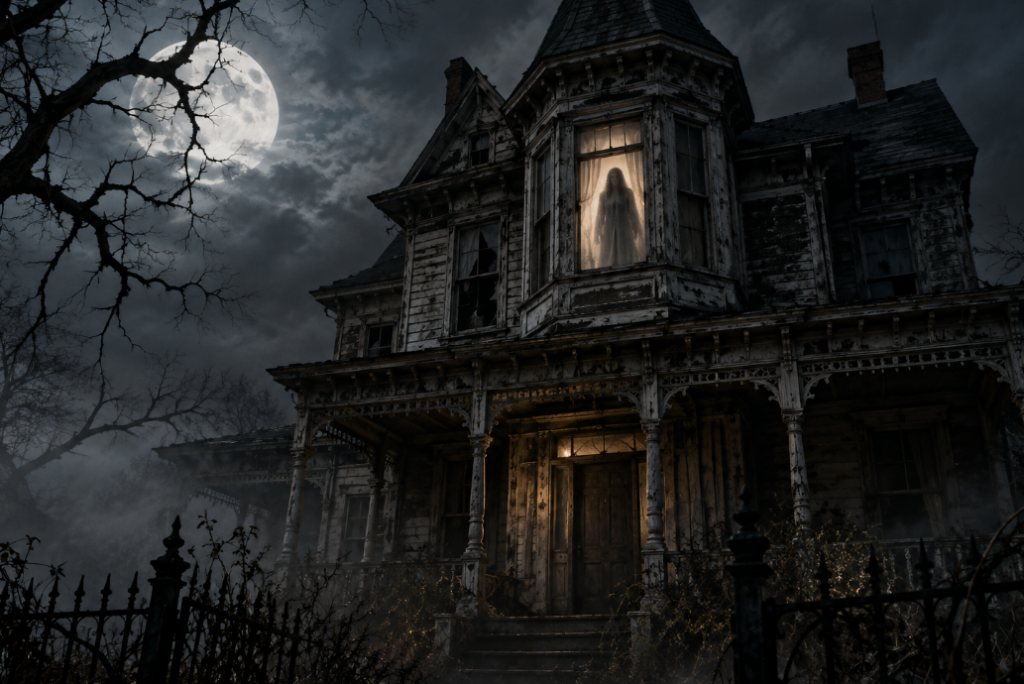
If you are told that people sometimes see a figure in an upstairs window, an ambiguous reflection may take on a very different meaning.
Memory Can Make Ghost Stories Stronger
Memory feels like a recording, but it is actually reconstructive.
Every time we remember an event, the brain rebuilds it.
Later information, conversations with other people, emotional meaning, repeated storytelling, and suggestions can all shape how we remember an event.
Researchers have also studied whether paranormal beliefs are associated with particular thinking patterns.
A systematic review covering 71 studies and more than 20,000 participants found that stronger paranormal belief was most consistently associated with greater intuitive thinking, confirmation bias, weaker conditional reasoning, and difficulty judging randomness.
The researchers also pointed out weaknesses in this field, including the heavy use of university student samples and inconsistent research practices.
These are statistical relationships, not judgments about individuals.
But they illustrate how a strange event can grow more convincing over time.
Something moves in the corner of your vision.
You decide it looked like a person.
Later, someone tells you that a former owner died in the house.
Months afterward, you may remember the experience as the night you saw the former owner.
Scientists Have Created a “Ghost” in the Lab
Perhaps the strangest evidence comes from neuroscience.
One classic feature of ghost stories is a sensed presence: the unmistakable feeling that someone is standing nearby even though you cannot clearly see them.
Neurologist Olaf Blanke and his colleagues studied patients who experienced this sensation.
They identified a network of brain regions that integrate movement, touch, body position, and spatial awareness. The researchers then created a robotic system designed to disrupt those signals.
Participants moved their hands while a robot delivered corresponding touches to their backs.
When the movements and touches happened at the same time, the experience generally made sense to the brain.
Then researchers introduced a delay.
The participant moved, but the touch on their back happened slightly later.
That small mismatch had a remarkable effect.
Some healthy participants began feeling as though another person was nearby.
The researchers had produced something remarkably similar to an apparition without an apparition being present.
The experiment suggests that the feeling of an invisible presence can emerge when the brain struggles to integrate information about movement, touch, and the body’s location.
There Probably Isn’t One Explanation for Every Ghost
Sleep paralysis is one pathway.
Grief may be another.
Exhaustion can also produce perceptual distortions and hallucinations. Neurological conditions can affect how people perceive their bodies and surroundings. Expectation and suggestion can influence ambiguous sensations.
This is why scientists are unlikely to discover a single “ghost mechanism.”
Two people can have very similar experiences for completely different reasons.
One person’s shadowy bedroom visitor might occur during sleep paralysis. Another person’s sense of a deceased spouse sitting nearby might occur during grief. Someone exploring an abandoned building may misinterpret an unfamiliar sound after being told the building is haunted.
The experience may feel similar even when the underlying processes are different.
Can Haunted Houses Actually Make You Feel Strange?
Buildings themselves can contribute to unusual experiences.
Old buildings can be especially good at producing ambiguous sensory information.
Pipes knock. Heating systems click. Wood expands and contracts. Rodents move inside walls. Air flows through small openings. Distant traffic creates low-frequency vibrations. Reflections move across windows. Uneven heating creates sudden cold spots.
Low lighting also changes visual perception.
In an unfamiliar building at night, your brain receives a steady stream of uncertain information.
Add the expectation that the place is haunted and those sensations can become much more meaningful.
Researchers studying supposedly haunted locations have found that reports of strange experiences can cluster in particular areas and sometimes correspond with environmental features such as lighting and variations in local magnetic fields.
That does not mean those conditions prove ghosts exist.
It means the environment may influence where people experience something unusual.
What About Infrasound?
Infrasound is sound below or near the lower edge of normal human hearing.
It has often been proposed as an explanation for feelings of uneasiness, dread, or even ghost sightings.
Researchers have tested this idea experimentally.
In the controlled “Haunt” project, 79 participants entered a specially constructed room where researchers could expose them to infrasound, complex electromagnetic fields, both, or neither.
Participants reported plenty of strange sensations.
But the paranormal explanation had a problem.
The number of unusual experiences was not related to which physical stimulus people actually received.
Suggestibility better explained the results.
Do Electromagnetic Fields Cause Ghost Encounters?
Electromagnetic fields, or EMFs, are another popular explanation in paranormal investigations.
Ghost hunters often carry EMF meters and interpret unusual readings as possible evidence of paranormal activity.
Controlled research has not provided strong support for that idea.
In one double-blind experiment involving 89 participants, researchers tested whether weak, complex magnetic fields could produce sensed presences or mystical experiences.
They found no evidence that the magnetic fields caused the experiences.
Suggestibility predicted them instead.
So while an EMF meter can detect electromagnetic fields, an unusual reading does not establish that a ghost produced it.
Carbon Monoxide Is a Much More Serious Concern
One environmental factor deserves immediate attention: carbon monoxide.
Carbon monoxide is a colorless, odorless gas that can cause headache, dizziness, weakness, nausea, confusion, impaired coordination, unconsciousness, and death.
Some of those symptoms could contribute to frightening or unusual experiences.
More importantly, carbon monoxide exposure is a genuine medical emergency.
If several people in a building experience unexplained headaches, dizziness, confusion, or similar symptoms, the priority should not be paranormal investigation. The building should have working carbon monoxide detectors, and someone should inspect potential combustion sources.
Sometimes investigating a “haunted” house is really an indoor-safety problem.
Does Mold Cause Ghost Sightings?
Mold also comes up often in discussions about haunted buildings.
Damp buildings can certainly contain mold, and mold can create real health problems. Established concerns include allergic reactions, worsening asthma, and respiratory irritation.
However, current health evidence does not establish normal household mold exposure as a cause of seeing ghosts.
Moisture problems and mold growth should still be addressed.
They just should not be treated as a universal explanation for paranormal experiences without evidence.
Culture Shapes What a Ghost Experience Means
People around the world can experience similar sensations while explaining them in very different ways.
Sleep paralysis is a good example.
The biological state can be similar across populations, yet different cultures may interpret the frightening nighttime visitor as a demon, witch, spirit, supernatural attacker, or another culturally familiar being.
Research on voice hearing reveals a similar pattern.
One study compared people with psychosis in the United States, India, and Ghana. Participants described very different relationships with the voices they heard.
The underlying experience of hearing a voice occurred across cultures, but its meaning and emotional character differed.
This suggests something important about paranormal experiences.
The brain produces sensations and perceptions. Culture helps provide the stories and concepts people use to explain them.
How Would Scientists Actually Test a Haunted House?
Imagine a house where people repeatedly report footsteps at 2 a.m., sudden temperature drops in an upstairs bedroom, and the feeling that someone is standing in a hallway.
A good scientific investigation would not simply wait for something strange to happen and then pull out a meter.
Researchers could continuously record temperature, sound, vibration, light, air quality, carbon monoxide, electromagnetic fields, and other environmental conditions.
Witnesses could record experiences immediately with exact timestamps.
Researchers could then compare those reports with the environmental data.
Did the mysterious footsteps happen when the heating system activated?
Did a passing truck create vibrations?
Did the supposed cold spot actually experience a measurable temperature change?
Did multiple people independently report the same experience before talking to one another?
Researchers could also use blinded observers, control locations, preregistered hypotheses, and independent replication.
These safeguards matter because strange coincidences are inevitable when you collect enough measurements.
Finding one unexplained spike on one instrument during one night does not tell scientists what caused it.
What Famous Haunted Locations Teach Us
Researchers have actually used this approach in famous supposedly haunted places.
Wiseman and colleagues studied visitors at Hampton Court Palace and Edinburgh’s South Bridge Vaults.
Participants reported unusual sensations while exploring locations associated with haunting stories.
People reported strange experiences more often in areas considered haunted. Reports were also associated with environmental features such as lighting and variations in magnetic fields.
That is interesting because the experiences were not randomly distributed.
Certain places produced more reports.
But that finding does not establish that ghosts occupied those areas. It shows that environmental features and expectations around a location can produce repeatable clusters of unusual experiences.
Why Ghost Experiences Can Feel So Convincing
None of these explanations require people who report ghosts to be dishonest or foolish.
A sensed presence can feel unmistakably real.
A voice heard during grief can sound exactly like someone you loved.
A figure seen during sleep paralysis can seem to stand directly beside the bed.
A strange noise in an empty building can be genuinely frightening.
Human perception evolved to interpret incomplete information quickly. Memory preserves emotionally meaningful events. Culture gives those experiences explanations. Other people’s stories reinforce them.
Confirmation bias can then make supporting events easier to notice and remember.
Together, these processes can create experiences powerful enough to support a belief for years.
What Scientists Still Don’t Know
There are still important unanswered questions.
Researchers need better estimates of how often specific experiences occur. Seeing an apparition, hearing an unexplained voice, sensing an invisible presence, and feeling a mysterious touch are often grouped together as “paranormal experiences,” even though they may have very different causes.
Future studies could examine sleep, grief, medication, health, substance use, stress, and cultural background alongside specific paranormal experiences.
Natural investigations of allegedly haunted places could also become much more rigorous.
Researchers could place synchronized sound, vibration, temperature, carbon monoxide, light, air-quality, and other sensors inside a location for weeks or months.
People could record strange experiences immediately without seeing the sensor data or other people’s reports.
Researchers could decide in advance what would count as meaningful evidence and allow independent teams to analyze the results.
Cross-cultural research may be especially useful. Similar experiences receive very different supernatural explanations around the world. Understanding those differences could teach scientists more about the relationship between biology, perception, and culture.
Neuroscience also continues to explore how the brain creates our sense of body, self, location, and the presence of other people.
So, Are Ghosts Real?
Science gives us two different answers depending on what we mean by “ghost.”
Ghost experiences are real.
People genuinely see figures, hear voices, feel touches, sense invisible presences, and experience events they cannot immediately explain. Some of these experiences are surprisingly common.
Scientists can even reproduce certain ghost-like sensations under controlled laboratory conditions.
But if the question is whether ghosts are independently existing spirits of dead people, the evidence looks very different.
Reliable scientific evidence has not established that apparitions, sensed presences, haunted locations, or other paranormal experiences are caused by surviving spirits.
Instead, decades of research point toward a complicated interaction among perception, sleep, memory, grief, expectation, brain function, culture, and the physical environment.
That may make ghost stories more scientifically interesting, not less.
A shadow that turns into a person, a dead loved one’s voice heard during grief, or the unmistakable sensation that someone is standing behind you reveals something extraordinary about the human brain.
Our experience of reality feels immediate.
But behind that experience, the brain constantly interprets, predicts, fills gaps, combines sensations, and decides what is out there.
Sometimes, what it creates looks remarkably like a ghost.
Build Your Own Science Issue
Tell us what fascinates you. We’ll search today’s science and build a personalized issue just for you.
Your science issue is being built.
We’re searching today’s research for stories that match your interests. Your personalized issue will arrive in your inbox shortly.
Something went wrong.
We couldn’t build your issue right now. Please try again in a moment.
Sources
Blanke, O., Pozeg, P., Hara, M., Heydrich, L., Serino, A., Yamamoto, A., Higuchi, T., Salomon, R., Seeck, M., Landis, T., Arzy, S., Herbelin, B., Bleuler, H., & Rognini, G. (2014). Neurological and robot-controlled induction of an apparition. Current Biology, 24(22), 2681–2686. https://doi.org/10.1016/j.cub.2014.09.049
Castelnovo, A., Cavallotti, S., Gambini, O., & D’Agostino, A. (2015). Post-bereavement hallucinatory experiences: A critical overview of population and clinical studies. Journal of Affective Disorders, 186, 266–274. https://doi.org/10.1016/j.jad.2015.07.032
Centers for Disease Control and Prevention. (2026). Carbon monoxide poisoning basics.
Dean, C. E., Akhtar, S., Gale, T. M., Irvine, K., Grohmann, D., & Laws, K. R. (2022). Paranormal beliefs and cognitive function: A systematic review and assessment of study quality across four decades of research. PLOS ONE, 17(5), e0267360. https://doi.org/10.1371/journal.pone.0267360
French, C. C., Haque, U., Bunton-Stasyshyn, R., & Davis, R. (2009). The “Haunt” project: An attempt to build a “haunted” room by manipulating complex electromagnetic fields and infrasound. Cortex, 45(5), 619–629. https://doi.org/10.1016/j.cortex.2007.10.011
Granqvist, P., Fredrikson, M., Unge, P., Hagenfeldt, A., Valind, S., Larhammar, D., & Larsson, M. (2005). Sensed presence and mystical experiences are predicted by suggestibility, not by the application of transcranial weak complex magnetic fields. Neuroscience Letters, 379(1), 1–6. https://doi.org/10.1016/j.neulet.2004.10.057
Kamp, K. S., Steffen, E. M., Alderson-Day, B., Allen, P., Austad, A., Hayes, J., Larøi, F., Ratcliffe, M., & Sabucedo, P. (2020). Sensory and quasi-sensory experiences of the deceased in bereavement: An interdisciplinary and integrative review. Schizophrenia Bulletin, 46(6), 1367–1381. https://doi.org/10.1093/schbul/sbaa113
Luhrmann, T. M., Padmavati, R., Tharoor, H., & Osei, A. (2015). Differences in voice-hearing experiences of people with psychosis in the USA, India and Ghana: Interview-based study. The British Journal of Psychiatry, 206(1), 41–44. https://doi.org/10.1192/bjp.bp.113.139048
McGrath, J. J., Saha, S., Al-Hamzawi, A., Alonso, J., Bromet, E. J., Bruffaerts, R., Caldas-de-Almeida, J. M., Chiu, W. T., de Jonge, P., Fayyad, J., Florescu, S., Gureje, O., Haro, J. M., Hu, C., Kovess-Masfety, V., Lepine, J. P., Lim, C. C. W., Medina Mora, M. E., Navarro-Mateu, F., . . . Kessler, R. C. (2015). Psychotic experiences in the general population: A cross-national analysis based on 31,261 respondents from 18 countries. JAMA Psychiatry, 72(7), 697–705. https://doi.org/10.1001/jamapsychiatry.2015.0575
National Academies of Sciences, Engineering, and Medicine. (2019). Reproducibility and replicability in science. The National Academies Press. https://doi.org/10.17226/25303
Sharpless, B. A., & Barber, J. P. (2011). Lifetime prevalence rates of sleep paralysis: A systematic review. Sleep Medicine Reviews, 15(5), 311–315. https://doi.org/10.1016/j.smrv.2011.01.007
U.S. Environmental Protection Agency. (2026). Introduction to indoor air quality.
Wiseman, R., Greening, E., & Smith, M. (2003). Belief in the paranormal and suggestion in the seance room. British Journal of Psychology, 94(3), 285–297. https://doi.org/10.1348/000712603767876235
Wiseman, R., Watt, C., Stevens, P., Greening, E., & O’Keeffe, C. (2003). An investigation into alleged “hauntings.” British Journal of Psychology, 94(2), 195–211. https://doi.org/10.1348/000712603321661886
SEO Assets
Primary SEO Keyword:
are ghosts real
Secondary Keywords:
science of ghosts, are ghosts scientifically proven, paranormal experiences, ghost sightings explained, science behind ghosts, why do people see ghosts, sleep paralysis ghosts, ghost hallucinations, haunted houses explained, sensed presence, paranormal activity explained
SEO Title:
Are Ghosts Real? What Science Says About Paranormal Experiences
Alternative SEO Title:
Are Ghosts Real? The Science Behind Ghost Sightings and Haunted Houses
Meta Description:
Are ghosts real? Explore what neuroscience, psychology, sleep research, and environmental science reveal about ghost sightings and paranormal experiences.
Suggested URL Slug:
are-ghosts-real-science-paranormal-experiences
Social/Open Graph Title:
Are Ghosts Real? Here’s What Science Has Discovered
Social Description:
Ghost sightings can feel incredibly real. From sleep paralysis and grief to haunted houses and laboratory-made apparitions, science has uncovered surprising explanations for paranormal experiences.
Suggested Excerpt:
Why do people see ghosts, hear unexplained voices, or feel invisible presences? Research into sleep, perception, memory, grief, and neuroscience reveals why paranormal experiences can feel so convincing.
Suggested Featured Image Alt Text:
Illustration of a shadowy ghost-like figure in a dark hallway representing scientific research into paranormal experiences and ghost sightings.
Suggested Internal-Link Anchor Topics:
sleep paralysis, hallucinations and the brain, how human memory works, paranormal beliefs, psychology of fear, scientific investigation of extraordinary claims
Suggested Tags:
Ghosts, Paranormal, Psychology, Neuroscience, Sleep, Sleep Paralysis, Perception, Haunted Houses, Scientific Skepticism, Halloween Science