
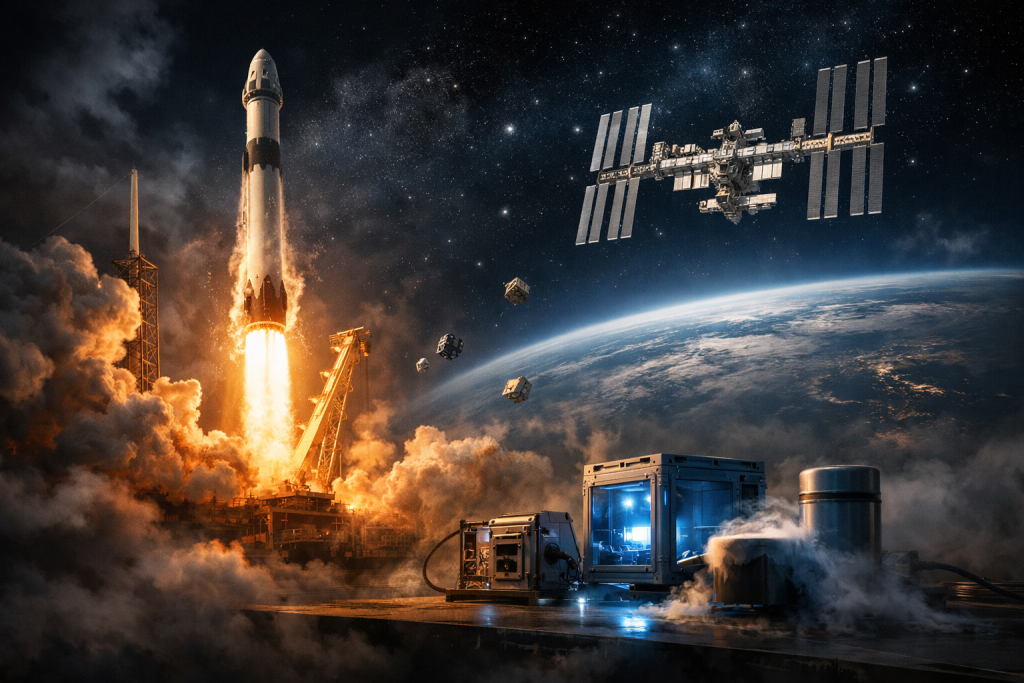
Why One SpaceX Launch Matters More Than the Rest This Week
October 2026 has been a busy month for SpaceX. Rockets have carried astronauts, scientific supplies, satellites, and national security payloads into space. Each launch has a different purpose, but together they show just how much modern life and scientific discovery depend on regular access to orbit.
While rocket launches capture our attention with spectacular flames and powerful engines, some of the most exciting work begins long after the rocket disappears into the sky.
A Busy Month of Space Launches
SpaceX kicked off October with NASA’s Crew-13 mission on October 1, sending four astronauts to the International Space Station (ISS). Their destination was more than 250 miles above Earth, where astronauts live and work in a laboratory unlike anything on the ground.
Less than two weeks later, on October 13, SpaceX launched NASA’s CRS-35 cargo mission from Cape Canaveral Space Force Station in Florida. The Dragon spacecraft arrived at the ISS on October 15, bringing supplies and materials to support scientific research.
SpaceX also continued expanding its Starlink satellite network with a launch around October 12–13. Another mission on October 16 supported the U.S. Space Force.
Four missions, four different objectives, and one increasingly important reality: spaceflight is becoming a regular part of how we conduct science, communicate, and operate technology.
The Space Station Is a Laboratory Like No Other
One of October’s most scientifically important launches was CRS-35, a cargo delivery to the International Space Station.
At first glance, sending supplies into orbit might not sound as exciting as sending astronauts to space. But the ISS is a working laboratory, and keeping it running requires a steady flow of equipment, materials, food, and other essentials.
The station’s greatest scientific advantage is microgravity, an environment where objects experience continuous free fall. This allows scientists to study physical and biological processes in ways that are difficult to reproduce on Earth.
Researchers aboard the ISS can investigate how human bodies respond to extended periods in space, how materials behave in microgravity, and how biological systems change when gravity no longer affects them in familiar ways.
These studies have implications far beyond space travel. Research conducted in orbit can help scientists better understand human health, develop new technologies, and prepare for longer missions to the Moon and Mars.
Every successful cargo delivery helps keep that research moving.
Why Astronauts Still Matter
The October 1 Crew-13 mission highlighted another essential part of space science: the people who conduct it.
Although satellites and robotic spacecraft can perform incredible tasks, astronauts remain vital to research aboard the ISS.
They set up experiments, collect samples, maintain scientific equipment, and respond when something unexpected happens. They also serve as research participants themselves, helping scientists understand what happens to the human body during long periods in space.
Living in microgravity affects muscles, bones, circulation, and other biological systems. Understanding these changes is essential if humans hope to travel farther into the solar system.
Crewed missions also demonstrate how much coordination is required to maintain a permanent human presence in orbit. Astronauts depend on launch vehicles, spacecraft, ground teams, and regular deliveries to continue their work.
Not All Rockets Are Going to the Same Place
SpaceX’s October schedule also illustrates how different the goals of spaceflight can be.
Starlink missions deploy satellites designed to provide internet connectivity from orbit. These launches contribute to a growing network of spacecraft that can connect communities and devices across the planet.
National security missions serve another purpose, supporting government operations and space-based capabilities.
NASA’s crew and cargo missions, meanwhile, help sustain scientific research and human activity aboard the ISS.
The same basic technology, reusable rockets carrying spacecraft into orbit, can support very different objectives.
That versatility is one reason SpaceX has become such a prominent part of the modern space industry.
The Most Exciting Part Happens After Liftoff
There is something undeniably thrilling about watching a rocket launch. The countdown reaches zero, engines ignite, and an enormous machine rises into the sky against the force of Earth’s gravity.
But a successful launch is only the first step.
For the astronauts aboard Crew-13, the journey leads to months of living and working in orbit. For the cargo aboard CRS-35, the destination is a laboratory where supplies and equipment support ongoing experiments. For Starlink satellites, the mission continues as they become part of a communications network.
Each launch begins a much longer story.
And as rockets become more reusable and launches more frequent, the possibilities for science continue to expand.
A New Rhythm for Space Exploration
Space exploration once revolved around rare, historic events. Today, multiple launches can take place within a single week, supporting everything from satellite communications to experiments hundreds of miles above Earth.
SpaceX’s busy October offers a glimpse of that changing world.
The spectacle of a rocket leaving Earth will always be exciting. But the bigger story is what those rockets make possible: more research, more people working in space, and new opportunities to understand our planet and the universe beyond it.
The future of space exploration isn’t just about getting off Earth. It’s about everything we can accomplish once we get there.
Build Your Own Science Issue
Tell us what fascinates you. We’ll search today’s science and build a personalized issue just for you.
Your science issue is being built.
We’re searching today’s research for stories that match your interests. Your personalized issue will arrive in your inbox shortly.
Something went wrong.
We couldn’t build your issue right now. Please try again in a moment.
References
NASA Science, Cargo Launch on 35th SpaceX Resupply Mission to Station
NASA’s SpaceX Crew-13 Launches to International Space Station