
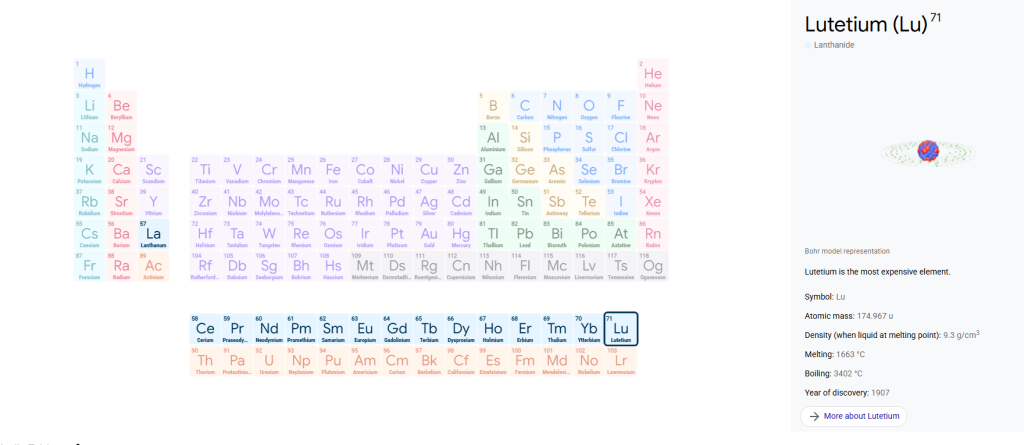
The Mysterious Case of the Lu Inversion: Solving a Nuclear Puzzle
In the esoteric world of nuclear physics, scientists have stumbled upon a riddle that seems straight out of a detective novel. Imagine a sequence of deformed rare-earth nuclei where size and shape are meticulously arranged by nature, and then something peculiar happens — one oddball element, lutetium (Lu), decides not to fit the pattern.
What’s going on here?
The Lu Anomaly Uncovered
For decades, Lu has been a puzzling mystery among nuclei with an odd number of protons. Conventional wisdom held that these odd-proton nuclei should appear more compact than their even-numbered neighbors. Yet Lu’s charge radius—the space its protons occupy—appeared anomalously larger than expected.
Enter a team determined to crack this anomaly using a novel approach: extreme-ultraviolet (EUV) spectroscopy of highly charged ions. By precisely measuring differences in charge radii between Lu and neighboring ytterbium (Yb), the team has not only reestablished the odd-even staggering pattern but also challenged existing nuclear theories.
Investigative Techniques
Instead of the typical tools of the trade, the team used high-precision EUV spectroscopy in combination with theoretical atomic-structure calculations. By ionizing Lu and Yb atoms to their Na-like and Mg-like states in an electron-beam ion trap, they measured the energy separations of emitted EUV lines. These separations, when analyzed alongside advanced calculations, provided a scaled difference in the nuclear charge radius —a critical clue in solving the Lu enigma.
Anchoring their findings to muonic atom data, the researchers reduced the uncertainty in Lu’s charge-radius measurement by threefold. They discovered that Lu is, in fact, smaller than Yb, resolving the longstanding Lu inversion anomaly.
Why This Matters
This discovery carries significant implications for nuclear physics. By providing a more precise measurement, it challenges our current understanding and models of nuclear size, particularly the phenomenon known as odd-even staggering in isotonic chains. Reconciling these findings with existing theories could prompt revisions in our view of nuclear structure.
Moreover, it showcases an innovative method that could offer new insights into other nuclear puzzles, particularly in heavy, deformed nuclei — a frontier ripe for exploration.
Unsolved Mysteries and Next Steps
Despite this leap forward, questions remain. Current nuclear density functional theory models fail to predict the large odd-even staggering observed along the N = 94 isotonic chain. This discrepancy suggests potential deficiencies in our theoretical descriptions of deformed rare-earth nuclei.
Further investigations are needed to explore the precision of charge radii for elements like terbium (Tb) and holmium (Ho) to provide deeper insights into this intriguing odd-even pattern. Highly charged ion spectroscopy might just be the key to unlocking these mysteries.
The Big Mystery
Ultimately, why is Lu’s charge-radius smaller than our data once suggested, and what does this tell us about the fundamental forces at play in the nuclei of the universe? With each new discovery, science continues to remind us that the unseen world is filled with wonders waiting to be uncovered. Perhaps the real intrigue lies in the questions that remain unanswered.
Build Your Own Science Issue
Tell us what fascinates you. We’ll search today’s science and build a personalized issue just for you.
Your science issue is being built.
We’re searching today’s research for stories that match your interests. Your personalized issue will arrive in your inbox shortly.
Something went wrong.
We couldn’t build your issue right now. Please try again in a moment.