How Big Is the Universe We Can Never See?
The observable universe stretches 92 billion light-years across. But beyond that enormous distance lies a mystery that science may never fully solve.
Imagine traveling through space at the speed of light. You pass the Moon, the planets, and eventually the stars of our galaxy. You cross the vast distances between galaxies, traveling for billions of years.
And still, you have barely begun to explore the universe.
Scientists estimate that the observable universe is about 92 billion light-years across. It contains countless stars, galaxies, and worlds. Yet everything we can observe may be just a small part of something far larger.
How much larger? Twice as big? A trillion times bigger? Infinite?
The surprising answer is that nobody knows. And there are good reasons why we might never find out.
The Observable Universe Is Not the Whole Universe
The universe is about 13.8 billion years old. Since light travels at a limited speed, we can only see objects whose light has had enough time to reach us.
This creates a boundary called the cosmic horizon.
Think of standing in a huge field on a dark night. Your flashlight lights up a circle around you. Beyond that circle, everything is dark.
But the darkness doesn’t mean the field ends. It only means you cannot see any farther.
The observable universe works similarly. We can receive light and other signals from only a limited region of space.
There is another surprising detail.
If the universe is 13.8 billion years old, why is the observable universe 92 billion light-years across instead of 27.6 billion?
The answer is the expansion of space.
While light has been traveling toward us, the space it travels through has expanded. As a result, the most distant regions we can observe today are roughly 46 billion light-years away, measured using their present-day distance.
That gives us an observable universe about 92 billion light-years in diameter.
And here’s the important part: that boundary is not a wall. It is simply the limit of what we can observe from our location.
An observer in a distant galaxy would have a different observable universe centered on them.
What Lies Beyond the Cosmic Horizon?
Scientists generally expect space to continue beyond the part we can observe.
There could be more galaxies, stars, planets, black holes, and enormous stretches of empty space.
Those distant regions might look much like our own cosmic neighborhood.
Why would scientists think that?
Because the universe we can observe appears remarkably similar on the largest scales.
Galaxies form groups and clusters, but when we look across enormous distances, matter follows a broadly consistent pattern. The basic laws of physics also appear to work the same way wherever we can test them.
This suggests that our observable region may be one piece of a much larger universe.
But it is still an assumption when applied to places we cannot observe.
We cannot simply point a better telescope beyond the horizon. No telescope can detect light that has not had time to reach us.
To understand what might exist out there, scientists must look for clues within the part of the universe we can study.
Clue #1: The Universe Appears Almost Perfectly Flat
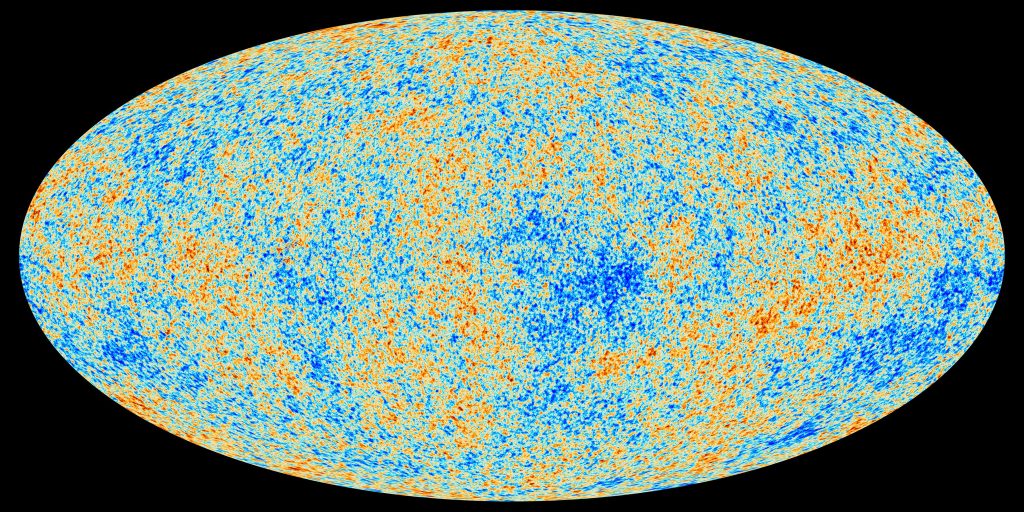
One of the biggest clues comes from something called the cosmic microwave background.
This is ancient light left over from when the universe was only about 380,000 years old.
Scientists have measured this radiation across the entire sky. Tiny changes in its temperature reveal important details about the early universe.
One of those details is the shape of space.
Space can have different kinds of geometry.
In a positively curved universe, space bends back on itself like the surface of a sphere, but in three dimensions. Such a universe could be finite without having an edge.
In a negatively curved universe, space has a different kind of geometry, sometimes compared to the shape of a saddle.
And in a flat universe, familiar rules of geometry hold on large scales. For example, parallel lines remain parallel.
Measurements from the European Space Agency’s Planck mission, combined with observations of galaxy patterns, show that the universe is extremely close to flat.
Why does this matter?
The simplest flat model extends forever in every direction. If that model describes reality, the universe could be infinite.
But flatness alone cannot prove infinity.
A flat universe could also have a more complicated shape that connects back to itself, much like a video game where moving off one side of the map brings you back on the other.
So the evidence tells us something remarkable about the geometry of space. It does not yet tell us whether space goes on forever.
Clue #2: The Early Universe May Have Expanded Enormously
Another clue comes from a theory called cosmic inflation.
According to this idea, the universe went through an extraordinarily brief period of rapid expansion shortly after the Big Bang.
During that period, space may have expanded by a staggering amount.
Imagine drawing a tiny circle on a balloon and then inflating the balloon until that circle becomes enormous.
Something similar may have happened to the region of space we now observe.
Inflation could help explain why the universe looks so uniform and why its geometry is so close to flat.
It also raises a remarkable possibility: everything we can see today might represent only a tiny patch of a much larger cosmos.
Some versions of inflation even suggest that expansion could continue in distant regions, potentially creating separate cosmic domains.
These ideas are fascinating, but they are not established facts.
Observations are consistent with several important predictions of inflation. However, scientists have not directly confirmed the physical process that caused it, or determined how far space extends beyond our horizon.
Inflation gives us reasons to consider an enormous universe. It does not provide a reliable measurement of its total size.
Clue #3: Scientists Have Looked for Signs That Space Loops Around
What if the universe is finite but has no edge?
Imagine walking across the surface of Earth. You can travel a great distance without reaching an edge. Eventually, if you keep going in the right direction, you return to where you started.
Could light do something similar in the universe?
If space connects back to itself, light from the same region might reach us along different paths.
Scientists have searched for signs of this possibility in the cosmic microwave background.
For example, they have looked for matching patterns that could suggest we are seeing the same region of space from different directions.
The Planck mission found no convincing evidence of these repeating patterns in the types of cosmic shapes it tested.
This helps rule out some models of a relatively small, repeating universe.
But it does not rule out every finite universe.
A universe that loops around on a scale much larger than our observable region could hide those connections beyond our view.
The overall shape of space remains an open question.
So How Much Bigger Could the Universe Be?
We know that the observable universe is about 92 billion light-years across.
But scientists have found clues that the entire universe could be much, much larger.
In fact, measurements from the European Space Agency’s Planck mission allow us to put some surprising numbers on the possibilities.
One possibility: At least 800 times more space than we can observe.
In 2020, scientists published results from Planck showing that the universe is extremely close to flat.
If the universe is actually curved and closes back on itself, like a three-dimensional sphere, those measurements put an interesting limit on its size.
Under the simplest version of that model, the universe would need a radius of curvature greater than approximately 260 billion light-years.
That is not a distance to an edge. It describes how gradually space curves.
In this model, the greatest possible shortest distance between two points would be more than roughly 830 billion light-years. And the universe would contain at least about 900 times as much space as our entire observable universe.
That estimate comes from actual measurements, not just imagination. But it applies only if the universe has that particular spherical shape.
Another possibility: A universe a trillion light-years across.
Suppose the entire universe is approximately 10 times wider than the region we observe.
It would span about 920 billion light-years.
Because space has three dimensions, making the universe 10 times wider would give it roughly 1,000 times the volume.
Now imagine a universe 100 times wider than the observable universe.
It would stretch about 9.2 trillion light-years across and contain roughly one million times the observable volume.
These are examples, not predictions. Scientists have not established that either size is correct.
The biggest possibility: The universe is infinite.
If space continues forever, its size cannot be expressed as any number of light-years.
There would be infinitely more space beyond what we can see.
And even if the universe is finite, its dimensions could be far greater than a trillion light-years.
The important limitation is that measurements of curvature do not reveal every possible shape of space. Some flat universes could also be finite, with space connecting back on itself in ways that are difficult to detect.
So what can we reasonably conclude?
Our observable universe is enormous. But in one scientifically supported model of a finite universe, the full cosmos would contain hundreds of times more space than we can see. In other models, it could contain millions, billions, or infinitely many times more.
We have evidence that the universe may be vastly larger than our visible region. But we still have no reliable measurement of its total size and no known upper limit.
Some Parts of the Universe May Be Hidden Forever
There is another twist to this mystery.
The universe is not just expanding. Observations show that its expansion has been accelerating. Scientists call whatever is driving this acceleration dark energy. If the acceleration continues as predicted by the standard cosmological model, some distant regions will remain permanently beyond our ability to receive new signals from them.
Light emitted there today may never reach us.
This means there are two different limits worth understanding.
The first is the limit of what we can observe now. As time passes, some signals from regions currently beyond that limit may eventually reach us.
The second is a deeper limit on which signals can ever reach us if accelerated expansion continues.
Even with unlimited patience and better technology, parts of the universe could remain forever hidden.
That future depends on how dark energy behaves, which scientists are still working to understand.
What Might Be Impossible to Know?
Science has answered questions that once seemed impossible.
We have measured the age of the universe, detected light from its earliest visible stages, discovered planets around distant stars, and observed the effects of black holes.
But the size of the entire universe may be a different kind of problem.
We can measure the part of reality that has affected us. We can build models that describe what might lie beyond it.
What we cannot do is directly inspect regions from which no information can ever reach us.
This creates questions that may never have testable answers:
- Is the universe truly infinite, or merely much larger than we can see?
- Does space eventually connect back to itself?
- Are the laws of physics exactly the same in every distant region?
- Does the universe have a total size that could ever be measured?
Future discoveries might reveal clues that narrow these possibilities. More precise observations could detect a subtle curve in space or evidence that it wraps around itself.
But there is an important difference between showing that a universe is very large and proving that it is infinite.
No matter how much territory we observe, a finite region alone cannot establish that space continues forever.
The Most Extraordinary Possibility
Consider everything we know exists.
Every star you have ever seen. Every galaxy photographed by the James Webb Space Telescope. Every black hole, nebula, planet, and cloud of cosmic gas.
All of it fits inside the observable universe.
And that entire region might be only a tiny fraction of what exists.
We might live in an infinite cosmos. Or we might inhabit a finite universe so enormous that its overall shape is hidden from us.
Both possibilities remain open.
The most astonishing thing is not simply that the universe is big.
It is that 92 billion light-years of observable space may still be far too small to reveal the true size of reality.
And that raises one final thought: the greatest mystery in the universe might not be something hidden among the stars.
It might be everything beyond them.
Build Your Own Science Issue
Tell us what fascinates you. We’ll search today’s science and build a personalized issue just for you.
Your science issue is being built.
We’re searching today’s research for stories that match your interests. Your personalized issue will arrive in your inbox shortly.
Something went wrong.
We couldn’t build your issue right now. Please try again in a moment.