From Bone Marrow Niches to AI Cancer Tools: Science Week’s Big Threads (and What They Mean)
This week’s science spans the microscopic neighborhoods inside our bodies, the messy patterns of weather, and the fast-growing toolkit of AI. The common theme isn’t just “new results”—it’s better models for reality: chips that mimic bone marrow, cloud-scale datasets that mimic clinical practice, and improved sensor and machine-learning frameworks that try to untangle overlapping signals. Here are the stories that matter most to a general science-curious audience—and why.
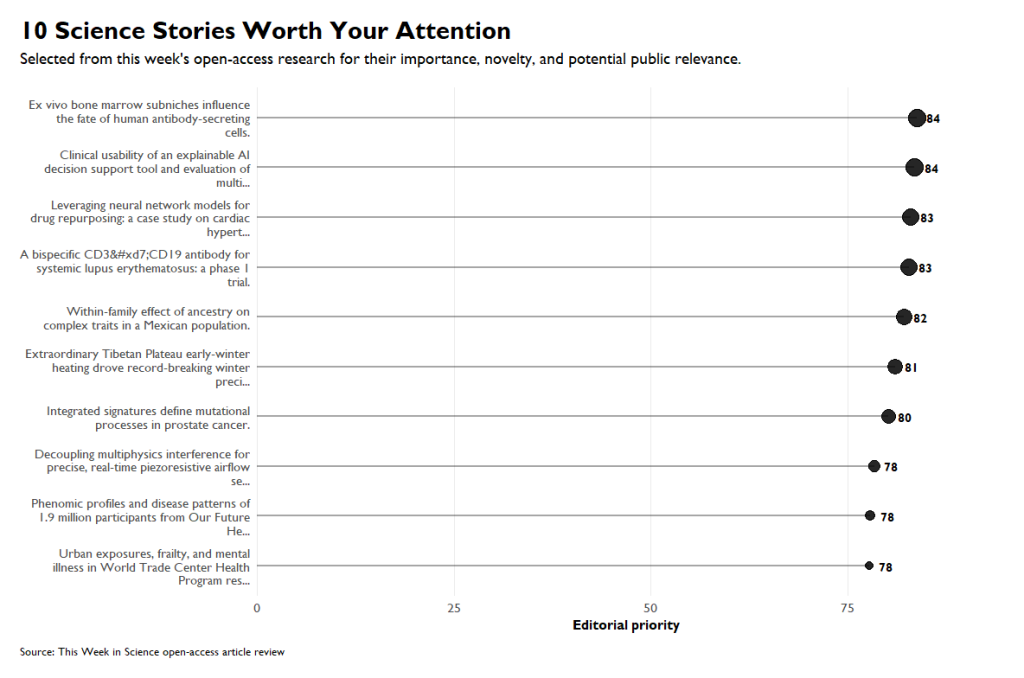
How “micro-neighborhoods” in bone marrow shape antibody-producing cells
Long-term immunity depends on special immune cells called plasma cells. These cells make antibodies and can survive for years inside our bone marrow. But scientists still don’t fully understand where these cells settle in human bone marrow or what helps them stay alive.
A new study in Science Advances created a human bone marrow-on-a-chip. This small laboratory model acts like real bone marrow, including tiny blood vessels and different areas where immune cells can live. Researchers used it to watch antibody-producing cells move through the bone marrow environment.
They found that the cells traveled through tiny blood vessels and then gathered in areas around those vessels. These locations contained important signals that help plasma cells survive.
The researchers also found that bone marrow areas close to the bone itself affected whether the cells survived, moved around, or stayed in one place. This suggests that different parts of the bone marrow work together to support long-lasting immune cells.
Interestingly, some of the cells showed a “stop-and-go” pattern. They would move for a while, stop, and then begin moving again. A chemical signaling system called CXCR4–CXCL12 helped control some of this behavior.
Vaccines work partly because some antibody-producing cells remain in our bodies for a long time. Understanding where these cells live and what keeps them alive could help scientists develop vaccines that provide longer-lasting protection.
This new bone marrow-on-a-chip also gives scientists a way to study human immune cells directly, rather than relying mainly on studies in mice. In the future, researchers could use the model to investigate how immunity changes as we age, why some vaccines last longer than others, and what happens to plasma cells during disease.
AI for lung cancer: promising performance, but benefits depend on the setting
Choosing the best immunotherapy for people with non-small cell lung cancer (NSCLC) is difficult because current tests cannot perfectly predict who will respond.
A new Nature Medicine study called I³LUNG tested whether artificial intelligence could help. Researchers studied 2,396 patients and used information including medical records, blood tests, CT scans, tumor images, and genetic data.
AI models using only clinical and blood data performed well, reaching an AUC of 0.77, and outperformed several measures doctors currently use. However, performance dropped when the models were tested on different patient populations, showing that AI tools may not work equally well everywhere.
Importantly, both lung cancer experts and other doctors made better predictions when they used an explainable AI tool. More complicated models combining several types of data also showed promise, but their added value is not yet clear.
Many AI tools look impressive in research but may not help doctors make real decisions. This study suggests AI could actually improve treatment decisions. Researchers are now testing the system in more than 2,000 additional patients to see how well it works in real clinical settings.
Repurposing drugs with deep learning—finding signal inside messy gene expression
Drug repurposing means finding new uses for existing medicines. Because these drugs have already been developed and tested, repurposing them could save both time and money.
In a Scientific Reports study, researchers used deep learning to look for possible treatments for cardiac hypertrophy, a condition in which the heart muscle becomes enlarged. The AI was trained using large amounts of data showing how genes behave in human cells.
Researchers then gave the model gene activity data from heart cells showing signs of cardiac hypertrophy. The AI looked for patterns and compared them with known drug targets.
The model identified several possible drugs, including lapatinib and amiodarone, that might affect biological changes linked to cardiac hypertrophy.
Gene activity in diseases can be extremely complicated. AI may help scientists find patterns that humans would have difficulty spotting and identify existing drugs worth studying for new purposes. However, these results are only a starting point. The drugs still need further laboratory and clinical testing before researchers can know whether they actually work.
A bispecific antibody for lupus: early-phase safety and immune reprogramming
Lupus (SLE) is an autoimmune disease in which the immune system mistakenly attacks the body. One problem involves B cells, immune cells that can produce harmful antibodies.
A small phase 1 trial in Nature Medicine tested A-319, a drug designed to help T cells find and destroy harmful B cells. Unlike CAR T-cell therapy, which requires collecting and modifying a patient’s own cells, A-319 could potentially be given as an off-the-shelf treatment.
Researchers treated 12 people with active lupus and followed them for one year. No treatment-related serious adverse events or deaths occurred. Most patients experienced a mild immune reaction called cytokine release syndrome.
The treatment also greatly reduced B cells. Among 10 patients evaluated for effectiveness, 80% reached a low level of disease activity and 60% reached remission after one year. Researchers also found signs that the immune system was rebuilding a healthier B-cell population.
The treatment may offer some of the powerful immune effects of CAR T-cell therapy without its complicated manufacturing process. However, this was a very small early-stage trial. Larger controlled studies are needed to determine whether A-319 is truly safe and effective for lupus.
When remote heat reshapes West Coast rainfall predictability

California experienced two extremely wet winters in 2016–2017 and 2022–2023. Both happened during La Niña conditions, which are usually linked to drier weather in California. That made the record rainfall especially difficult to explain and predict.
A new Science Advances study points to an unexpected factor: unusually warm temperatures over the Tibetan Plateau, thousands of miles away.
When researchers added this unusual warming to their climate model, it reproduced part of California’s extreme precipitation—about 56% of the January 2017 anomaly and 38% of the March 2023 anomaly.
The researchers found that warming over the Tibetan Plateau can affect large patterns of air movement across the Pacific Ocean and North America. These changes can influence atmospheric rivers, which carry huge amounts of water vapor and can produce heavy rain and snow in California.
Weather in one part of the world can influence extreme events thousands of miles away. Tracking temperatures over high-elevation regions such as the Tibetan Plateau could eventually help scientists predict California’s extreme winter precipitation weeks or even months in advance.
Bottom line
This week’s research isn’t just “science advances.” It’s science trying to make the complicated parts tractable—whether that means recreating bone marrow neighborhoods in a chip, building AI clinicians can use, or tracing how distant plateau heat nudges regional rainfall.