
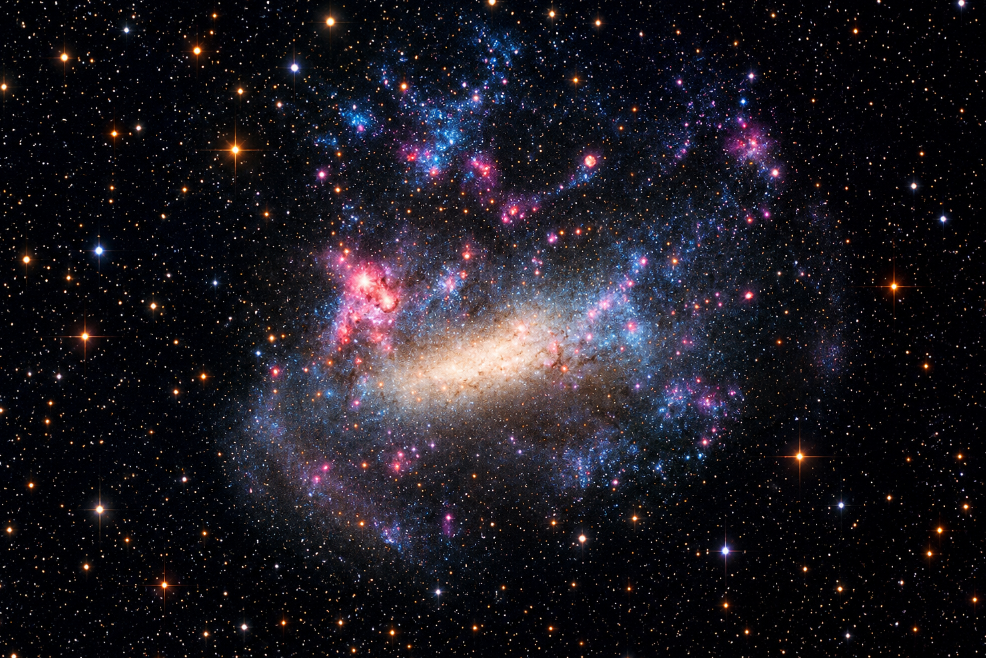
Hidden Galaxies: Dwarfs in Cluster Environments
Some of the universe’s most elusive members are faint and ultra-faint dwarf galaxies, quietly nestled within massive galaxy clusters. These diminutive systems hold clues to the broader structures they inhabit, yet their presence often slips just beneath the resolution of our most advanced telescopes and simulations. Thanks to recent advances, a new method promises to bring these hidden galaxies into clearer focus, offering tantalizing insights into the makeup of our universe.
The Search for Subtle Stars
Imagine a bustling cosmic city, where each towering galaxy cluster is like a metropolis filled with stars, planets, and cosmic debris. Within these clusters lie the lesser-known members of the celestial community: the dwarf galaxies. Unlike their grander counterparts, dwarfs are quaint, quiet, and notably challenging to spot.
The conundrum? Traditional simulations struggle to capture these diminutive formations because of resolution limits, leading to discrepancies in predicting their numbers and distribution. Solving this mystery is pivotal, not just for theoretical astrophysicists but for understanding the fabric of galaxy clusters as a whole.
Shedding Light on Dark Matters
At the heart of the research is a connection between the luminous matter (stars) and the ‘invisible’ scaffolds (dark matter) in these dwarf galaxies. Using data from the TNG50 cosmological simulation, researchers devised an innovative model to trace the evolution and distribution of these faint celestial bodies, well beyond previous reach.
By coupling detailed simulations of tidal interactions—how these galaxies are stretched, squeezed, or stripped by gravitational forces in their clusters—they can build a clearer picture. This blend of hydrodynamical simulation and empirical modeling lets scientists predict, with uncanny accuracy, the homes of galaxies too faint to see.
Cracking the Cluster Code
And what have they found? A plethora of dwarf galaxies lurking within the core of galaxy clusters. Specifically, in clusters with a virial mass around 1014 M☉, there could be between 2,000 and 7,000 of these faint entities hidden within the cosmic ‘urban sprawl.’
More interesting is the clustering pattern of these unseen celestial bodies. Typical observational techniques may overlook the most stripped dwarfs, which are stealthily settled nearer the galaxy cluster’s center. As technologies like the Euclid, Rubin, or Roman telescopes come online, they are expected to unveil the neighborhood of ultra-faint galaxies and verify these predictions.
Why This Matters
Understanding the faint dwarf population extends beyond sheer curiosity; it’s a piece of the cosmic puzzle. These galaxies offer insight into the nature of dark matter and help refine our models of cosmic evolution and galaxy formation.
This research sheds light on how larger galaxies and their small counterparts affect and interact with their surroundings. These refined techniques could help us navigate the universe’s complex web, improving our grasp of everything from the distribution of dark matter to the finer details of galaxy evolution.
Limits and Unknowns
Despite its promise, the study isn’t without its limitations. Constraints stem from the reliance on simulations, which, despite advances, cannot perfectly replicate every variable in the vastness of space. The study also assumes universal properties across diverse galactic structures, which may not hold in all contexts.
Moreover, while the research uses advanced simulation techniques, predicting galaxy numbers depends on model assumptions that may require revision as more data becomes available.
Let’s Explore Together
As we gear up to explore these mysterious modulations of matter and light, the road remains ripe with potential discovery. Each revelation promises to reshape our understanding of the cosmos.
Discussion Questions:
- How might these findings change the way we view galaxy formation?
- What could discovering more ultra-faint galaxies mean for our understanding of dark matter?
- In what ways can emerging technology continue to refine our cosmic observations?