
Galaxies Share Metal-Rich Winds in a Cosmic Cross-Pollination
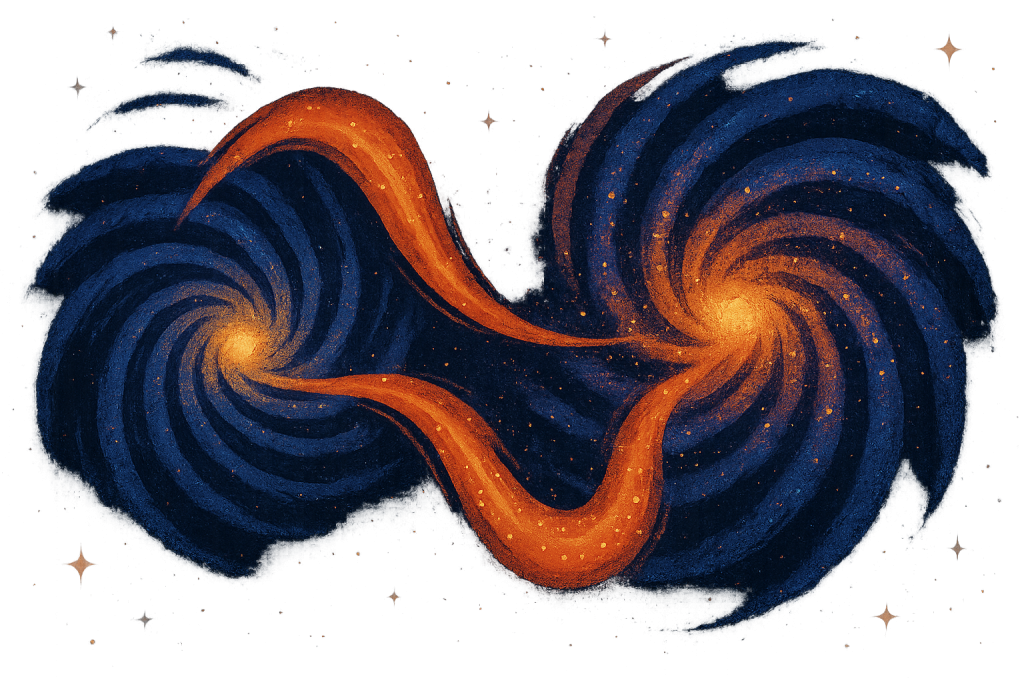
Imagine a gigantic galactic gardening project, where one galaxy enriches another with metal-laden gusts. This might sound like science fiction, but recent observations have revealed a surprising cosmic process in which galaxies distribute metals to their neighbors through directional outflows.
The Strange Effect of Cosmic Winds
For a long time, astronomers believed galactic winds, which carry away metals formed in stars, flowed uniformly outward in all directions from a galaxy. However, a recent study using data from the Dark Energy Spectroscopic Instrument (DESI) suggests that these outflows are anything but uniform. Instead, they escape along galaxies’ minor axes, creating a cone-like spray of metallic particles.
What does this unusual behavior imply? It means neighboring galaxies near these outflows can receive unexpected metal enrichment, particularly when they lie within these outflow cones. This study’s findings indicate that the neighbors situated along these pathways show a noticeable increase in metal content, challenging conventional expectations about where and how galaxies share their elemental wealth.
Detecting the Enrichment
By analyzing over 1,400 galaxy pairs, researchers found that galaxies aligned with a primary galaxy’s minor axis showed metal content up to 24.2% higher than those aligned along the major axis. It seems like these galactic partners receive an extra sprinkle of elements like oxygen, iron, and magnesium, which are crucial for star and planet formation.
The researchers used a sophisticated approach, comparing observations with simulations from the IllustrisTNG model, which supported the same anisotropic outflow conclusion. These simulations reinforced the idea that galactic winds are not a uniform spread but a targeted delivery system.
Beyond Close Neighbors
The study found that the closest galaxy pairs, separated by 15 to 30 kiloparsecs (1 kiloparsec is about 3,262 light-years), showed a marginally detected signal. Meanwhile, those between 30 and 60 kiloparsecs presented a stronger, more significant enhancement. Pairs farther than this range showed no similar enrichment, suggesting a spatial limit to how far these metals can travel before dispersing into the broader cosmic environment.
Why This Matters
This discovery not only refines our understanding of galactic interactions but also reshapes our perception of the cosmic ecosystem. The metal exchange these directional outflows facilitate helps explain the varying chemical compositions observed across different regions of the universe.
It raises a fascinating possibility: intergalactic chemical transport might have influenced galaxy evolution, potentially affecting everything from star formation rates to the development of environments capable of fostering life.
(I feel like that needs to be said again: intergalactic chemical transport might have influenced galaxy evolution.)
Remaining Mysteries
Despite the compelling evidence, questions linger. How does this metal transfer precisely influence the development of the receiving galaxies? How do these processes interact with other cosmic phenomena, such as mergers or the influx of pristine intergalactic gas?
The concept of cosmic ‘cross-pollination’ aligns with simulations, but direct evidence of these metals being integrated into neighbor galaxies’ interstellar medium remains to be seen. Future observations and enhanced simulations are set to explore these enigmatic exchanges further.
In conclusion, as more mysteries about our universe emerge, the study of galactic outflows and intergalactic enrichment continues to offer thought-provoking insights into cosmic evolution.
Build Your Own Science Issue
Tell us what fascinates you. We’ll search today’s science and build a personalized issue just for you.
Your science issue is being built.
We’re searching today’s research for stories that match your interests. Your personalized issue will arrive in your inbox shortly.
Something went wrong.
We couldn’t build your issue right now. Please try again in a moment.