
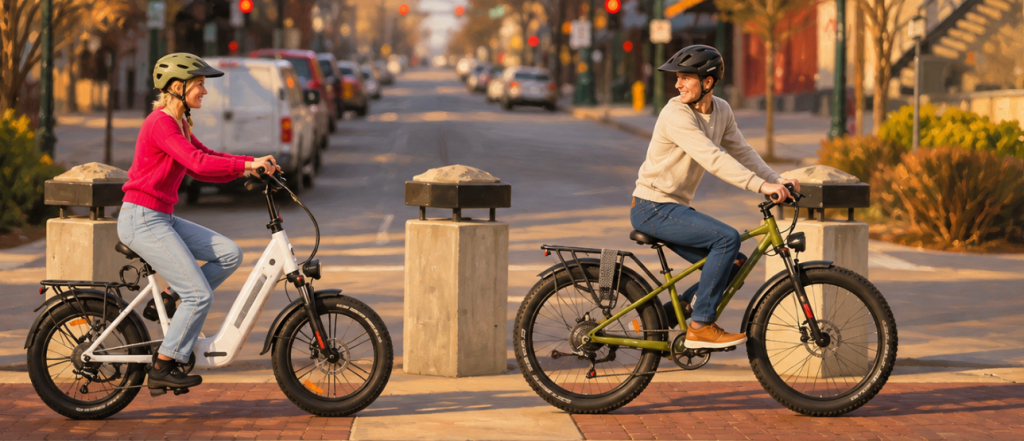
Electric Bike Injuries Are Rising. The Science Reveals a Troubling Pattern.
Electric bikes and scooters are changing how people get around. They’re relatively affordable, easy to use, and increasingly common in neighborhoods, parks, and on city streets. For teenagers, they can offer something particularly valuable: independence.
But a new study raises an important question: Are these new ways of getting around creating new risks for children?
Research published November 2, 2026, in JAMA suggests that injuries involving electric bicycles and scooters are becoming more common in pediatric health systems. More concerning, injuries involving electric devices were more likely to be severe than those involving their nonmotorized counterparts.
The findings reveal an emerging safety challenge. They also demonstrate how scientists can use routinely collected hospital information to identify problems before traditional surveillance systems fully capture them.
What Researchers Found in More Than 13,000 Injuries
Researchers analyzed electronic health records from six major pediatric health systems participating in PEDSnet, a national pediatric research network.
The study covered January 2023 through March 2026 and examined 13,307 injury encounters involving bicycles, scooters, and skateboards.
Among these encounters:
- 642 involved electric bicycles.
- 1,396 involved electric scooters.
- 7,572 involved traditional bicycles.
- 2,460 involved nonmotorized scooters.
- 1,237 involved skateboards.
Researchers classified injuries according to severity, separating visits requiring only emergency or urgent care from hospitalizations and more serious injuries.
They then examined how injury patterns changed over time.
The results were striking.
Electric Bike Injuries Increased 33% Per Quarter
After accounting for seasonal differences, researchers estimated that the rate of electric bicycle injuries increased by approximately 33% per quarter relative to the preceding quarter.
Electric scooter injuries increased by approximately 15% per quarter.
For comparison, the corresponding increases were much smaller for traditional bicycles and nonmotorized scooters.
These figures represent proportional changes in injury encounter rates, not increases in the percentage of all children injured. They also should not be interpreted as evidence that an individual rider’s risk increased by those percentages.
Nevertheless, the pattern suggests that electric micromobility injuries are becoming a much more prominent part of pediatric emergency and hospital care.
But injury frequency was only part of the story.
Electric Bikes Were Linked to More Severe Injuries
Researchers found that injuries involving electric devices were more likely to fall into their highest severity category than injuries involving traditional bicycles or scooters.
| Device | High-severity injuries | Brain injuries |
|---|---|---|
| Electric bicycles | 8% | 10% |
| Traditional bicycles | 4% | 5% |
| Electric scooters | 5% | 9% |
| Nonmotorized scooters | 2% | 4% |
Electric bicycle injuries also had the highest observed hospitalization percentage, at 17%.
For this study, high severity included injuries requiring intensive care or involving serious neurological, internal, vascular, or other trauma, as well as fractures requiring surgical fixation.
The findings suggest that electric-powered devices may be associated with a different injury profile from their nonmotorized counterparts.
Higher travel speeds may explain this. The researchers also identified helmet use as a potential consideration.
However, the study did not directly test whether speed or helmet use explained the differences.
The Surprising Finding: Many Injured Riders Were Under 12
Electric bikes and scooters are often associated with teenagers and young adults.
But the study revealed that many injuries involved considerably younger children.
Approximately 24% of electric bicycle injuries and 44% of electric scooter injuries occurred among children younger than 12.
That finding complicates how we think about electric transportation.
A device marketed as a convenient alternative to driving or walking may also be used by children who are still developing the judgment, coordination, and awareness necessary to navigate roads and other shared environments.
Age, riding environment, supervision, and device characteristics may all matter.
The study did not determine which combinations of those factors contributed most to injuries. But the age distribution suggests an important direction for future research.
How Scientists Detected an Emerging Safety Problem
One of the most interesting aspects of this study is how the researchers identified injuries.
Rather than depending exclusively on national accident reports, they used electronic health records from pediatric hospitals.
Recent additions to the ICD-10-CM medical coding system allow clinicians and health systems to identify electric bicycle and scooter injuries more specifically.
Researchers used these codes to track injury encounters across participating institutions and examine patterns over time.
This approach has a major scientific advantage: electronic health records can be updated relatively frequently.
Traditional injury surveillance systems may take longer to compile and release national estimates. Hospital data can potentially provide earlier signals of emerging problems.
That makes this study relevant beyond transportation safety.
The same general approach could help scientists investigate other rapidly changing health concerns using routinely collected clinical information.
What This Study Cannot Tell Us
The results are concerning, but several limitations are important.
First, the researchers measured injuries among patients receiving emergency, urgent, or inpatient care. They did not know how many children were riding each type of device or how much time they spent riding.
If electric bicycle use increased rapidly over the study period, some increase in injuries would be expected simply because more children were using them.
Without exposure information, the study cannot determine injury risk per ride, mile traveled, or hour of use.
Second, medical coding practices changed during the study period. Some of the observed increase may reflect improved identification of electric-device injuries rather than an equivalent increase in actual events.
Third, the study included six pediatric health systems, rather than a nationally representative sample of every child riding these devices.
These limitations do not erase the findings, particularly the differences in injury severity. But they affect how confidently we can interpret the trends.
What Should Researchers Investigate Next?
Several questions emerge from this research.
How much of the increase is explained by rising ownership and use? Do certain speeds or device designs contribute disproportionately to severe injuries? How much protection do helmets provide in different crash scenarios? Are risks different on neighborhood streets, bike lanes, or sidewalks?
Researchers also need more information about the circumstances surrounding these injuries, including rider experience, supervision, protective equipment, and interactions with motor vehicles.
Better exposure data would allow scientists to distinguish between a device that produces more injuries because it is more popular and one that produces more injuries because each trip is more dangerous.
That distinction is essential for developing effective prevention strategies.
The Bigger Scientific Lesson
Electric bicycles and scooters are spreading faster than researchers can fully characterize their safety implications.
That is a familiar challenge in science.
New technologies often become part of daily life before researchers have enough information to understand their long-term consequences.
This study’s important contribution is not that electric transportation should be avoided. It is that the growing use of these devices warrants more attention to how injuries occur and how they might be prevented.
The evidence already identifies a clear concern: injuries involving electric bicycles and scooters are increasing within the pediatric health systems studied, and severe injuries make up a larger share of these encounters than injuries involving traditional devices.
The next scientific challenge is understanding why—and determining what will make these devices safer for children.
The question is no longer simply how quickly electric transportation is expanding. It is whether our understanding of safety can keep pace.
Build Your Own Science Issue
Tell us what fascinates you. We’ll search today’s science and build a personalized issue just for you.
Your science issue is being built.
We’re searching today’s research for stories that match your interests. Your personalized issue will arrive in your inbox shortly.
Something went wrong.
We couldn’t build your issue right now. Please try again in a moment.