
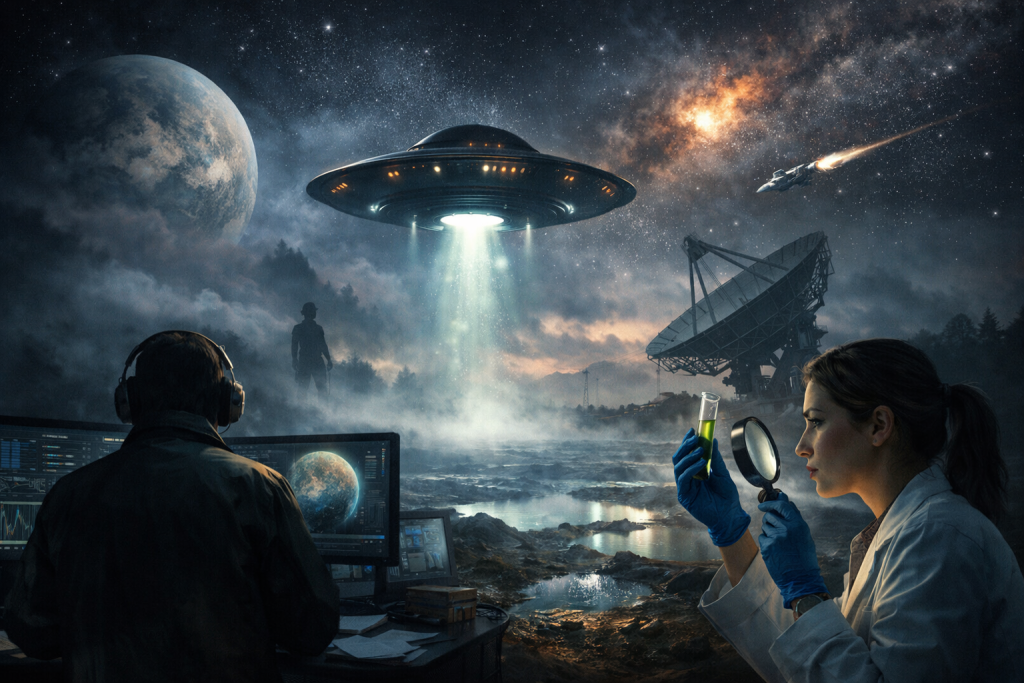
Aliens, UAP, and the Real Search for Life:
Why Science Still Has No Proof
Every few months, the word aliens shoots back into the spotlight. A strange light appears in the sky. A new rumor spreads online. A hearing or headline stirs up old questions. But the biggest scientific story is not that aliens have been found. It is that the search for life beyond Earth has become smarter, more careful, and more fascinating than ever.
Right now, scientists have no confirmed evidence that extraterrestrial life has been discovered, and NASA says it has not found evidence that aliens have visited Earth. That may sound disappointing. In reality, it points to something much more interesting: finding life beyond Earth is one of the hardest scientific puzzles humans have ever tried to solve.
The word “aliens” hides three very different questions
When people ask whether aliens are real, they often mean very different things.
One question is whether simple life, like microbes, might exist somewhere beyond Earth. Another is whether intelligent civilizations are out there sending signals or building technology we could detect. A third is whether mysterious objects seen in the sky are visitors from another world.
Science treats these as separate problems, because each one needs different kinds of evidence. A chemical hint in a planet’s atmosphere is not the same as a radio signal. And an unexplained sighting is not the same as proof of a spacecraft.
Why unexplained objects are not the same as extraterrestrials
Unidentified anomalous phenomena, or UAP, get enormous attention because mystery is exciting. If something is not immediately explained, people naturally wonder if it could be alien.
But unexplained does not mean extraterrestrial. NASA and the U.S. Department of Defense have both said there is no verified evidence that UAP are alien technology. In many cases, the problem is not that an alien explanation is being hidden. The problem is that the data are too limited, blurry, brief, or incomplete to reach a solid conclusion.
That is a normal part of science. Some observations stay unresolved because the evidence is weak, not because the answer must be extraordinary.
The real hunt is happening far from Earth
The most serious scientific search for aliens is not focused on internet rumors. It is focused on planets, moons, atmospheres, chemistry, and signals from space.
This field is called astrobiology. Its main goal is to understand where life might exist, how life changes a planet, and what clues living things might leave behind. Scientists look for biosignatures, which are signs that life may have altered an environment, and technosignatures, which are signs of technology from an advanced civilization.
A biosignature could be a gas in a planet’s atmosphere that might be linked to living organisms. A technosignature could be an unusual radio signal or another pattern that looks artificial rather than natural.
That sounds simple until you ask the hardest question of all: how do you know a signal really comes from life?
Life can be hard to spot—and easy to misread
This is where the science becomes especially tricky. A planet might have life, but the clues could be too faint for us to detect. Or a planet might look alive when natural chemistry is actually causing the signal.
Researchers describe this as a problem of false negatives and false positives. A false negative means life is there, but we miss it. A false positive means we think we see evidence of life, but a nonliving process is producing the same effect.
Imagine trying to tell whether a house is occupied just by looking at it from miles away. Smoke from a chimney might suggest someone is home, unless the smoke comes from a machine. A dark house might look empty, even though people are inside with the lights off. That is similar to the challenge scientists face when they study distant worlds.
Even a promising clue would not be enough on its own. Scientists would want multiple lines of evidence that fit together before claiming they had found life.
Even advanced civilizations might be surprisingly hard to detect
People often picture alien life as something dramatic: giant ships, bright beacons, or powerful messages crossing the galaxy. But technology may not announce itself so clearly.
NASA scientists have pointed out that even large-scale technology, such as vast arrays of solar panels on another world, might be difficult for us to recognize from far away. Distance, noise, viewing angle, and limited instruments can all hide a real signal.
That means the universe could be full of interesting worlds and still appear quiet to us. Silence is not proof that nobody is there. It may simply mean the clues are subtle, rare, or hard to interpret.
Why scientists still think the question is worth chasing
The lack of proof has not made the search less important. It has made it more precise.
Astrobiology brings together astronomy, biology, chemistry, geology, and planetary science to ask one of science’s deepest questions: is life a cosmic accident, or something the universe makes more than once?
That question matters far beyond science fiction. If life exists elsewhere, even simple microbial life, it would change how we understand biology and our place in the universe. It would suggest that the processes that led to life on Earth may not be unique.
And if the search keeps coming up empty despite better tools and better methods, that would also teach us something profound. It could mean life is much rarer, stranger, or more fragile than many people expect.
The most exciting answer is still waiting
So, are aliens real? Science has not answered yes. But it has shown that this is not a silly question or a solved one. It is a hard, careful investigation into how to recognize life when you cannot visit it, touch it, or watch it grow.
That may be the most surprising part of all. The story is not about proving every mystery in the sky is alien. It is about building a reliable way to tell the difference between a false alarm and one of the biggest discoveries in human history.
For now, aliens remain unconfirmed. The search, however, is very real.
Build Your Own Science Issue
Tell us what fascinates you. We’ll search today’s science and build a personalized issue just for you.
Your science issue is being built.
We’re searching today’s research for stories that match your interests. Your personalized issue will arrive in your inbox shortly.
Something went wrong.
We couldn’t build your issue right now. Please try again in a moment.
References
NASA Astrobiology: About Astrobiology
NASA: Do Aliens Exist? We Asked a NASA Scientist
NASA UAP Independent Study Team Final Report
U.S. Department of Defense: DOD report discounts sightings of extraterrestrial technology
Nature Astronomy: False negatives in the search for extraterrestrial life
NASA Scientists on Why We Might Not Spot Solar Panel Technosignatures
Nature Astronomy: Surveys of the scientific community on the existence of extraterrestrial life